<?xml version="1.0" encoding="utf-8"?><feed xmlns="http://www.w3.org/2005/Atom" xml:lang="en"><generator uri="https://jekyllrb.com/" version="4.2.2">Jekyll</generator><link href="/feed.xml" rel="self" type="application/atom+xml" /><link href="/" rel="alternate" type="text/html" hreflang="en" /><updated>2026-08-10T18:25:23+09:00</updated><id>/feed.xml</id><title type="html">Blog</title><subtitle>&amp;copy; &lt;a href=&quot;/&quot;&gt;Sakana AI 株式会社&lt;/a&gt;</subtitle><author><name>Sakana AI</name></author><entry xml:lang="ja"><title type="html">ベースモデルに依存しないオーケストレーションに向けて：Gemma 4版 Sakana Fuguの検証</title><link href="/fugu-gemma4/" rel="alternate" type="text/html" title="ベースモデルに依存しないオーケストレーションに向けて：Gemma 4版 Sakana Fuguの検証" /><published>2026-08-10T08:00:00+09:00</published><updated>2026-08-10T08:00:00+09:00</updated><id>/fugu-gemma4</id><content type="html" xml:base="/fugu-gemma4/"><![CDATA[<p><img src="/assets/fugu-gemma4/gemma4-benchmark.png" width="100%" /><br />
Sakana AIは、Sakana Fuguの指揮者モデルをGemma 4ベースで訓練し、従来と同等のオーケストレーション性能が出ることを確認しました。モデルプールに加えて指揮者モデルの多様化・モジュール化を図ることで、国内のさまざまな用途で求められるソブリン性の要件に応じたオーケストレーション技術を開発し、提供していきます。
<!--more--></p>

<p><br /></p>

<h2 id="背景sakana-fuguの二層構造">背景：Sakana Fuguの二層構造</h2>

<p><a href="/fugu-release/">Sakana Fugu</a>は、マルチエージェントのオーケストレーションシステムを一つの基盤モデルとして提供するプロダクトです。ユーザーが一つのエンドポイントにリクエストを送ると、Sakana Fugu自身が処理の仕方を判断し、必要に応じて高性能なモデル群を動的に呼び出して、その成果を一つの答えにまとめます。この設計はICLR 2026で発表した<a href="https://arxiv.org/abs/2512.04695">Trinity</a>と<a href="https://arxiv.org/abs/2512.04388">Conductor</a>の研究を基盤としています。</p>

<p>Sakana Fuguは二つの層からなります。</p>

<ul>
  <li><strong>指揮者モデル（オーケストレーターモデル）</strong>：モデル間の「協調の仕方」をSakana AIが学習させた小規模な言語モデル。</li>
  <li><strong>モデルプール</strong>：実際の処理を担うモデル群。数百Bクラスのフロンティアモデルを含む。設計上、何を入れるか・何と入れ替えるかを自由に構成できる。</li>
</ul>

<p><br /></p>

<center>
<img class="b-lazy" src="data:image/gif;base64,R0lGODlhAQABAAAAACH5BAEKAAEALAAAAAABAAEAAAICTAEAOw==" data-src="/assets/fugu-gemma4/fugu-two-layers.png" style="width: 100%;" />
</center>
<p><small><i>Sakana Fuguは、モデル間の「協調の仕方」をSakana AIが学習させた小規模な言語モデルである指揮者モデルと、実際の処理を担うモデルプールからなる。</i></small></p>

<p><br /></p>

<p>指揮者モデルに求められるのは、あらゆる知識を自分の重みに抱えることではなく、どのモデルにどう任せるかを判断することです。知識や推論の重い部分はプール側のモデルが担うため、指揮者モデル自身は小さくてよく、だからこそ現実的なコストで訓練を繰り返し、ベースモデルを載せ替えて検証することもできます。</p>

<p>モデルプールの側は、当初から入れ替え可能であることを前提に設計してきました。標準構成では最高性能を基準にモデルを選定していますが、用途によっては選定基準そのものを変えたいという要望があります。コストを優先したい場合、モデルの提供元の所在地を限定したい場合、実行環境を限定したい場合などです。この選定基準は構成側で選べるようにしており、その一環として先日の<a href="/nvidia-open-model-innovation/">NVIDIAとの提携</a>によりNemotronを利用できるようにする取り組みを開始しました。</p>

<p><br /></p>

<h2 id="検証gemma-4ベースの指揮者モデル">検証：Gemma 4ベースの指揮者モデル</h2>

<p>一方で、指揮者モデル自身のベースモデルの多様性はこれまで担保できていませんでした。そこで私たちは、これまでとは別系統のオープンモデルであるGemma 4（Apache 2.0ライセンス）をベースに、同じ訓練手法で指揮者モデルを訓練しました。同規模のモデルであれば、系統が違っても同じ手法が通用するのかを確かめることが目的です。</p>

<p>検証には、当社が独自に構築した評価用設問セット（知識を問う問題、コード修正、コード生成、大学院水準の科学の設問からなる）を用いました（これらの設問は訓練にも、訓練途中の候補選定にも使用せず、テスト時のみ一度だけ使用）。指揮者モデルのベースにはGemma 4 E2Bを用い、Fuguと同様の訓練を行いました。「ランダムな振り分け」は、訓練を行わず、モデルプールから無作為に送り先を選んだ場合です。その結果、Gemma 4ベースの指揮者モデルにおいて、下図のとおり既存の指揮者モデルと遜色ない性能と、同等のコスト削減効果が確認できました。</p>

<p><br /></p>

<center>
<img class="b-lazy" src="data:image/gif;base64,R0lGODlhAQABAAAAACH5BAEKAAEALAAAAAABAAEAAAICTAEAOw==" data-src="/assets/fugu-gemma4/gemma4-benchmark.png" style="width: 100%;" />
</center>
<p><small><i>当社の評価セットにおける、指揮者モデルの正答率とコスト。「ランダムな振り分け」は訓練前の無作為初期値による一例。コストは、ランダムな振り分けを1とした相対値。</i></small></p>

<p><br /></p>

<h2 id="今後の展望">今後の展望</h2>

<p>これまでのSakana Fuguの指揮者モデルは、Qwenをベースに訓練したものを用いていました。今回の検証は、モデルプールのみならず指揮者モデルもモジュール化可能であり、多様な選択肢があることを示すものです。私たちは今後、自社開発モデルをベースとした指揮者モデルの訓練にも取り組み、お客様が求めるソブリン性の要件に応じて指揮者モデルを国産モデル（事前学習から国内で構築されたモデル）ベースに切り替えて提供できる体制を整えていきます。海外の最高性能のAI能力にアクセスし続けることと、求められるソブリン性を確保することの二つを両立させるための開発を、引き続き進めていきます。</p>

<p><br /></p>

<h2 id="sakana-ai">Sakana AI</h2>

<p>Sakana AIは、AIの未来を私たちと一緒に切り拓いてくださる方を募集しています。当社の<a href="/careers/">募集要項</a>をご覧ください。</p>

<p><br /></p>

<center>
<a href="/applied-careers/"><img class="b-lazy" src="data:image/gif;base64,R0lGODlhAQABAAAAACH5BAEKAAEALAAAAAABAAEAAAICTAEAOw==" data-src="/assets/careers/applied_research_eng_high_res4.jpg" style="width: 80%;" /></a><br />
</center>

<p><br /></p>]]></content><author><name>Sakana AI</name></author><category term="media" /><summary type="html"><![CDATA[Sakana AIは、Sakana Fuguの指揮者モデルをGemma 4ベースで訓練し、従来と同等のオーケストレーション性能が出ることを確認しました。モデルプールに加えて指揮者モデルの多様化・モジュール化を図ることで、国内のさまざまな用途で求められるソブリン性の要件に応じたオーケストレーション技術を開発し、提供していきます。]]></summary></entry><entry xml:lang="ja"><title type="html">Sakana AI、大和証券グループとの共同AIプロジェクトを本格展開フェーズへ移行　ウェルスマネジメント業務支援AIの開発を開始</title><link href="/daiwa-shoken-full-scale/" rel="alternate" type="text/html" title="Sakana AI、大和証券グループとの共同AIプロジェクトを本格展開フェーズへ移行　ウェルスマネジメント業務支援AIの開発を開始" /><published>2026-08-05T00:00:00+09:00</published><updated>2026-08-05T00:00:00+09:00</updated><id>/daiwa-shoken-full-scale</id><content type="html" xml:base="/daiwa-shoken-full-scale/"><![CDATA[<p><img class="b-lazy" src="data:image/gif;base64,R0lGODlhAQABAAAAACH5BAEKAAEALAAAAAABAAEAAAICTAEAOw==" data-src="/assets/pub/daiwa-sakana.png" style="width: 100%;" /><br />
<!--more--></p>

<p><br /></p>

<p>Sakana AI株式会社（以下「Sakana AI」）は、株式会社大和証券グループ本社傘下の大和証券株式会社（以下「大和証券」）との間で2025年9月に締結したパートナーシップ契約に基づき、マーケット情報の収集・分析をテーマとする技術検証を実施しました。本検証の結果、Sakana AIのAIエージェント技術が大和証券のコンサルティング業務の高度化に資する可能性を確認できたことから、2026年8月1日より、ウェルスマネジメント領域における本格導入に向けた本番開発フェーズを開始します。</p>

<p><br /></p>

<h2 id="背景と目的">背景と目的</h2>

<p>本パートナーシップは、Sakana AIの最先端AI技術と大和証券が長年にわたり培ってきた証券ビジネスの知見を融合し、大和証券のビジネス上の課題解決および証券ビジネスの高度化を目指す長期的な取り組みです。</p>

<p>その第一段階となる技術検証フェーズでは、証券ビジネスの土台となるマーケット情報の収集・分析に着目しました。Sakana AIの独自技術である「<a href="/ai-scientist-jp/">AIサイエンティスト</a>」、「<a href="/ab-mcts-jp/">AB-MCTS</a>」等のAIエージェント技術について、コンサルティング業務への適用可能性を大和証券と共同で検証しました。</p>

<p><br /></p>

<h2 id="実施内容と実証結果">実施内容と実証結果</h2>

<p>本プロジェクトでは、大和証券の業務を題材として、Sakana AIのAIエージェント技術の実用性を検証しました。情報収集・分析に至る一連の業務プロセスを支援するAIエージェントシステムを構築し、業務の効率化および高度化に向けた有用性を評価しました。</p>

<p>検証の結果、情報収集・分析業務の各工程において、Sakana AIの技術が有効に機能し、業務を支援し得ることを確認しました。また、品質および処理能力の両面において、本番開発フェーズへの移行に必要な技術的な基盤を確立しました。さらに、利用者からのフィードバックを継続的に取り込みながらAIの分析品質を向上させる仕組みについても、その実現可能性を確認しました。</p>

<p><br /></p>

<h2 id="今後の展望">今後の展望</h2>

<p>資産形成・資産運用に関するお客様ニーズが多様化するなか、証券会社には、お客様一人ひとりの状況を深く理解し、最適なコンサルティングを提供することがこれまで以上に求められています。技術検証フェーズを通じて有用性を確認した、Sakana AIの情報収集・分析技術や、現場の知見を取り込みながら継続的に進化するAIの仕組みは、こうしたコンサルティングの高度化を実現するコア技術となることが期待されます。</p>

<p>こうした背景を踏まえ、本番開発フェーズではSakana AIの技術をウェルスマネジメント領域へ適用します。技術検証フェーズで確立した技術基盤をお客様への提案業務を支援するAIプロダクトへと発展させることで、大和証券のウェルスマネジメント業務の高度化を推進するとともに、大和証券内への段階的な展開を進めていきます。</p>

<p>Sakana AIは、AI技術を通じて大和証券がお客様と向き合う時間の創出とコンサルティング品質の向上を支援し、大和証券のウェルスマネジメント事業のさらなる高度化と持続的な成長に貢献していきます。</p>

<p><br /></p>

<center>
<img src="/assets/careers/applied_research_eng_high_res4.jpg" width="80%" /><br />
</center>

<p><br /></p>

<h2 id="sakanaai">Sakana AI</h2>

<p>日本でのAIの未来を、Sakana AIと一緒に切り拓いてくださる方を募集しています。当社の<a href="/careers/">募集要項</a>をご覧ください。</p>

<p><br /></p>]]></content><author><name>Sakana AI</name></author><category term="media" /><summary type="html"><![CDATA[]]></summary></entry><entry xml:lang="ja"><title type="html">Sakana AI、日本語特化のLLM API「Sakana Namazu」を提供開始</title><link href="/namazu-api/" rel="alternate" type="text/html" title="Sakana AI、日本語特化のLLM API「Sakana Namazu」を提供開始" /><published>2026-08-03T00:00:00+09:00</published><updated>2026-08-03T00:00:00+09:00</updated><id>/namazu-api</id><content type="html" xml:base="/namazu-api/"><![CDATA[<center>
<video src="/assets/namazu-release/namazu-icon.mp4" type="video/mp4" autoplay="" muted="" playsinline="" loop="" style="margin: 0; width: 100%;"></video>
<!--<video class="b-lazy" autoplay="" muted="" playsinline="" loop="" style="display: block; margin: auto; width: 100%;"><source src="/assets/namazu-release/namazu-icon.mp4" /></video>-->
</center>

<!--more-->

<hr />

<p><i><small><a href="#English" style="color:#555;">（English Announcement Below.）</a></small></i></p>

<p><br /></p>

<p>Sakana AIは本日、これまでSakana Chatに搭載してきた大規模言語モデル「Namazu」をアップデートし、API「Sakana Namazu（サカナ・ナマズ）」として提供を開始しました。日本語と日本の商習慣に特化したLLMで、Web検索とコード実行のビルトインツールを備えています。OpenAI互換APIを利用している既存コードであれば、<code class="language-plaintext highlighter-rouge">base_url</code>を書き換え、APIキーを設定するだけで、そのままご利用いただけます。</p>

<p><strong>👉 詳細はこちら：<a href="/namazu/">https://sakana.ai/namazu</a></strong></p>

<p><br /></p>

<h2 id="sakananamazuとは"><strong>Sakana Namazuとは</strong></h2>

<p>Sakana Namazuは、Sakana AIが提供する日本語特化のLLM APIです。Moonshot AIが公開するオープンモデル「Kimi K2.6」をベースに、社内独自のデータで日本語と日本の業務文脈への適合を進め、あわせて、特定の話題での応答回避や出力の偏りを抑えるチューニングを施しました。Sakana Chatで提供してきたモデルを、さらに強化したものにあたります。</p>

<p>Sakana Chatでの提供開始時からモデルを更新しており、日本語での応答品質とエージェントとしての実行能力の双方で、これまでのバージョンを上回ります。Sakana Chat公開時の技術的な背景については、<a href="/namazu-alpha/">こちらのブログ</a>をご覧ください。</p>

<p><br /></p>

<h2 id="開発の背景"><strong>開発の背景</strong></h2>

<p>Sakana Chatの公開以来、「このモデルを自社のプロダクトやワークフローからAPI経由で使いたい」という声を数多くいただいてきました。</p>

<p>一方で、日本語で業務に使えるLLM APIの選択肢は、まだ限られているのが現状です。フロンティアモデルはコストが高く、オープンモデルをそのまま使う場合には、品質やデータの取り扱いに対する不安が残ります。</p>

<p>Sakana Namazuは、その間を埋める選択肢として開発しました。日本語と日本の業務文脈に適合させたモデルを、扱いやすい価格とOpenAI互換のAPIで提供します。料金の詳細は <strong><a href="https://console.sakana.ai/pricing#sakana-namazu">料金ページ</a></strong> をご覧ください。</p>

<p><br /></p>

<h2 id="ベンチマーク評価"><strong>ベンチマーク評価</strong></h2>

<p><img class="b-lazy" src="data:image/gif;base64,R0lGODlhAQABAAAAACH5BAEKAAEALAAAAAABAAEAAAICTAEAOw==" data-src="/assets/namazu-release/namazu-benchmarks.png" style="width: 100%;" /></p>

<p>Sakana Namazuの強みは、高度な推論・問題解決能力と、日本語・日本固有の文脈における高い性能の2点です。
1つ目の推論・問題解決能力は、数学的推論を測るAIME26、幅広い知識と推論力を評価するMMLU-Pro、コーディング能力を測るLiveCodeBench v6で評価しています。Sakana Namazuは、ベースモデルであるKimi K2.6の高い性能を維持しながらチューニングを行っています。これにより、複雑な課題を理解し、推論しながら解決へ導く高いタスク遂行能力を確認できます。</p>

<p>2つ目は、日本語および日本固有の文脈に対する高い理解力です。日本語での指示追従性能を測るJFBench、日本固有の名詞や敬語等を考慮した日英翻訳タスク、特定の国の価値観に偏らない回答の中立性を測るFairPoliticsQAのすべてで、ベースモデルを上回りました（※）。特にFairPoliticsQAでは34.10%から56.30%へと大幅に向上しており、一般的な日本語能力に加え、日本固有の知識や文脈を踏まえて回答する能力が強化されています。</p>

<p><small><i>（※）JFBenchは、Preferred Networks社が開発した日本語における指示追従能力を測るための<a href="https://github.com/pfnet-research/jfbench">ベンチマーク</a>です。本評価では、制約数1,2,4,8のそれぞれから200サンプルをサンプリングし、評価を実施しました。日英翻訳タスクとFairPoliticsQAは社内で構築した独自ベンチマークです。</i></small></p>

<p><br /></p>

<h2 id="sakananamazuapiを使って何ができるか"><strong>Sakana Namazu APIを使って何ができるか</strong></h2>

<p>Sakana Namazuの使いどころを、3つのユースケースで紹介します。</p>

<p>1つ目は、市場調査レポートの自動生成です。毎週月曜の朝に届くレポートを、調査計画の立案からWeb検索の繰り返し、情報の突き合わせ、レポートの執筆まで、人手を介さず自律的に完走して作成します。この長い多段階のワークフローを支えるのは、ベースモデル由来の高いエージェント能力と、標準搭載のWeb検索ツールです。</p>

<video class="b-lazy" autoplay="" muted="" playsinline="" loop="" style="display: block; margin: auto; width: 100%;"><source src="/assets/namazu-release/usecase-1-jp.mp4" /></video>

<p>2つ目は、カスタマーサポートの自動化と受注データの分析です。日本語に特化したモデルを、問い合わせ対応から受注データの集計・分析まで一気通貫で活用できます。低い利用単価で提供するため、全社に点在する小さなAI利用をまとめても、コストを抑えて運用できます。</p>

<video class="b-lazy" autoplay="" muted="" playsinline="" loop="" style="display: block; margin: auto; width: 100%;"><source src="/assets/namazu-release/usecase-2-jp.mp4" /></video>

<p>3つ目は、魚群ライトショーの自動演出です。「海の世界」というお題をひとつ渡すだけで、次にどんなモチーフを見せるかをモデル自身が決め、題材となる参考画像をWeb検索で収集し、約1,000匹の魚群をどう動かせばその形になるかを組み立てて指示します。このデモを支えるのは、OpenAI 互換の function calling と画像認識能力です。各ステップで水槽のスクリーンショットを画像として受け取りながら、「見て・決めて・動かす」ループを自律的に回し続けます。業務の自動化と同じエージェント能力が、こうした創造的な演出にまで届くことを示すデモです。</p>

<video class="b-lazy" autoplay="" muted="" playsinline="" loop="" style="display: block; margin: auto; width: 100%;"><source src="/assets/namazu-release/namazu-light-show.mp4" /></video>

<p><br /></p>

<h2 id="おわりに"><strong>おわりに</strong></h2>

<p>Sakana Namazuは、Moonshot AIが開発・公開するKimi K2.6をはじめとする、オープンなAIエコシステムの上に成り立っています。優れたモデルを公開し続けるAIコミュニティに、深く敬意を表します。</p>

<p>Sakana Namazuは、<a href="https://console.sakana.ai/">API Console</a>から本日よりご利用いただけます。詳細は<a href="https://sakana.ai/namazu/">プロダクトページ</a>および<a href="http://console.sakana.ai/get-started#using-sakana-namazu">スタートガイド</a>をご覧ください。</p>

<p>また、エンタープライズ用途に向けた展開も視野に入れています。ご関心のある方は<a href="https://forms.gle/V2xyBhiirXkMHwNg8">こちら</a>からお問い合わせください。</p>

<p>Sakana AIは、日本でのAIの未来を私たちと一緒に切り拓いてくださる方を募集しています。当社の<a href="https://sakana.ai/careers/">採用情報</a>をご覧ください。</p>

<p><br /></p>

<center>
<a href="/careers/"><img src="/assets/azabudai-hills/fish-outside-hills.jpeg" style="width: 80%;" /></a><br />
</center>

<p><br /></p>

<hr />

<p><h id="English" style="color:#FFF;">English Announcement</h></p>

<h1 id="sakana-namazu-an-llm-api-with-japanese-vibes">Sakana Namazu: An LLM API with Japanese-vibes!</h1>

<video src="/assets/namazu-release/namazu-icon.mp4" type="video/mp4" autoplay="" muted="" playsinline="" loop="" style="margin: 0; width: 100%;"></video>

<p>Today we are releasing Sakana Namazu, an API powered by an updated version of the large language model that has been running inside Sakana Chat. It is an LLM specialized for the Japanese language and for the way business is done in Japan, with web search and code execution available as built-in tools. If you already have code written against an OpenAI-compatible API, rewriting <code class="language-plaintext highlighter-rouge">base_url</code> is all it takes to start using it.</p>

<p><strong>👉 Sakana Namazu API: <a href="/namazu/">https://sakana.ai/namazu</a></strong></p>

<p><br /></p>

<h2 id="what-sakana-namazu-is"><strong>What Sakana Namazu is</strong></h2>

<p>Sakana Namazu is a Japanese-specialized LLM API from Sakana AI. It is built on Kimi K2.6, the open model published by Moonshot AI. Using our own in-house data, we adapted the model to Japanese and to Japanese business contexts, and we also tuned it to reduce unnecessary refusals on certain topics and to limit bias in its outputs. It is a further strengthened version of the model we have offered through Sakana Chat.
We have kept updating the model since Sakana Chat first launched, and this version improves on earlier ones both in the quality of its Japanese responses and in its ability to carry out work as an agent. For the technical background at the time of the Sakana Chat release, see this <a href="/namazu-alpha/">blog</a>.</p>

<p><br /></p>

<h2 id="why-we-built-it"><strong>Why we built it</strong></h2>

<p>Ever since Sakana Chat launched, we have heard the same request many times over: people wanted to use this model from their own products and workflows through an API.
At the same time, the choice of LLM APIs that can handle real work in Japanese is still limited. Frontier models are costly, and using an open model as it comes leaves open questions about quality and about how data is handled.
We developed Sakana Namazu as an option that sits between the two. It offers a model adapted to Japanese and to Japanese business contexts, at a price that is easy to work with, through an OpenAI-compatible API. See the
 <strong><a href="https://console.sakana.ai/pricing#sakana-namazu">pricing page</a></strong> for details.</p>

<p><br /></p>

<h2 id="benchmark-evaluation"><strong>Benchmark Evaluation</strong></h2>

<p><img class="b-lazy" src="data:image/gif;base64,R0lGODlhAQABAAAAACH5BAEKAAEALAAAAAABAAEAAAICTAEAOw==" data-src="/assets/namazu-release/namazu-benchmarks.png" style="width: 100%;" /></p>

<p>Sakana Namazu is strong in two areas: advanced reasoning and problem solving, and high performance in Japanese and in contexts specific to Japan.</p>

<p>For the first, we evaluated reasoning and problem solving on AIME26 for mathematical reasoning, MMLU-Pro for broad knowledge and reasoning, and LiveCodeBench v6 for coding ability. Sakana Namazu preserves the strong performance of its base model, Kimi K2.6, through tuning. The results confirm a model that can take in a complex task and reason its way through to a solution.</p>

<p>Sakana Namazu has two core strengths: advanced reasoning and problem-solving, and strong performance in Japanese and Japan-specific contexts.</p>

<p>The second is its understanding of Japanese and of context specific to Japan. It outperformed the base model on all of the following: JFBench, which measures instruction following in Japanese; a Japanese-English translation task that accounts for Japan-specific proper nouns and honorific language; and FairPoliticsQA, which measures whether answers stay neutral rather than leaning toward the values of any one country.（※）</p>

<p>The gain on FairPoliticsQA is especially large, rising from 34.10% to 56.30%, showing that on top of general Japanese ability, the model is better able to answer with Japan-specific knowledge and context in mind.</p>

<p><small><i>（※）<a href="https://github.com/pfnet-research/jfbench">JFBench</a> is a benchmark developed by Preferred Networks for measuring instruction-following ability in Japanese. For this evaluation, we sampled 200 items from each of the constraint counts 1, 2, 4, and 8. The Japanese-English translation task and FairPoliticsQA are internal benchmarks we built ourselves.</i></small></p>

<p><br /></p>

<h2 id="what-you-can-do-with-the-sakana-namazu-api"><strong>What You Can Do with the Sakana Namazu API</strong></h2>

<p>Here are three use cases that show where Sakana Namazu fits.</p>

<p>The first is generating market research reports automatically. A report lands every Monday morning, and the model runs the entire job on its own, from drawing up the research plan through repeated web searches, cross-checking what it finds, and writing the report itself. What supports this long, multi-stage workflow is the strong agentic ability inherited from the base model, together with the web search tool that comes as standard.</p>

<video class="b-lazy" autoplay="" muted="" playsinline="" loop="" style="display: block; margin: auto; width: 100%;"><source src="/assets/namazu-release/usecase-1-en.mp4" /></video>

<p>The second is automating customer support and analyzing order data. A model specialized for Japanese can handle everything end to end, from answering inquiries to aggregating and analyzing order data. Because we offer it at a low unit price, you can consolidate all the small pockets of AI use scattered across a company and still keep running costs down.</p>

<video class="b-lazy" autoplay="" muted="" playsinline="" loop="" style="display: block; margin: auto; width: 100%;"><source src="/assets/namazu-release/usecase-2-en.mp4" /></video>

<p>The third is a fish light show that directs itself. Hand the model a single theme, in this case the world of the ocean, and it decides what motif to show next, gathers reference images through web search, and works out the instructions for moving a school of roughly 1,000 fish into that shape. Behind the demo are OpenAI-compatible function calling and image recognition. At each step the model receives a screenshot of the tank as an image, keeping a loop of looking, deciding, and moving running on its own. It is a demonstration that the same agentic ability behind workplace automation extends all the way into creative direction like this.</p>

<video class="b-lazy" autoplay="" muted="" playsinline="" loop="" style="display: block; margin: auto; width: 100%;"><source src="/assets/namazu-release/namazu-light-show.mp4" /></video>

<p><br /></p>

<h2 id="summary"><strong>Summary</strong></h2>

<p>Sakana Namazu stands on an open AI ecosystem, including Kimi K2.6, developed and published by Moonshot AI. We have deep respect for the AI community that continues to release excellent models.</p>

<p>Sakana Namazu is available from the <a href="https://console.sakana.ai/">API Console</a> starting today. For details, see the <a href="/namazu/">product page</a> and the <a href="http://console.sakana.ai/get-started#using-sakana-namazu">Get-started</a> page.</p>

<p>We are also looking ahead to enterprise deployments. If that is of interest, please get in touch <a href="https://forms.gle/HtmuMmLAGbeMS61E6">here</a>.</p>

<p>Sakana AI is looking for people to build the future of AI in Japan alongside us. Please take a look at our <a href="/careers/">careers</a> page.</p>

<p><br /></p>

<center>
<a href="/careers/"><img src="/assets/azabudai-hills/fish-outside-hills.jpeg" style="width: 80%;" /></a><br />
</center>

<p><br /></p>]]></content><author><name>Sakana AI</name></author><category term="media" /><summary type="html"><![CDATA[]]></summary></entry><entry xml:lang="en"><title type="html">From Japan, Products the World Will Use: An Interview with Sakana AI’s Head of Product Development</title><link href="/product-development-interview/" rel="alternate" type="text/html" title="From Japan, Products the World Will Use: An Interview with Sakana AI’s Head of Product Development" /><published>2026-07-31T00:00:00+09:00</published><updated>2026-07-31T00:00:00+09:00</updated><id>/product-development-interview</id><content type="html" xml:base="/product-development-interview/"><![CDATA[<!--<img class="b-lazy" src="data:image/gif;base64,R0lGODlhAQABAAAAACH5BAEKAAEALAAAAAABAAEAAAICTAEAOw==" data-src="/assets/product-development-interview/thumbnail-product-development.jpeg" style="width: 100%;"/>-->
<p><img src="/assets/product-development-interview/thumbnail-product-development.jpeg" width="100%" /><br />
<!--more--></p>

<p><a href="#Japanese">日本語版はこちら</a></p>

<p><br /></p>

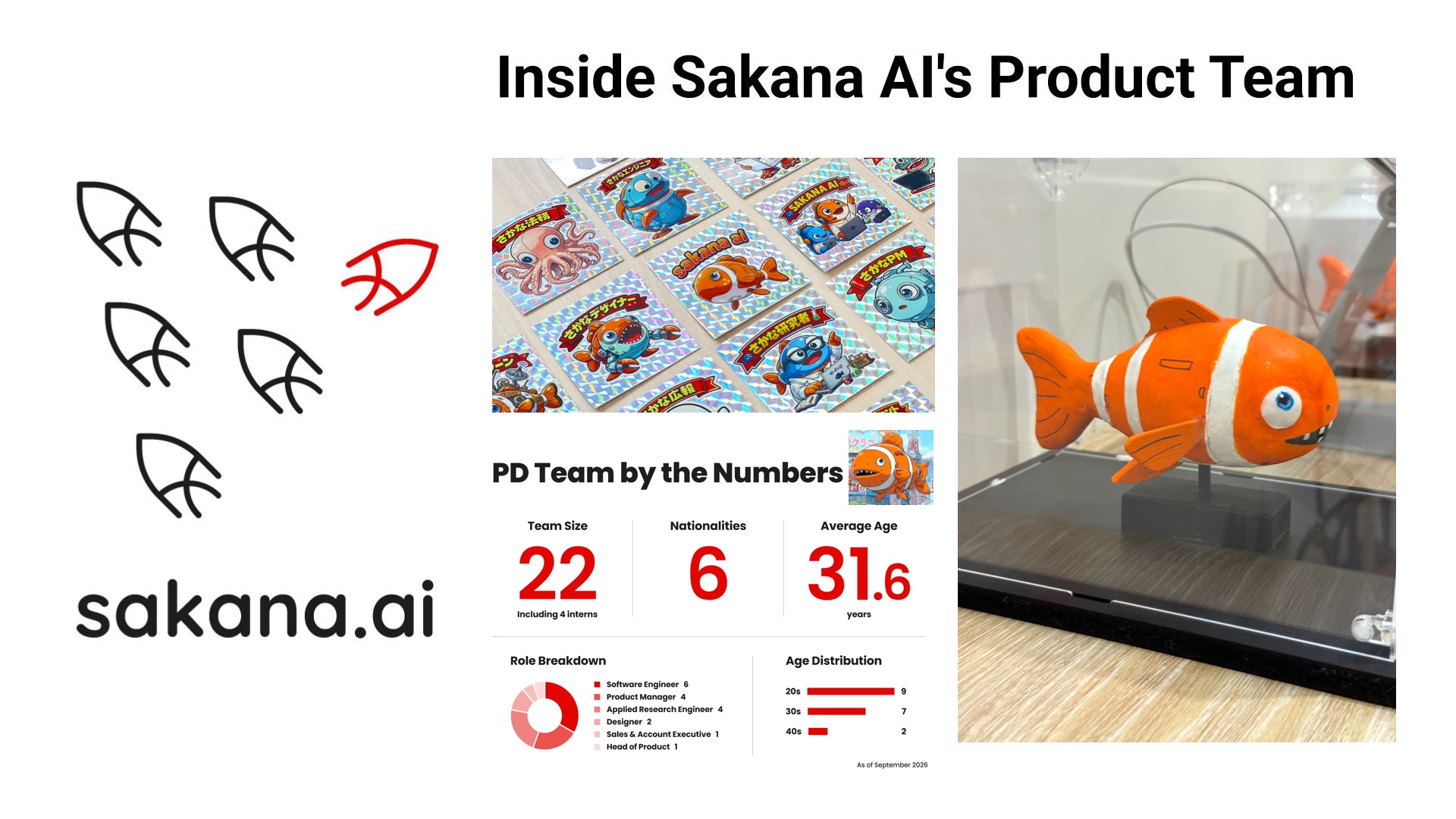
<p>Sakana AI, a Tokyo-based AI company, has released four products in rapid succession: starting with Sakana Chat in March 2026, followed by Sakana Marlin, Sakana Fugu, and Sakana Translate. Why is a company long known for research and development shipping products at this pace? And what vision lies beyond it?</p>

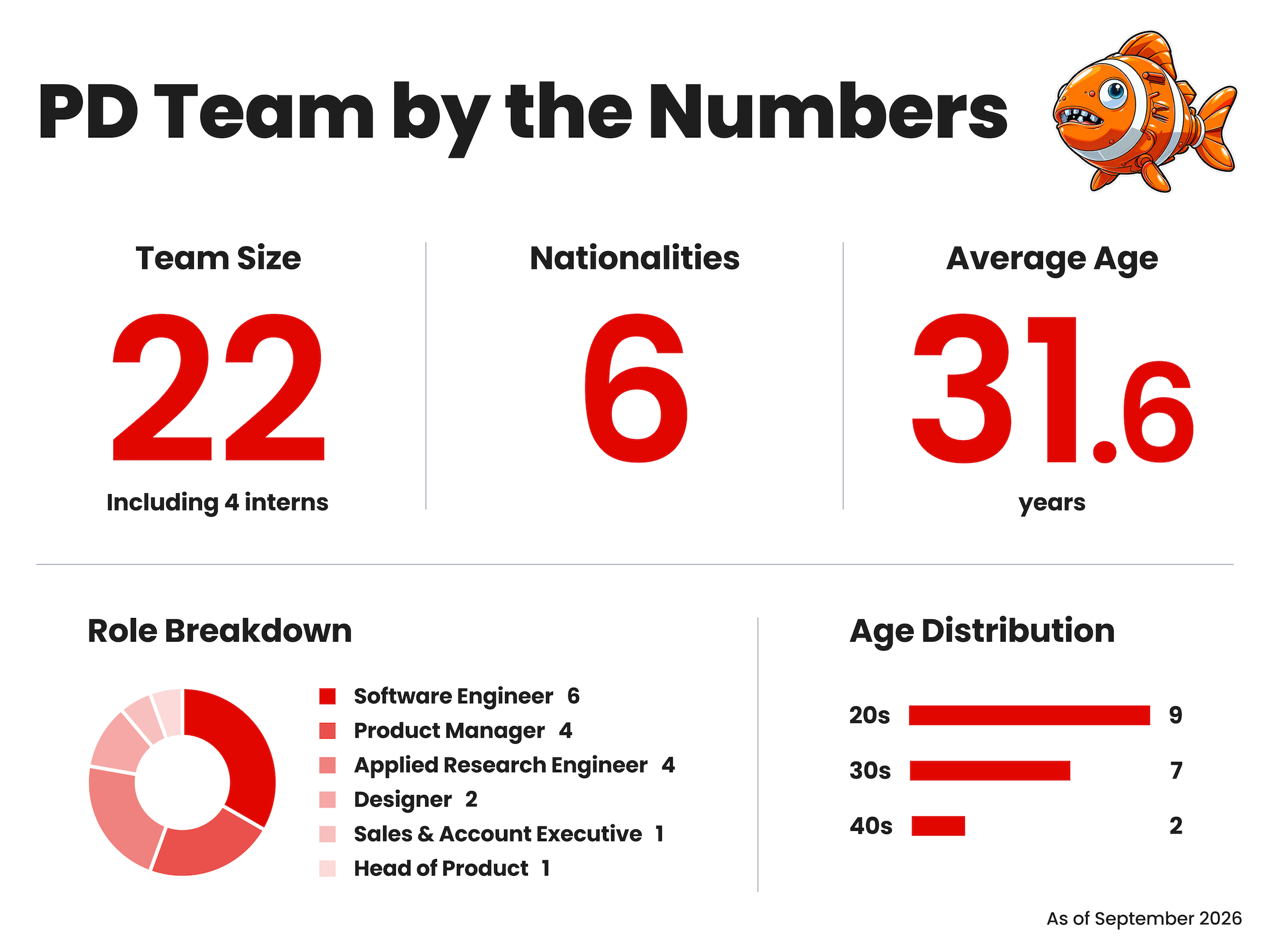
<p>We spoke with Sota Omura, who leads the product team as head of product development. The conversation ranged from how the team came into being, to the reasons behind the unusual release pace, a vision of a future in which humans and AI make decisions together, and an organizational philosophy of turning diversity into strength.</p>

<hr />

<h2 id="interviewee">Interviewee</h2>

<table style="background-color: #FFF;border: 1px solid white;border-collapse: collapse;margin:0;padding:0;">

<tr>
<td width="45%" style="background-color: #FFF;border: 1px solid white;border-collapse: collapse;margin:0;padding:0.5em;">
<img class="b-lazy" src="data:image/gif;base64,R0lGODlhAQABAAAAACH5BAEKAAEALAAAAAABAAEAAAICTAEAOw==" data-src="/assets/product-development-interview/sota.jpg" style="width: 100%;" />
</td>
<td width="55%" style="background-color: #FFF;border: 1px solid white;border-collapse: collapse;margin:0;padding:0.5em;">
<b>Sota Omura</b><br />Head of Product Development<br /><br />
Previously engaged in strategy formulation and business transformation consulting at Deloitte Tohmatsu Consulting LLC. Later served as Business Lead at Coincheck, Inc., managing multiple businesses including crypto asset trading and staking services. Joined Sakana AI in July 2025 as a Product Manager, leading the planning, design, and implementation of AI products.
<p><br /></p>
</td>
</tr>
</table>

<p><br /></p>

<hr />

<h2 id="from-consulting-and-a-startup-to-an-industry-that-leans-forward"><strong>From Consulting and a Startup to an “Industry That Leans Forward”</strong></h2>

<p><strong>— To start, could you walk us through your career so far?</strong></p>

<p>My career began in consulting. I joined Deloitte Tohmatsu Consulting straight out of university, on a team serving companies that provide services close to everyday life — supermarkets, railway companies, and the like. Most of my work involved projects to rebuild aging IT systems.</p>

<p>As I gained experience as an IT consultant, I wanted to know what it really means to build and grow a product with my own hands. So I moved to Coincheck, a company that operates an exchange app for buying and selling crypto assets such as Bitcoin. Everything was developed in-house: product managers, designers, engineers, and customer support worked as one to refine a single service. Eventually I came to lead the entire product as head of the business.</p>

<p><br /></p>

<p><strong>— What led you from there to Sakana AI?</strong></p>

<p>My time at Coincheck coincided with the period when the blockchain industry suddenly captured the world’s attention. The prices of Bitcoin and other crypto assets swung between surges and crashes; NFTs and Web3 filled the news day after day. Debates over regulation moved forward, and large corporations entered the space one after another. We were in the middle of society deciding, in real time, how to receive this technology. Money and talent were pouring in, and the whole industry was racing to claim a future several years ahead of its time.</p>

<p>“There are views you can only see by placing yourself in an industry that leans forward.” My boss at the time told me that, and it proved true. Inside an industry swaying between what a technology makes possible and how society responds, there was a fascination you could find nowhere else. Those words remain my compass whenever I think about where to go next.</p>

<p>In 2025, when I had time to step back and look at my career, I reconsidered where to base myself next. Measured against my old boss’s words, the industry leaning furthest forward was, without question, generative AI.</p>

<p><br /></p>

<p><strong>— There are plenty of AI companies. Why Sakana AI?</strong></p>

<p>There were many reasons, but one deciding factor was that the headquarters is in Japan. At the Japan office of a foreign tech company, a division of roles tends to emerge with the home country, where the decisions are made — and the work tends to center on delivering products that already exist, through sales and marketing. When a customer says, “We’d like it to work more like this,” you can find yourself escalating the request to headquarters and spending a long time coordinating.</p>

<p>Sakana AI, by contrast, is run from Japan, so the core of its product-making is entirely here. For someone based in Japan competing in the global market, I saw a company born in Japan as a major advantage.</p>

<p><br /></p>

<hr />

<h2 id="a-product-team-born-from-members-grassroots-discussions"><strong>A Product Team Born from Members’ Grassroots Discussions</strong></h2>

<p><strong>— We understand you initially joined the Applied team. How did the product team come about?</strong></p>

<p>At the time, Sakana AI had two main teams: the Research team, which studies a wide range of technologies including the development of foundational AI models, and the Applied team, which puts those results to work solving problems for enterprise customers. I joined the Applied team; a product team did not yet exist. The Applied team’s work — walking closely alongside each client, one company at a time — creates value nothing else can. At the same time, from the Applied team’s earliest days there had been a discussion: couldn’t a product deliver the value of the same technology to many more customers at once?</p>

<p>So from around the summer of 2025, I reached out to younger members of the Applied team who were interested in building products, and on our own initiative we set up sessions to discuss what shape product work could take at this company.</p>

<p>Amid all this, Ren Ito, our co-founder and chairman, approached me: he wanted to discuss how to treat model development as part of our own business. I presented a plan for growing a product business, model development included. As a result, the effort began moving as a partly independent offshoot of the Applied team. When the release of Sakana Chat was decided, we became a fully independent team to make the lines of responsibility clear, and I have led it since February 2026. Sakana AI, which began as a research and development company, is coming to wear the face of a product company as well. I feel I am standing at that turning point.</p>

<p><br /></p>

<p><strong>— How do the three teams — Research, Applied, and Product — relate to one another?</strong></p>

<p>The basic division of labor is that the Research team creates new technology, and the product team delivers those results to customers as products and monetizes them. On top of that, the two teams are in everyday contact. Sometimes we tell Research, “This is the kind of model the business front lines are asking for”; sometimes a request arrives from Research: “We’d like this used in such-and-such a way.” That is exactly what happened when the model Sakana Fugu was born.</p>

<p>It is the same with the Applied team. From the customer’s point of view, both are services of the same Sakana AI. If an Applied customer takes an interest in Sakana Marlin, we provide it; if a customer who came in through a product wants more hands-on support, we pass the baton to the Applied team.</p>

<p><br /></p>

<hr />

<h2 id="four-products-in-rapid-succession-standard-practice-for-the-ai-era"><strong>Four Products in Rapid Succession: “Standard Practice for the AI Era”</strong></h2>

<p><img class="b-lazy" src="data:image/gif;base64,R0lGODlhAQABAAAAACH5BAEKAAEALAAAAAABAAEAAAICTAEAOw==" data-src="/assets/product-development-interview/products.jpg" style="width: 100%;" /></p>

<p>Sakana Chat is a chat service powered by Namazu, our flagship model. It aims to be a chat AI from Japan that feels as natural to use as ChatGPT or Claude. Sakana Translate is a translation service, also powered by Namazu, and a sister product to Sakana Chat.</p>

<p>Sakana Fugu is a model built on “orchestration,” a technology that has multiple AI models work in concert. It handles tasks with higher performance than entrusting them to any single model. It is currently offered to developers through an API.</p>

<p>Sakana Marlin is a service for high-quality research, built on AB-MCTS, a technique for deep reasoning over extended time. We aim to grow it into an AI service that serves as a sounding board for management — a virtual CSO (chief strategy officer).</p>

<p><br /></p>

<p><strong>— Sakana Chat launched in March 2026, followed by Sakana Marlin, Sakana Fugu, and Sakana Translate. Compared with the usual approach — rounds of market research and user interviews before releasing a single product — this pace is extraordinary. Why did you choose to work this way?</strong></p>

<p>First and foremost, there was strong direction from the top. Our CEO, David, had made his intent clear: this would be the year Sakana AI ships products. Release Sakana Chat, then follow with Sakana Marlin, Sakana Fugu, and Sakana Translate. Day after day, the message we received was that making this sequence happen, without fail, was essential for Sakana AI right now.</p>

<p>That said, you are right that this departs sharply from the conventional approach. But I see releasing at this pace as what is becoming standard practice in the AI era. With AI’s help, prototypes that once took months are finished in weeks, sometimes days. Rather than spending a year on research before building, it is faster to ship first and learn from real reactions. Analyze closely what resonates, set the direction from there, and correct course quickly as you learn. That kind of agile decision-making is exactly what will be demanded of players in the AI era.</p>

<p><br /></p>

<p><strong>— None of the four products is specialized for a particular industry. Was that also deliberate?</strong></p>

<p>If we are delivering a service in the form of a product, we want it to be usable across a wide range of fields. Translation, research, consulting over chat — these are tasks performed every day at every company, whatever the industry. If we start by building products that help with this shared work, we can deliver value to that many more people. The size of the market we can target, and the size of the value we can create there: cross those two with our read on where we can win, and the result is the current four products.</p>

<p>Of course, deeper builds specialized for particular industries or use cases very much remain an option going forward. For example, we are actively exploring specialized versions of Sakana Marlin for finance and for manufacturing.</p>

<p><br /></p>

<hr />

<h2 id="making-sakana-marlin-a-platform-for-decision-making"><strong>Making Sakana Marlin a Platform for Decision-Making</strong></h2>

<p><strong>— Can you tell us about the direction of your products from here?</strong></p>

<p>To set the premise: we do not believe it is desirable for dependence on any single model to grow too strong. Let me be clear that we hold deep respect for the companies polishing excellent models — our own products, and our society, are supported by them. The more good models there are in the world, the greater the value of combining them intelligently. That is how we see it.</p>

<p>At the same time, every model has quirks, strengths, and weaknesses that trace back to its training data and design. Supply chain risk, too, is becoming harder to ignore. Just as an ecosystem with diverse organisms withstands environmental change better, we believe the world as a whole is healthier when diversity remains in how we work with AI.</p>

<p>Sakana Chat and Sakana Translate are products for experiencing Namazu, a model given additional training so that it attunes closely to the Japanese context. Sakana Fugu and Sakana Marlin, on the other hand, are products exploring how to use multiple models intelligently: Sakana Fugu combines several models cleverly to tackle a single task, while Sakana Marlin has them think deeply over extended time.</p>

<p>What we work on lies in territory that is technically possible but that few people have taken up — or likely ever will. We rapidly test the value that emerges from it. We prize this stance of keeping our gaze fixed at an angle askew from everyone else’s.</p>

<p><br /></p>

<p><strong>— You have said before that you want to make Sakana Marlin “a platform for decision-making.”</strong></p>

<p>A key intellectual foundation for Sakana Marlin is hypothesis thinking, proposed by Kazunari Uchida, a management scholar who served as head of the Boston Consulting Group in Japan. When we think something through, we first investigate the situation, form a hypothesis, act on it, then verify the results and revise the hypothesis. Whether weighing a new business or choosing where to work next, people follow these steps without realizing it. We want to implement this cycle as an application.</p>

<p>Today’s Sakana Marlin covers only the “investigate” step. But research is always followed by the steps in which humans form hypotheses and act. Pushed to its essence, every activity in business is made of this cycle. The state we aim for is one where every decision is made in Sakana Marlin, with humans and AI thinking together.</p>

<p><br /></p>

<p><strong>— Concretely, how would it be used?</strong></p>

<p>Take investment as an example. Suppose you are deciding, in light of your company’s portfolio, which fields to invest in. First you look into which industries are growing and where you could expect synergies with your own business, to get a rough fix. This initial research is where today’s Sakana Marlin helps most.</p>

<p>After the initial research produces a list of 100 to 200 companies, the next steps follow: study the ten most promising in detail, and simulate investment schemes and return scenarios. Once you are satisfied, you decide which companies to invest in, how much, in what form, over what recovery horizon, and with what team. Then you look back at how the investments actually performed and set the next year’s plan — which calls for another round of research. Decision-making unfolds within this spiral structure. Today, humans carry most of it.</p>

<p><br /></p>

<p><strong>— True — that territory has traditionally belonged to consulting firms and the like.</strong></p>

<p>Consulting and advisory services persist precisely because this territory is hard to replace with an application. Decision-making is an uncertain endeavor, and which factors a person weighs depends heavily on context. That is exactly why I see great possibility here.</p>

<p>Indeed, some predicted that the arrival of AI would erode demand for consultants and think tanks. In reality, demand for such experts has held remarkably firm — a measure, I think, of just how uncertain and ambiguous the practice of decision-making is.</p>

<p>Most AI use today stops at piecemeal efficiency: writing Excel formulas, arranging schedules. We want to take on decision-making itself — more uncertain, and further upstream. What I picture is humans and AI each bringing their own hypotheses and evidence, thinking together at the same table. “An AI sat in on the board meeting and, through discussion with the human directors, helped decide where to invest.” How many companies will be able to say that in the years ahead? We intend to translate that practice, carefully, into an application.</p>

<p><br /></p>

<hr />

<h2 id="an-organization-where-everyone-chases-the-same-numbers-knowledge-creation-theory-and-the-roots-of-scrum"><strong>An Organization Where Everyone Chases the Same Numbers: Knowledge-Creation Theory and the Roots of Scrum</strong></h2>

<p><strong>— As the products multiply, the organization will grow too. What kind of organization do you envision?</strong></p>

<p>There are broadly three ways to structure an organization. A functional structure groups people by specialty — engineers in an engineering division, salespeople in a sales division. A business-unit structure gathers every role under a single service. A matrix structure combines the two. I strongly favor the business-unit structure, because it lets people of every function aim at the same numbers — revenue, user counts — and the same value.</p>

<p><br /></p>

<p><strong>— Yet as they grow, many companies seem to shift toward functional organizations.</strong></p>

<p>I think that is because many people find business-unit organizations hard to run. Divide the organization by business unit, and each manager must grasp every corner of what it takes to run one service; the load on middle management inevitably becomes excessive. So most companies choose functional organizations aligned with individual specialties.</p>

<p>The greatest weakness of the functional organization, though, is that it fragments the process. Developers see only the development stage; quality assurance sees only the QA stage. Work starts falling into the cracks between organizations, and fewer people commit to the final value delivered. Everything becomes someone else’s problem, and you get finger-pointing: “We did hand over the deliverables.” That is the state I want to avoid.</p>

<p>I want everyone to hold responsibility for, and commit to, the whole process. But this is also a way of working that demands a high standard of each individual: take a broad view of your own remit while delivering solid results in your specialty. What we ask for is not just a mindset — it is skill, and professionalism. Because roles deliberately overlap, the team keeps up communication consciously and constantly. It is precisely among professionals working at a high standard that free, emergent exchange arises across role boundaries. I see it happen every day.</p>

<p><br /></p>

<p><strong>— Why choose that difficult path deliberately?</strong></p>

<p>There are two management scholars, Ikujiro Nonaka and Hirotaka Takeuchi, authors of <em>The Knowledge-Creating Company</em>. They argued as follows: new knowledge is born when people with different experiences keep talking, putting into words and sharing the tacit knowledge each carries in their body — experiential knowledge not yet verbalized. That is why Japanese companies deliberately built overlap into roles and information, made things in a way where everyone committed to the final value reaching the customer, and produced innovation.</p>

<p>Knowledge-creation theory is one of the few management theories born in Japan to spread worldwide. It is also the wellspring of Scrum, the emblematic method of agile development. Developers who read the pair’s 1986 Harvard Business Review article, “The New New Product Development Game,” brought its thinking into software development and created Scrum. In other words, at the root of a way of working now taken for granted at IT companies around the world lies a Japanese philosophy of making things.</p>

<p>For those used to organizations with clearly bounded job scopes, working on the premise of overlapping roles can be deeply disorienting. Even so, this Japanese philosophy of making things retains a strength that still carries in the world today. Our founders chose to establish Sakana AI in Japan, and I intend to embody the meaning of that choice in the shape of this organization.</p>

<p><br /></p>

<hr />

<h2 id="the-ideal-team-turning-diversity-into-strength"><strong>The Ideal Team: Turning Diversity into Strength</strong></h2>

<p><strong>— What kind of people do you hope will join the team?</strong></p>

<p>The strongest organization is one that can turn diversity into strength — that is my conviction. There is research behind it, too. In 2004, the economist Lu Hong and the complexity scientist Scott Page, in a study that modeled problem-solving mathematically, proved that under certain conditions a group with diverse ways of seeing and solving problems outperforms a group of individually more capable but similar-minded people. The result is known as the “diversity trumps ability” theorem. The study has drawn many critical responses since, but it remains one of the intellectual endeavors I love most.</p>

<p>I myself have moved fields from consulting to crypto assets to AI, and my own roots include a background outside Japan. Diversity lives not only in a team’s composition but within each individual. I feel that firsthand.</p>

<p><br /></p>

<p><strong>— What does the product team look like today?</strong></p>

<p>We are about fifteen people now, centered on product managers, designers, and engineers, and increasingly diverse in nationality. Functions like marketing and sales are about to be built. The work of designing, from zero, the machinery that carries our products to the world still remains on this team. That is an excitement you find only in the founding period.</p>

<p><br /></p>

<p><strong>— On the other hand, there is the model of a charismatic leader — an Elon Musk, a Steve Jobs — deciding top-down. In fact, that philosophy seems to be what drives today’s tech industry.</strong></p>

<p>True, there is the way of brilliant elites building a tightly commanded organization and changing the world. Raise a strong vision and run the shortest line as a monolith. For sheer speed of execution, no form is stronger. Applied to the AI industry, it is the strategy of polishing one supreme model or application and delivering it to the whole world. But simplify where that line eventually leads, and you get a world where everyone on earth relies on the same “strongest AI.” What is more, how much access anyone has to high-quality models is starting to hinge on external factors — how much they can pay, their nationality, their geography. I want to be cautious about the world becoming that uniform.</p>

<p>The real world is not that simple. The same question has different good answers depending on who is asking — their position and experience, the situation of the moment, the relationships around them. That is exactly why we want to hold up another goal for the relationship between AI and humans: using multiple models intelligently, in forms that attune to each person’s context. And for that, diversity of people and diversity of perspective are indispensable.</p>

<p><br /></p>

<p><strong>— Finally, a message for those interested in product development at Sakana AI. What kind of experience does the product team offer?</strong></p>

<p>Few IT products born in Japan are used around the world. At the Japan office of a foreign company, chances to touch the core of product-making are limited. An environment aiming for the global market this seriously is rare in Japan today. For those with global ambitions who also want to be based in Japan, I would claim this is the most interesting place there is. Building world-class products together, from a home base in Japan — we are waiting for people who seek that challenge.</p>

<p>And to those outside Japan: parts of how Sakana AI works are distinctive, and they may be disorienting at first. Even so, I believe the challenge here is worth taking — because I cannot yet call the direction today’s AI industry is heading, or the visions of the future told along the way, optimal. Every person lives within a context of their own. We need the challenge of building products that attune to human context, where diverse people can exercise their strengths while remaining diverse. The world needs a path different from investing in a single model and raising it. With anyone who thinks so, whatever their country or background, I believe we can join forces.</p>

<hr />

<p>Aiming for the world from Japan, while holding human context and diversity dear — that conviction ran unbroken through everything Omura said. If this challenge resonates with you and you want to build new products together, please visit our <a href="https://sakana.ai/careers/?category=product">careers page</a>.</p>

<p><img class="b-lazy" src="data:image/gif;base64,R0lGODlhAQABAAAAACH5BAEKAAEALAAAAAABAAEAAAICTAEAOw==" data-src="/assets/careers/data-engineer-product.jpg" style="width: 100%;" /></p>

<h1 id="Japanese">日本から、世界で使われるプロダクトを：Sakana AI プロダクト開発責任者インタビュー</h1>

<p>東京を拠点とするAI企業、Sakana AIは2026年3月の「Sakana Chat」を皮切りに、「Sakana Marlin」「Sakana Fugu」「Sakana Translate」と、4つのプロダクトを立て続けにリリースしました。研究開発企業として知られてきたSakana AIは、なぜこのスピードでプロダクトを世に出すのか。その先にどんな構想を描いているのか。</p>

<p>プロダクトチームを率いる開発責任者の大村壮太さんに聞くと、話はチーム発足の経緯から、異例のリリースペースの理由、人とAIが一緒に意思決定する未来の構想、そして「多様であることを力に変える」という組織の哲学にまで及びました。</p>

<p><br /></p>

<hr />

<h2 id="インタビューイー">インタビューイー</h2>

<table style="background-color: #FFF;border: 1px solid white;border-collapse: collapse;margin:0;padding:0;">

<tr>
<td width="45%" style="background-color: #FFF;border: 1px solid white;border-collapse: collapse;margin:0;padding:0.5em;">
<!--<img class="b-lazy" src="data:image/gif;base64,R0lGODlhAQABAAAAACH5BAEKAAEALAAAAAABAAEAAAICTAEAOw==" data-src="/assets/product-development-interview/sota.jpg" style="width: 100%;"/>-->
<img src="/assets/product-development-interview/sota.jpg" width="100%" /><br />
</td>
<td width="55%" style="background-color: #FFF;border: 1px solid white;border-collapse: collapse;margin:0;padding:0.5em;">
<b>大村壮太</b><br />Sota Omura<br />プロダクトチーム 開発責任者<br /><br />
デロイトトーマツコンサルティング合同会社にて、戦略策定およびビジネス変革のコンサルティングに従事。その後、コインチェック株式会社にて事業責任者として、暗号資産取引サービスやステーキングを含む複数事業の企画・執行を統括。2025年7月に Sakana AI に入社し、Product Manager として AI プロダクトの企画・設計および実装プロジェクトをリードしている。
<p><br /></p>
</td>
</tr>
</table>

<p><br /></p>

<hr />

<h2 id="コンサルスタートアップを経て前のめりなインダストリーへ"><strong>コンサル、スタートアップを経て、「前のめりなインダストリー」へ</strong></h2>

<p><strong>——まずはこれまでのご経歴を教えてください。</strong></p>

<p>キャリアの入り口はコンサルティングです。新卒で入ったデロイトトーマツコンサルティングでは、スーパーマーケットや鉄道会社など、暮らしに身近なサービスを提供する企業を担当するチームにいました。手がけていたのは、主に古くなったITシステムを作り替える案件です。</p>

<p>ITコンサルタントとして仕事を重ねるうちに、自分の手でプロダクトを作り育てるとはどういうことかを知りたくなりました。そこで移ったのが、ビットコインなどの暗号資産を売買できる取引所アプリを運営するコインチェックという会社です。システムをすべて社内で開発している会社で、プロダクトマネージャー、デザイナー、エンジニア、カスタマーサポートが一体となってひとつのサービスを磨いていく。最終的には、そのプロダクト全体を事業責任者として率いる立場になりました。</p>

<p><br /></p>

<p><strong>——そこからなぜSakana AIに移られたのでしょうか。</strong></p>

<p>私がコインチェックにいたのは、ブロックチェーン業界に世の中の注目が一気に集まった時期でした。ビットコインをはじめとする暗号資産の価格が急騰と急落を繰り返し、NFTやWeb3という言葉が連日ニュースをにぎわせる。規制のあり方をめぐる議論が進み、大企業の参入も相次ぐ。この技術を社会がどう受け止めるかが、リアルタイムで決まっていく渦中にありました。資金も人材も勢いよく流れ込み、業界全体が数年先の未来を先取りしようとしていたのです。</p>

<p>「前のめりなインダストリーに身を置くことでしか見えない景色がある」。当時の上司にそう言われましたが、実際にその通りでした。技術の可能性と社会の反応の間で揺れる業界の内側には、そこでしか味わえない面白さがあった。この言葉は、いまも進路を考えるときの軸になっています。</p>

<p>2025年、自分のキャリアを見つめ直す時間ができた時、自分の拠点を次はどこに移すかを考え直しました。上司の言葉に照らせば、いま最も前のめりな業界は間違いなく生成AIでした。</p>

<p><br /></p>

<p><strong>——AI企業は他にもあるなかで、なぜSakana AIだったのでしょうか。</strong></p>

<p>色々ありますが、本社が日本にあることが決め手の一つでした。外資系IT企業の日本拠点では、意思決定の中心である本国との役割分担が生まれやすく、セールスやマーケティングなど、すでにあるプロダクトを届ける仕事が中心になりがちです。お客さまから「もっとこうしたい」という要望をいただいても、本国に上げて時間をかけて調整する場面が出てきます。</p>

<p>一方、Sakana AIは日本で経営されているので、ものづくりの根幹がすべて日本にあります。日本に拠点を置く人間がグローバル市場で勝負するうえで、日本発の企業であることは大きなアドバンテージだと考えました。</p>

<hr />

<h2 id="メンバーの自発的な議論からプロダクトチームが生まれた"><strong>メンバーの自発的な議論からプロダクトチームが生まれた</strong></h2>

<p><strong>——入社当初はAppliedチームに入ったそうですね。プロダクトチームはどのように生まれたのでしょうか。</strong></p>

<p>当時のSakana AIには、大きく2つのチームがありました。基盤となるAIモデルの開発をはじめ、幅広い技術を研究するResearchチームと、その成果を法人のお客さまの課題解決に活かすAppliedチームです。私はAppliedチームに加わったのですが、プロダクトチームはまだ存在していませんでした。Appliedチームが一社ごとに深く伴走する仕事には、それでしか生めない価値があります。そのうえで、Appliedチームの立ち上げ当初から「プロダクトという形なら、同じ技術の価値をより多くのお客さまへ同時に届けられるのではないか」という議論もありました。</p>

<p>そこで2025年の夏ごろから、プロダクト作りに関心のあるAppliedチームの若手メンバーに声をかけ、「この会社でプロダクトを手がけるならどのような形が考えられるか」を話し合う場を自発的に設けていました。</p>

<p>そうした中、共同創業者で社長の伊藤錬から「モデル開発を自社ビジネスの一部としてどう扱うかを議論したい」と声がかかりました。そこで、モデル開発を含めたプロダクトビジネスの育て方をプレゼンしました。その結果、この取り組みはAppliedチームから一部独立する形で動き出します。Sakana Chatのリリース決定を機に、責任の所在を明確にするため完全に独立したチームとなり、2026年2月から私が責任者を務めています。研究開発企業として始まったSakana AIが、プロダクト企業の顔も持つようになっていく。その転換点に立ち会っていると感じています。</p>

<p><br /></p>

<p><strong>——Research、Applied、プロダクトの3チームは、どのような関係にあるのでしょうか。</strong></p>

<p>基本の役割分担としては、Researchチームが新しい技術を生み出し、プロダクトチームがその成果をプロダクトとしてお客さまに届けて収益化します。そのうえで、両チームの間には日常的なやり取りがあります。「ビジネスの現場ではこういうモデルが求められている」とResearchに伝えることもあれば、Researchから「このように使ってほしい」という要望が届くこともあります。Sakana Fuguというモデルが生まれたときが、ちょうどそうでした。</p>

<p>Appliedチームとの関係も同じです。お客さまから見れば、どちらも同じSakana AIのサービスです。Appliedチームのお客さまがSakana Marlinに関心を持てばこちらで提供し、プロダクト側から入ったお客さまがより手厚い支援をお望みであれば、Appliedチームにバトンタッチします。</p>

<hr />

<h2 id="4プロダクトを立て続けにai時代のスタンダードプラクティス"><strong>4プロダクトを立て続けに。「AI時代のスタンダードプラクティス」</strong></h2>

<p><img class="b-lazy" src="data:image/gif;base64,R0lGODlhAQABAAAAACH5BAEKAAEALAAAAAABAAEAAAICTAEAOw==" data-src="/assets/product-development-interview/products.jpg" style="width: 100%;" /></p>

<p>Sakana Chatは、私たちのフラッグシップモデル「Namazu」によるチャットサービスです。ChatGPTやClaudeのような感覚で使える、日本発のチャットAIを目指しています。Sakana Translateは、同じくNamazuによる翻訳サービスで、Sakana Chatの姉妹プロダクトです。</p>

<p>Sakana Fuguは、複数のAIモデルを協調させる「オーケストレーション」技術を使ったモデルです。単一のモデルに任せるより高い性能でタスクを処理します。現在は、開発者向けにAPIで提供しています。</p>

<p>Sakana Marlinは、時間をかけて深く推論する技術「AB-MCTS」を使った、高品質なリサーチのためのサービスです。経営の相談相手（バーチャルCSO＝最高戦略責任者）となるようなAIサービスに成長させることを目指しています。</p>

<p><br /></p>

<p><strong>——Sakana Chatが2026年3月、以降Sakana Marlin、Sakana Fugu、Sakana Translateとリリースが続きました。マーケット調査やユーザーインタビューを重ねてから1つのプロダクトを出す、という一般的な流れと比べると、異例のペースだと思います。なぜこのやり方を選んだのでしょうか。</strong></p>

<p>まず何より、経営の強いディレクションがありました。CEOのDavidが「今年はSakana AIがプロダクトを出す年にする」という強い意志を示していました。Sakana Chatを出し、Sakana Marlin、Sakana Fugu、Sakana Translateへと続ける。この流れを確実に作ることが、今のSakana AIにとって不可欠だというメッセージを日々受け取っていました。</p>

<p>そのうえで、「一般的なやり方と大きく異なるのでは」というご指摘はその通りです。ただ私は、このようなペースでのリリースは、AI時代のスタンダードプラクティスになっていると捉えています。AIの力を借りれば、以前なら数カ月かかったプロトタイプ作りが数週間、ときには数日で終わります。作る前に1年かけて調査するより、まず出して、実際の反応から学ぶほうが早いのです。反応の良い部分を細かく分析し、方向性を決めていく。学びに応じて素早く軌道修正する。そうした機動的な意思決定こそ、AI時代のプレイヤーに求められるはずです。</p>

<p><br /></p>

<p><strong>——4つのプロダクトは、いずれも特定の業界に特化していません。これも意図したものでしょうか。</strong></p>

<p>プロダクトという形でサービスを届ける以上、幅広い領域で使えるものにしたいと考えています。例えば翻訳や調べ物、チャットでの相談などは、業界を問わずどの会社でも毎日行われている仕事です。まずはこうした共通の仕事を助けるプロダクトを作れば、それだけ多くの方に価値を届けられます。狙える市場の大きさと、そこで発揮できる価値の大きさ。この2つに勝算の見立てを掛け合わせた結果が、いまの4つのプロダクトです。</p>

<p>もちろん、特定の業界やユースケースに特化させた作り込みはこの先の選択肢として多いにありえます。例えば、Sakana Marlinのファイナンス向け、製造業向けといった特化版については非常にアクティブに検討しています。</p>

<p><br /></p>

<hr />

<h2 id="sakana-marlinを意思決定のプラットフォームへ"><strong>Sakana Marlinを意思決定のプラットフォームへ</strong></h2>

<p><strong>——今後のプロダクトの方向性も伺えますか。</strong></p>

<p>前提として、私たちは、単一のモデルへの依存が強すぎる状態が望ましいとは考えていません。前提として、優れたモデルを磨き上げている各社の仕事には深い敬意を抱いていますし、私たちのプロダクトも、私たちの社会もそうしたモデルに支えられています。世の中に良いモデルが増えるほど、それらを賢く組み合わせる価値も大きくなる。それが私たちの見方です。</p>

<p>そのうえで、どのモデルにも、学習のデータや設計に由来する癖や得意不得意があります。また、サプライチェーンに対するリスクも見逃せなくなりつつあります。多様な生き物がいる生態系のほうが環境の変化に強いように、AIとの付き合い方にも多様さが残っているほうが、世の中全体として健全なはずだと私たちは思っています。</p>

<p>Sakana ChatとSakana Translateは、Namazuというモデルを触っていただくためのプロダクトです。Namazuは、こうしたモデルが日本の文脈に寄り添うようにトレーニングを加えたものです。一方、Sakana FuguとSakana Marlinは、複数のモデルを賢く使う形を探るプロダクトです。Sakana Fuguは複数のモデルを賢く組み合わせて一つのタスクにあたらせ、Sakana Marlinは時間をかけて深く考えさせる。</p>

<p>私たちが取り組んでいるのは、技術的には可能だが、まだあまり多くの人が手がけていない、あるいはおそらく手がけないであろう領域です。そこから生まれる価値を高速に検証していく。この「斜めにずれた角度を見続ける」姿勢を大切にしています。</p>

<p><br /></p>

<p><strong>——以前、Sakana Marlinを「意思決定のプラットフォームにしたい」とおっしゃっていました。</strong></p>

<p>Sakana Marlinの重要な思想的前提になっているのが、『仮説思考』です。ボストン コンサルティング グループの日本代表を務めた経営学者、内田和成氏が提唱しました。何かを考えるときは、まず状況を調べ、仮説を立て、行動に移し、結果を検証して仮説を修正する。例えば新しい事業を検討するときも、転職先を選ぶときも、人は無意識にこの手順を踏んでいます。この繰り返しを、アプリケーションとして実装したいのです。</p>

<p>現状のSakana Marlinが担っているのは「調べる」工程だけです。しかし、調査の後には必ず、人間が仮説を立てて行動する工程が続きます。ビジネス上のあらゆる活動は、突き詰めればこの繰り返しでできています。あらゆる意思決定が、Sakana Marlinという場で、人とAIが一緒に考えながら行われる状態。それが目指す姿です。</p>

<p><br /></p>

<p><strong>——具体的には、どのような使われ方になるのでしょうか。</strong></p>

<p>投資を例にします。自社のポートフォリオを踏まえ、どの領域に投資すべきかを考えるとします。まず、いまどの業界が伸びているのか、どの領域なら自社との相乗効果を見込めるのかを調べて当たりをつける。この初期調査は、現在のSakana Marlinが最も役立つ領域です。</p>

<p>初期調査で100〜200社のリストを作った後には、有望な10社を詳しく調べ、投資スキームやリターンのシナリオをシミュレーションする工程が続きます。納得できる段階まで来たら、どの会社に、いくらを、どのような形で投資し、どの程度の期間で回収し、どの体制で進めるのかを決める。実際に投資した結果がどうだったかを振り返り、次年度の計画を決める。そのためのまた調査をする。意思決定は、このようなスパイラル構造の中で行われていきます。いまはその大部分を人間が担っています。</p>

<p><br /></p>

<p><strong>——たしかに、この領域はコンサルティングファームなどが担ってきた印象があります。</strong></p>

<p>コンサルティングやアドバイザリーというサービスが根強く残っているのは、この領域をアプリケーションに置き換えるのが難しいからです。意思決定という営みは不確実で、人がどの要素を重視するかは文脈に強く依存します。だからこそ、ここには大きな可能性があると見ています。</p>

<p>実際、AIの登場でコンサルタントやシンクタンクへの需要が薄れるのではないか、という見方も一部にありました。現実には、そうした専門家への需要はむしろ底堅く続いています。意思決定という営みが、それだけ不確実で曖昧なものだからでしょう。</p>

<p>いまのAI活用の多くは、Excelの数式を書かせる、スケジュールを調整させるといった部分的な効率化にとどまっています。私たちは、より不確実で、物事の上流にある意思決定そのものに取り組みたい。思い描いているのは、人とAIがそれぞれ仮説や証拠を持ち寄り、同じテーブルで一緒に考える形です。「役員会にAIが同席して、人間の役員と議論を重ねながら投資先を決めた」。そう言える会社が、これからどれだけ現れるか。その営みを、丁寧にアプリケーションへ落とし込んでいくつもりです。</p>

<p><br /></p>

<hr />

<h2 id="全員が同じ数字を追う組織知識創造理論とスクラムの源流"><strong>全員が同じ数字を追う組織：知識創造理論とスクラムの源流</strong></h2>

<p><strong>——プロダクトが増えるにつれ、組織も拡大していきます。どのような組織像を思い描いていますか。</strong></p>

<p>組織の作り方は、大きく3つに分けられます。エンジニアはエンジニア部門、営業は営業部門と、専門ごとに人を束ねる「職能別」。1つのサービスの下にすべての職種を集める「事業単位別」。両者を組み合わせた「マトリクス型」です。私は、すべての職能の人が売上やユーザー数といった同じ数字、同じ価値を目指せるという理由で、事業単位の組織を強く支持しています。</p>

<p><br /></p>

<p><strong>——しかし、組織が拡大するにつれて、職能別の組織へ移っていく会社が多いように思います。</strong></p>

<p>事業単位の組織は運営が難しい、と考える方が多いためだと思います。事業単位で組織を分けると、マネージャーは1つのサービスの運営に必要な事柄をすみずみまで把握しなければならず、中間管理職への負荷がどうしても過大になります。そのため多くの会社が、各自の専門性に沿った職能別組織を選ぶわけです。</p>

<p>一方で、職能別組織の最大の課題は、プロセスが分断されることです。開発者は開発工程しか見ない。品質保証の担当は品質保証の工程しか見ない。その結果、組織と組織の間に落ちる業務が増え、最終価値にコミットする人が減っていきます。さまざまな事柄が他人事になり、「成果物は確かに渡した」という水掛け論が起こります。この状態は避けたいのです。</p>

<p>全員がプロセス全体に責任を持ち、コミットする状況を作りたい。ただ、これは一人ひとりに高い水準を求める働き方でもあります。自分の担当範囲を広く捉えながら、同時に自分の専門領域で確かな成果を出す。求めているのは心構えにとどまらず、技能であり、プロフェッショナリズムです。役割に重なりを持たせる働き方なので、チームでは意識的にコミュニケーションを取り続けています。高い水準で働くプロフェッショナル同士だからこそ、役割の境界を越えた自由で創発的なやり取りが生まれる。日々それを実感しています。</p>

<p><br /></p>

<p><strong>——あえてその難しい道を選ぶのはなぜでしょうか。</strong></p>

<p>『知識創造企業』を著した野中郁次郎氏と竹内弘高氏という、2人の経営学者がいます。両氏はこう論じました。新しい知識は、異なる経験を持つ人たちが対話を重ね、それぞれが体で覚えている暗黙知（言葉になっていない経験知）を言葉にして共有するところから生まれる。だから日本企業は、役割や情報にあえて重なりを持たせ、全員でお客さまに届く最終価値にコミットする形でものづくりをして、イノベーションを起こしてきた、と。</p>

<p>知識創造理論は、日本発の経営理論としてグローバルに浸透した数少ない例です。そして、アジャイル開発の代表的な手法「スクラム」の源流でもあります。両氏が1986年に米ハーバード・ビジネス・レビュー誌に発表した論文「The New New Product Development Game」を読んだ開発者たちが、その考え方をシステム開発に取り入れ、スクラムを生み出しました。つまり、いま世界中のIT企業で当たり前になっている働き方の根っこには、日本のものづくりの思想があるのです。</p>

<p>職務範囲が明確な組織に慣れた方には、役割の重なりを前提にする働き方は戸惑いが大きいと思います。それでも、この日本的なものづくりの思想には、いまも世界に通じる強さがあります。創業者たちが日本にSakana AIを設立した意味を、私はこの組織の形で体現するつもりです。</p>

<p><br /></p>

<hr />

<h2 id="多様性を力に変える理想のチーム像"><strong>多様性を力に変える、理想のチーム像</strong></h2>

<p><strong>——どのような人にチームへ来てほしいと考えていますか。</strong></p>

<p>多様であることを力に変えられる組織が最も強い。これが私の信念です。裏付けになる研究もあります。経済学者のルー・ホンと複雑系研究者のスコット・ペイジは2004年、問題解決を数理モデルにした研究で、ものの見方や解き方が多様な集団は、一定の条件の下で、個々の能力は高いが視点の似た集団を上回ることを数学的に示しました。「多様性が能力に勝る」定理と呼ばれる結果です。その後、多くの批判的応答に晒されている研究ですが、私が最も愛している知的な営みの一つです。</p>

<p>私自身、コンサルティングから暗号資産、そしてAIへと畑を移りながら働いてきましたし、自分のルーツにも海外のバックグラウンドがあります。多様性はチームの構成だけでなく、個人の中にも宿る。そう実感しています。</p>

<p><br /></p>

<p><strong>——現在のプロダクトチームは、どのような構成なのでしょうか。</strong></p>

<p>現在は約15名で、プロダクトマネージャー、デザイナー、エンジニアが中心で、国籍も多様になりつつあります。マーケティングやセールスといった機能は、これから立ち上げるところです。プロダクトを世界に届ける仕組みをゼロから設計する仕事が、このチームにはまだ残っています。立ち上げ期にしかない面白さだと思います。</p>

<p><br /></p>

<p><strong>——一方で、イーロン・マスクやスティーブ・ジョブズのようなカリスマがトップダウンで決めていくやり方もあります。実際、現在のテック業界を牽引しているのはそちらの思想にも見えます。</strong></p>

<p>たしかに、優れたエリートが統率の取れた組織を作り、世の中を変えていくやり方もあるでしょう。強いビジョンを掲げ、一枚岩の組織で最短距離を走る。実行のスピードにおいて、これほど強い形はありません。AI業界に当てはめれば、最高のモデルやアプリケーションを一つ磨き上げ、世界中に届けるという戦略です。ただ、その延長線で行き着く先を単純化して言えば、世界中の誰もが同じ「最強のAI」に頼る世界です。しかも、高品質なモデルをどれだけ使えるかは、例えば支払える金額や国籍や地理的条件のような、様々な外的要因にも影響され始めています。世界がそこまで一様になることには、私は慎重でありたいのです。</p>

<p>実際の世の中は、それほど単純ではありません。同じ質問でも、尋ねる人の立場や経験、そのときの状況や人々をめぐる関係性によって、良い答えの内容は変わります。だからこそ、複数のモデルを賢く使い、人の文脈に寄り添う形を、AIと人間の関係のもう一つのゴールとして提示していきたい。そのためには、人材の多様性、観点の多様性が欠かせません。</p>

<p><br /></p>

<p><strong>——最後に、Sakana AIのプロダクト開発に関心をお持ちの方へメッセージをお願いします。Sakana AIのプロダクトチームでは、どのような経験が得られるのでしょうか。</strong></p>

<p>世界中で使われている日本発のITプロダクトは多くありません。外資系企業の日本支社では、ものづくりの根幹に関わる機会も限られます。ここまで本気でグローバル市場を狙える環境は、いまの日本では稀です。グローバル志向があり、なおかつ日本を拠点にしたい方にとって、最も面白い場所だと自負しています。日本という拠点から、世界水準のプロダクトを共につくり上げる。そういう挑戦を求める方をお待ちしています。</p>

<p>そして、日本の外にいる方々へ。Sakana AIの働き方には独特なところもあり、最初は戸惑いがあるかもしれません。それでも、この環境でチャレンジする価値はあるはずだと考えています。いまのAI業界が向かう方向や、そこで語られる未来像が、まだ最適だとは思えないからです。人は誰しも、固有の文脈の中で生きています。多様な人々が多様なまま力を発揮できる、人間の文脈に寄り添ったプロダクトを作る挑戦が必要です。単一のモデルに投資して育てる発想とは別の道が、世の中には要る。そう考える方となら、国や経歴を問わず、力を合わせられると思っています。</p>

<p><br /></p>

<hr />

<p>人の文脈や多様性を大切にしながら、日本発で世界を狙う。大村さんの語りには、その信念が一貫して流れていました。この挑戦に共感し、一緒に新しいプロダクトをつくり上げたいという方は、ぜひ<a href="https://sakana.ai/careers/?category=product">採用情報ページ</a>をご覧ください。</p>

<p><img class="b-lazy" src="data:image/gif;base64,R0lGODlhAQABAAAAACH5BAEKAAEALAAAAAABAAEAAAICTAEAOw==" data-src="/assets/careers/data-engineer-product.jpg" style="width: 100%;" /></p>]]></content><author><name>Sakana AI</name></author><category term="media" /><summary type="html"><![CDATA[]]></summary></entry><entry xml:lang="ja"><title type="html">Sakana AI防衛・インテリジェンスチーム、「DIVER OSINT CTF 2026」で5位入賞　Fuguを活用したOSINTエージェントの可能性</title><link href="/diver-osint/" rel="alternate" type="text/html" title="Sakana AI防衛・インテリジェンスチーム、「DIVER OSINT CTF 2026」で5位入賞　Fuguを活用したOSINTエージェントの可能性" /><published>2026-07-30T00:00:00+09:00</published><updated>2026-07-30T00:00:00+09:00</updated><id>/diver-osint</id><content type="html" xml:base="/diver-osint/"><![CDATA[<p><img src="/assets/pub/Diver-OSINT.jpeg" width="100%" /><br />
<!--more--></p>

<p>Sakana AI の防衛・インテリジェンスチーム有志は、公開情報収集・分析のコンペティションである「Diver OSINT CTF 2026」に参加し、850以上の参加チームの中で5位となりました。</p>

<p>本大会では、ドメインエキスパートとエンジニアが協働し、Fugu-ultra 1.1を活用したOSINT分析エージェントを構築して 競技に臨みました。人間の専門知とAIエージェントを組み合わせるアプローチが防衛・安全保障の文脈でも有効であることを示唆する結果となりました。</p>

<p>競技を通じて得られた知見をもとに、エージェントを実務向けにさらに改善し、日本の防衛・インテリジェンスへの貢献につなげてまいります。</p>

<p><br /></p>
<center>
<a href="https://x.com/DIVER_OSINT_CTF/status/2043433978997195214"><img src="/assets/pub/Diver-OSINT-tweet.jpeg" width="80%" /></a><br />
</center>
<p><br /></p>]]></content><author><name>Sakana AI</name></author><category term="media" /><summary type="html"><![CDATA[]]></summary></entry><entry xml:lang="en"><title type="html">Dreaming in Voxels: How AI is Generating Playable Minecraft Worlds</title><link href="/dream-cubed/" rel="alternate" type="text/html" title="Dreaming in Voxels: How AI is Generating Playable Minecraft Worlds" /><published>2026-07-29T00:00:00+09:00</published><updated>2026-07-29T00:00:00+09:00</updated><id>/dream-cubed</id><content type="html" xml:base="/dream-cubed/"><![CDATA[<center>
<video class="b-lazy" autoplay="" muted="" playsinline="" loop="" style="display: block; margin: auto; width: 60%;"><source src="/assets/pub/dream-cubed.mp4" /></video>
</center>
<!--more-->

<p>Generative AI has conquered images, video, text. But what about interactive 3D environments? We trained models on billions of cubes to generate fully playable, structured worlds!</p>

<p>We are excited to share our latest work, together with New York University: <strong>Dream-Cubed: Controllable Generative Modeling in Minecraft by Training on Billions of Cubes</strong>.</p>

<ul>
  <li>Technical Blog: <a href="https://pub.sakana.ai/dream-cubed">https://pub.sakana.ai/dream-cubed</a></li>
  <li>Paper: <a href="https://arxiv.org/abs/2604.22847">https://arxiv.org/abs/2604.22847</a></li>
  <li>Code: <a href="https://github.com/SakanaAI/DreamCubed">https://github.com/SakanaAI/DreamCubed</a></li>
</ul>

<p>Generative AI has made incredible progress in language modeling, far beyond other modalities, where words and tokens offer a natural compositional unit for scalable training. This is similar to Minecraft and many other popular video games, where developers rely on cubes, tiles, and other discrete primitives to build rich, interactive worlds.</p>

<p>In this work, we show that using cubes as tokens allows large transformers to do the same. Our contribution is two-fold:</p>

<ol>
  <li>We release Dream-Cubed to the research community, a large-scale dataset of Minecraft worlds designed for generative modeling. Our data comprises tens of billions of carefully-balanced cubes from procedurally generated Minecraft terrain and high-quality human-authored maps (obtained with the authors’ consent).</li>
  <li>We use our data to train a family of powerful transformers for efficient generation of interactive 3D environments at cube resolution. We show how our models allow players to mold the world around them by generating structures, terrain, and maps that are immediately editable and playable.</li>
</ol>

<p>Using high-quality data, we demonstrate that these models can be successfully trained with different training objectives, including both continuous and discrete diffusion, unlocking targeted inpainting, large-scale outpainting, and user-conditioned generation of infinitely sized worlds with fine-grained block-level control.</p>

<p><br /></p>]]></content><author><name>Sakana AI</name></author><category term="media" /><summary type="html"><![CDATA[]]></summary></entry><entry xml:lang="en"><title type="html">Announcing Fugu-Ultra v1.1 and Claude Code interface for Fugu</title><link href="/fugu-1-1-claude-code-interface/" rel="alternate" type="text/html" title="Announcing Fugu-Ultra v1.1 and Claude Code interface for Fugu" /><published>2026-07-24T00:00:00+09:00</published><updated>2026-07-24T00:00:00+09:00</updated><id>/fugu-1-1-claude-code-interface</id><content type="html" xml:base="/fugu-1-1-claude-code-interface/"><![CDATA[<center>
<img src="/assets/fugu-1-1-release/fugu-ascii-v2.png" width="100%" /><br />
</center>
<!--more-->

<p>We’ve been thrilled by the reception to the Fugu model family. Thanks to everyone who tried it, shared feedback, and trusted Fugu with real, complex work.</p>

<p>Today, we are thrilled to announce the next evolution of our orchestration engine: <strong>Fugu-Ultra v1.1</strong> 🐡</p>

<p><strong>👉 <a href="/fugu/">Sakana Fugu</a></strong></p>

<p>By dynamically orchestrating the latest frontier models, we pushed performance up by as much as 7.9 points. We are now beating leading models like Fable 5 in complex coding and reasoning tasks, without even having Fable in our agent pool.</p>

<p>Collective intelligence is the future!</p>

<p><br /></p>

<h2 id="fugu-ultra-v11-the-frontier-keeps-moving">Fugu-Ultra v1.1: The Frontier Keeps Moving</h2>

<center>
<img src="/assets/fugu-1-1-release/fugu-1-1.png" width="100%" /><br />
</center>

<p>Fugu-Ultra is now upgraded to incorporate the latest frontier models. Our latest Fugu-Ultra v1.1 delivers stronger performance across every benchmark we track.</p>

<p>This orchestration upgrade resulted in gains of up to 7.9 points over v1.0, with particularly strong results on <strong>ProgramBench</strong> and <strong>Terminal Bench 2.1</strong>. Fugu-Ultra v1.1 is demonstrably more capable across coding, agentic tasks, and advanced reasoning.</p>

<p>The frontier keeps moving, and Fugu keeps getting better. Crucially, this massive leap in reasoning capabilities is available today at the same price as Fugu-Ultra v1.0.</p>

<ul>
  <li><strong>Explore Fugu-Ultra:</strong> <a href="https://sakana.ai/fugu">https://sakana.ai/fugu</a></li>
</ul>

<p><br /></p>

<h2 id="announcing-the-claude-code-compatible-interface-for-fugu">Announcing the Claude Code-compatible interface for Fugu</h2>

<p>Since launch, Fugu models have been adopted by platforms including OpenRouter and Vercel. We’ve loved seeing developers use them across coding agents, research workflows, automation, and applications we never anticipated.</p>

<p>Today, we’re making Fugu more accessible again with <strong>Claude Code-compatible endpoints</strong> for Sakana Fugu.</p>

<p>You can now bring Fugu’s multi-agent intelligence directly into Claude Code. This puts a dynamically coordinated team of frontier models to work inside the coding workflow you already know and love. Instead of relying on a single model to write, debug, and execute your code, you can now orchestrate a diverse pool of state-of-the-art models directly from your terminal.</p>

<p>Put the whole school of fish to work on your next task 🐟</p>

<ul>
  <li><strong>Claude Code-compatible interface details:</strong> <a href="https://console.sakana.ai/get-started">https://console.sakana.ai/get-started</a></li>
</ul>

<p><br /></p>

<center>
<img src="/assets/fugu-1-1-release/fugu-ascii.png" width="100%" /><br />
</center>

<p><br /></p>

<h2 id="sakanaai">Sakana AI</h2>

<p>Interested in joining us?</p>

<p>Please see our <a href="/careers/">career opportunities</a> for more information.</p>

<p><br /></p>

<center>
<img src="/assets/careers/applied_research_eng_high_res4.jpg" width="100%" /><br />
</center>

<p><br /></p>]]></content><author><name>Sakana AI</name></author><category term="media" /><summary type="html"><![CDATA[]]></summary></entry><entry xml:lang="en"><title type="html">UnMaskFork: Test-Time Scaling for Masked Diffusion via Deterministic Action Branching</title><link href="/umf/" rel="alternate" type="text/html" title="UnMaskFork: Test-Time Scaling for Masked Diffusion via Deterministic Action Branching" /><published>2026-07-23T00:00:00+09:00</published><updated>2026-07-23T00:00:00+09:00</updated><id>/umf</id><content type="html" xml:base="/umf/"><![CDATA[<center>
<video class="b-lazy" autoplay="" muted="" playsinline="" loop="" style="display: block; margin: auto; width: 100%;"><source src="/assets/pub/umf.mp4" /></video>
</center>
<!--more-->

<p><i><small><a href="#Japanese" style="color:#555;">（＊日本語は英文の後に）</a></small></i></p>

<hr />

<h2 id="can-test-time-scaling-work-for-diffusion-language-models">Can test-time scaling work for diffusion language models?</h2>

<p>In our ICML 2026 paper “UnMaskFork,” we show that having multiple masked diffusion language models collaborate on a single answer improves performance on coding and math tasks.</p>

<p>Test-time scaling is an actively researched technique that boosts LLM performance by using inference-time compute, for example, by having a model think longer or repeatedly refine its answers. This allows us to enhance performance simply by increasing computation during inference without relying on additional training, giving us the flexibility to balance compute costs and performance based on the specific use case.</p>

<p>Unlike standard LLMs that generate text left-to-right, masked diffusion language models (MDLMs) generate text by gradually filling in a fully masked sequence. MDLMs can generate multiple parts of a sequence in parallel, offering potential speed-ups, and they can generate flexibly while seeing the entire sequence at once. This makes them an actively studied new paradigm in language modeling. We found that the standard LLM approach of “raising the temperature to increase randomness and generate diverse answers” does not work well for MDLMs like Dream-Coder.</p>

<p>Instead of relying on this randomness, our proposed method, UnMaskFork (UMF), creates diversity through “model switching.” Multiple MDLMs share the task of unmasking a single answer, and we use Monte Carlo Tree Search to search for a promising sequence in which different models handle different stages. Each model picks up where the others left off, filling in the parts it is most confident about. This collaborative approach allows us to explore diverse answers while maintaining generation quality, consistently outperforming existing test-time scaling methods on coding benchmarks and scaling effectively on math as well.</p>

<p>Test-time scaling is also crucial for advancing MDLMs, and our work shows that UMF can sidestep the difficulties specific to them. UMF requires no additional training or changes to the models; it works simply by combining pre-trained models at inference time. This allows us to leverage the diversity of diffusion language models trained on different data and with different methods to improve performance. We believe the value of UMF will only grow as more diverse MDLMs emerge.
This work is part of our broader research into “collective intelligence of AI,” alongside methods like AB-MCTS and Sakana Fugu that have multiple LLMs collaborate. We’ll continue pursuing research that turns model diversity into a source of strength.</p>

<p>For details of the algorithm and illustrative examples showing how this collaboration works, please see our blog and paper.</p>

<ul>
  <li>Technical Blog: <a href="https://pub.sakana.ai/umf/">https://pub.sakana.ai/umf/</a></li>
  <li>Paper: <a href="https://arxiv.org/abs/2602.04344">https://arxiv.org/abs/2602.04344</a></li>
</ul>

<p><br /></p>

<hr />

<p><h id="Japanese" style="color:#FFF;">Japanese</h></p>

<h2 id="拡散言語モデルの協調による推論時スケーリングの実現">拡散言語モデルの協調による推論時スケーリングの実現</h2>

<p>ICML 2026に採択された私たちの論文”UnMaskFork: Test-Time Scaling for Masked Diffusion via Deterministic Action Branching”は、複数の拡散言語モデルを協調させることで、コーディングや数学の能力を向上できることを示しました。</p>

<p>一つの問題をLLMに長考させたり、解答の生成や改善を何度も繰り返させたりと、推論時のリソースを活用してLLMの性能を引き上げる「推論時スケーリング」が重要な手法として盛んに研究されています。この技術により、追加学習に頼らず推論時の計算を増やすことでLLMの性能を高められるようになり、用途に応じて計算コストと性能のバランスを柔軟に選ぶことができます。</p>

<p>テキストを前から順に生成する通常のLLMと異なり、近年注目を集めるマスク型拡散言語モデル（MDLM）は、全体がマスクされた状態から徐々にマスクを外しテキストを埋めていくことで文章を完成させます。MDLMは複数の箇所を並列に生成できるため高速化が期待できるほか、文章全体を見渡しながら柔軟に生成できるという特長があり、新しいパラダイムの言語モデルとして盛んに研究されています。我々は、通常のLLMで標準的な「温度を上げてランダム性を高め、多様な解答を何度も生成させる」手法はDream-CoderのようなMDLMではうまく機能しないことを実験により明らかにしました。</p>

<p>私たちの提案するUnMaskFork（UMF）は、このランダム性の代わりに「モデルの切り替え」で多様性を生み出します。複数のMDLMが一つの解答のマスク解除を分担し、どのモデルがどの段階を担当するかの有望な順番をモンテカルロ木探索で探索します。。各モデルは他のモデルの途中経過を引き継ぎ、最も自信のある箇所を埋めていきます。この協調アプローチにより、生成品質を保ったまま多様な解答を探索でき、コーディングのベンチマークで既存の推論時スケーリング手法を一貫して上回り、数学でも計算量に応じた着実な性能向上を示しました。</p>

<p>MDLMの発展においても推論時スケーリングは重要な鍵であり、本研究はMDLM特有の困難をUMFで回避できることを示しました。UMFは追加学習やモデル内部の改変を一切必要とせず、学習済みのモデルを推論時に組み合わせるだけで機能します。そのため、異なるデータや方法で学習された拡散言語モデルの多様性を活用することで、そのまま性能向上へ繋げることができます。今後多様なMDLMが登場するほど、UMFの価値はさらに広がっていくと考えています。</p>

<p>本研究は、複数のLLMを協調させるAB-MCTSやSakana Fuguなど、「AIの集合知」を追求する我々の研究の一環です。今後もモデルの多様性を力に変える研究を進めていきます。UMFの詳細なアルゴリズムや、実際にどのように協調が行われるかなどの具体例はブログや論文をご覧ください。</p>

<ul>
  <li>ブログ: <a href="https://pub.sakana.ai/umf/">https://pub.sakana.ai/umf/</a></li>
  <li>論文: <a href="https://arxiv.org/abs/2602.04344">https://arxiv.org/abs/2602.04344</a></li>
</ul>

<p><br /></p>]]></content><author><name>Sakana AI</name></author><category term="media" /><summary type="html"><![CDATA[]]></summary></entry><entry xml:lang="en"><title type="html">Introducing Fugu-Cyber: our new orchestration model that achieves state-of-the-art performance on real-world cybersecurity benchmarks</title><link href="/fugu-cyber-release/" rel="alternate" type="text/html" title="Introducing Fugu-Cyber: our new orchestration model that achieves state-of-the-art performance on real-world cybersecurity benchmarks" /><published>2026-07-21T00:00:00+09:00</published><updated>2026-07-21T00:00:00+09:00</updated><id>/fugu-cyber-release</id><content type="html" xml:base="/fugu-cyber-release/"><![CDATA[<center>
<img src="/assets/fugu-cyber-release/fugu-cyber-banner.png" width="100%" /><br />
</center>
<!--more-->

<hr />

<p>Today, we are releasing an update to our Fugu orchestration model: <strong><a href="/fugu/">Fugu Cyber</a></strong>.</p>

<p>Available as a new <a href="/fugu/#pricing">API endpoint</a>, Fugu-Cyber is purpose-built for the complexities of modern cyber defense. Fugu-Cyber achieves state-of-the-art performance on the industry’s most challenging security benchmarks, reaching a success rate of 86.9% on CyberGym and 72.1% on CTI-REALM, comparable to leading cybersecurity-focused frontier models such as GPT-5.5-Cyber and Mythos-Preview.</p>

<p><a href="/fugu/"><img class="b-lazy" src="data:image/gif;base64,R0lGODlhAQABAAAAACH5BAEKAAEALAAAAAABAAEAAAICTAEAOw==" data-src="/assets/fugu-cyber-release/fugu-cyber-benchmark.png" style="width: 100%;" /></a><br />
<small><i><b>Fugu-Cyber achieves state-of-the-art performance on real-world security benchmarks, matching cyber-focused frontier models like GPT-5.5-Cyber and Mythos Preview.</b></i></small></p>

<p><br /></p>

<p>Together, these benchmarks test the core pillars of enterprise defense: <strong>CyberGym</strong> evaluates an agent’s ability to analyze complex codebases to verify real-world vulnerabilities, while <strong>CTI-REALM</strong> measures its capacity to translate raw threat intelligence reports into working detection rules.</p>

<p>Like our original Fugu orchestration model, Fugu-Cyber is a multi-agent system that behaves like a single model. You send a request to one endpoint, and the system dynamically orchestrates a pool of specialized agents to tackle complex, multi-step tasks without the risk of single-vendor dependency. It is now available as a new API endpoint in <strong><a href="/fugu/#pricing">sakana.ai/fugu</a></strong></p>

<p><br /></p>

<h2 id="the-reality-check-on-frontier-cyber-capabilities"><strong>The Reality Check on Frontier Cyber Capabilities</strong></h2>

<p>Achieving high scores on an evaluation is only the beginning of the story.</p>

<p>Recently, there has been a lot of fearmongering about the cyber capabilities of frontier models. Much of the industry narrative suggests that simply granting an organization access to a frontier model with cyber capabilities will instantly solve their security challenges.</p>

<p>We believe it is time to ground this conversation in reality.</p>

<p>As highlighted in a recent Nikkei Digital Governance report (in <a href="https://www.nikkei.com/prime/digital-governance/article/DGXZQOUC071OG0X00C26A7000000">Japanese</a>), simply having access to a frontier model like Anthropic’s Mythos does not magically solve enterprise security. In reality, large organizations, including major financial institutions, often struggle to operationalize these tools. Without specialized internal talent and deep integration into proprietary source code, a frontier model, even with state-of-the-art cyber capabilities, cannot easily uncover or patch real-world vulnerabilities.</p>

<p>The challenges pointed out in the Nikkei article also reflect Sakana AI’s own experience as we work with the largest Japanese enterprises to tackle cybersecurity challenges. Successful deployments require having both the <em>human</em> expertise in cybersecurity and access to frontier capabilities.</p>

<p>A highly capable API with strong cyber reasoning is an incredibly important piece of the puzzle. It is not the entire solution.</p>

<p><br /></p>

<h2 id="beyond-the-api"><strong>Beyond the API</strong></h2>

<p>When deployed in isolation, raw models will inevitably generate false positives. They will struggle to understand the nuances of a live production environment without the right harness. True enterprise defense requires more than just having access to a frontier model.</p>

<p>In our experience, cybersecurity solutions require deploying frontier models with deep, localized cybersecurity human expertise and rigorous verification workflows. If an AI system surfaces a potential vulnerability, it must be validated by sub-agents specialized in cybersecurity and human-in-the-loop processes to confirm whether it would actually trigger in a real environment before a patch is proposed.</p>

<p>This is the exact challenge that Sakana AI is solving.</p>

<p><br /></p>

<h2 id="the-enterprise-solution-bridging-the-gap-between-frontier-capabilities-of-fugu-cyber-and-enterprise-security"><strong>The Enterprise Solution: Bridging the Gap Between Frontier Capabilities of Fugu-Cyber and Enterprise Security</strong></h2>

<p>This is where Sakana AI’s <a href="/applied-team-intro/">Applied Enterprise team</a> comes in. We are not just building the core engine; we are building the infrastructure required to use it safely.</p>

<p>We are currently working closely with major Japanese institutions to build the specialized harnesses and workflows required to deploy these models into production. By combining the raw reasoning power of Fugu-Cyber with the real-world experience of security professionals, we are helping enterprises build automated vulnerability verification and other subsequent tasks that are both highly capable and deeply reliable.</p>

<p>As industry experts have noted, the future of cyber defense relies on systems that can combine multiple AI models to achieve higher performance than any single model could alone. By orchestrating the world’s best models into a unified system, we are delivering the realistic, resilient blueprint required for AI sovereignty.</p>

<p><br /></p>

<h2 id="responsible-deployment"><strong>Responsible Deployment</strong></h2>

<p>Because Fugu-Cyber deals with sensitive security workflows, we are committed to its safe and responsible release.</p>

<p>To ensure safe deployment, Fugu-Cyber is being released under an updated Acceptable Usage Policy that prohibits offensive misuse and aligns with the industry’s safety standards.</p>

<p>The Fugu-Cyber API will be available for the <strong><a href="/fugu/#pricing">Token Plan</a></strong>.</p>

<p>Users will also need to apply for access by submitting an access request form detailing their intended use case and providing verified contact information. Our team will manually rigorously review and approve each application before granting users access to Fugu-Cyber.</p>

<p>We will continue to vet our systems and work alongside our enterprise partners to ensure this technology is used to fortify and defend critical infrastructure.</p>

<p>Sakana Fugu-Cyber is available today as a new model at our API endpoint on <a href="/fugu/#pricing">sakana.ai/fugu</a>.</p>

<p>To learn more about our enterprise solutions, please reach out to our <a href="/applied-team-intro/">Applied team</a>.</p>

<center>
<img src="/assets/fugu-cyber-release/fugu-cyber-character-transparent.png" width="80%" /><br />
</center>

<h2 id="sakanaai">Sakana AI</h2>

<p>Interested in joining us?</p>

<p>Please see our <a href="/careers/">career opportunities</a> for more information.</p>

<p><br /></p>]]></content><author><name>Sakana AI</name></author><category term="media" /><summary type="html"><![CDATA[]]></summary></entry><entry xml:lang="en"><title type="html">Sakana AI Teams With NVIDIA to Advance Open Model Innovation from Japan</title><link href="/nvidia-open-model-innovation/" rel="alternate" type="text/html" title="Sakana AI Teams With NVIDIA to Advance Open Model Innovation from Japan" /><published>2026-07-16T00:00:00+09:00</published><updated>2026-07-16T00:00:00+09:00</updated><id>/nvidia-open-model-innovation</id><content type="html" xml:base="/nvidia-open-model-innovation/"><![CDATA[<center>
<img src="/assets/pub/nvidia-open-model-innovation.png" width="100%" /><br />
</center>
<!--more-->

<p>Sakana AI is advancing AI progress by building more capable systems not only by scaling individual models, but by orchestrating many open, specialized models into a form of collective intelligence. The next phase of this work will bring NVIDIA’s open model stack, including <a href="https://www.nvidia.com/en-us/ai-data-science/foundation-models/nemotron/">NVIDIA Nemotron</a>, into Sakana Fugu, Sakana AI’s multi-agent orchestration system, combining NVIDIA’s open models and accelerated computing with Sakana AI’s Japan-born approach to collective intelligence. Together, the companies aim to show how open model ecosystems and intelligent orchestration can define a more modular, adaptable, and open future for AI, advancing open model innovation from Japan for the world.</p>

<p>At the center of this collaboration is <a href="/fugu-release/">Sakana Fugu</a>, which works as an intelligence orchestrator. Behind a single interface and API, Fugu dynamically selects, coordinates, and combines the strengths of multiple underlying models and agents, choosing the right capabilities for each task and synthesizing them into a single response. This design makes Fugu modular by nature, since new and better models can be added over time, allowing the system to improve not only through its own development but also through the progress of the broader AI ecosystem. It also makes Fugu more adaptable and resilient, because it is never tied to the strengths, limitations, or availability of any single model.</p>

<center>
<video class="b-lazy" autoplay="" muted="" playsinline="" loop="" style="display: block; margin: auto; width: 70%;"><source src="/assets/fugu_lp/videos/fugu-final-optimized-v2.mp4" /></video>
</center>

<p><br /></p>

<p>Sakana Fugu marks an early but important step toward a complementary path for advancing AI. In early evaluations, this orchestration-based approach has shown strong performance alongside leading frontier systems, suggesting that model coordination can become a powerful scaling path in its own right. The next opportunity is to expand the diversity, specialization, and quality of the models available to Fugu, so the system can draw on the best capabilities of the open model ecosystem as it grows.</p>

<p>As part of the expanded collaboration, Sakana is integrating Nemotron, an open model family with open weights and tooling, as specialized agents within Sakana Fugu. Nemotron, as open and specialized models, can complement frontier models within Fugu’s orchestration. With distinct strengths in coding, tool calling, and instruction following, Nemotron models will add new capabilities to Fugu’s pool of agents, alongside the other open and specialized models the system orchestrates. In doing so, Nemotron helps demonstrate a broader idea, that open models become more useful when orchestrated together inside agentic systems rather than used in isolation.</p>

<p><a href="/fugu/"><img class="b-lazy" src="data:image/gif;base64,R0lGODlhAQABAAAAACH5BAEKAAEALAAAAAABAAEAAAICTAEAOw==" data-src="/assets/fugu_lp/fugu_arch_image.png" style="width: 100%;" /></a><br />
<i>Sakana Fugu is itself a language model trained to call various LLMs in an agent pool, including instances of itself recursively. Fugu dynamically orchestrates the world’s best models to tackle complex, multi-step tasks. We are excited to integrate open models, such as NVIDIA’s Nemotron, into Fugu.</i></p>

<p><br /></p>

<p>The collaboration is designed to create a reinforcing cycle between open models, orchestration, and real-world use. Sakana Fugu gains access to a deeper pool of specialized model capabilities, while NVIDIA can evaluate how its models perform when coordinated as part of agentic, multi-step workflows. Developers and enterprises benefit from more choice, greater flexibility, and less dependence on any single model or provider. Over time, these real-world signals can help improve both the models and the orchestration layer, turning practical usage into a feedback loop for more capable, open AI systems.</p>

<p>This feedback loop reflects a broader shift in the AI industry. As open models become more numerous, capable, and specialized, progress will increasingly depend on how well these models can be evaluated, combined, and deployed in real workflows. No single model is likely to hold every advantage across every task, language, modality, and enterprise environment. That makes orchestration a critical layer for the next stage of open AI, turning a diverse model ecosystem into practical, reliable systems. NVIDIA’s open model stack, its support for companies building on open models, and its accelerated computing platform can help scale this layer, providing both high-quality models to orchestrate and the infrastructure to run them efficiently.</p>

<p>The stakes of this next stage of open AI reach well beyond any single company. Open models are quickly becoming a foundation for AI innovation worldwide, offering transparency, control, and freedom from single-provider lock-in, and their progress is now driven by contributions from many countries and communities. Sakana AI is proud to add to that effort from Japan, bringing a distinctive collective-intelligence approach that helps developers and enterprises put a growing world of open models to practical use. Working alongside NVIDIA, Sakana AI aims to advance open model innovation from Japan for the world, and to help ensure the benefits of open AI are shared as widely as the models themselves.</p>

<hr />

<div style="padding-left: 2em;padding-right: 2em;">
<i>
“We’re excited to collaborate with NVIDIA to build the next generation of Fugu orchestration models together, by incorporating leading open-weights models like Nemotron.”
</i>
<br /><br />
<b>David Ha, Co-Founder and CEO, Sakana AI
</b><br />
</div>

<hr />

<div style="padding-left: 2em;padding-right: 2em;">
<i>
”Open models give countries the ability to build AI that reflects their own language, culture and policies. By bringing NVIDIA Nemotron into Sakana Fugu, we're helping developers build more capable AI systems and demonstrating what's possible when open and closed models are intelligently orchestrated.”
</i>
<br /><br />
<b>Kari Briski, Vice President of Generative AI, NVIDIA</b><br />
</div>

<hr />

<p>The next phase of collaboration will begin with concrete technical work. Once NVIDIA Nemotron is integrated as a specialized agent in an upcoming version of Fugu, Sakana and NVIDIA Nemotron teams will collaborate to continuously observe and improve the performance of Nemotron in Fugu. In turn, NVIDIA will support the integration with technical guidance on Nemotron recipes and evaluation best practices, helping Fugu draw the strongest performance from Nemotron in its multi-agent workflows. Together, the companies will evaluate how Nemotron performs within Fugu’s multi-agent workflows and use those findings to inform future improvements to both Nemotron and Fugu.</p>

<p>Sakana AI and NVIDIA aim to help shape a new generation of AI systems that are modular, collaborative, and open by design. By pairing Sakana AI’s work in collective intelligence with NVIDIA’s open models and accelerated computing, the two companies are working to show that the most capable AI will come not from any single model, but from many models working in concert. It is a step toward a more open and adaptable future for AI, and toward building that future, from Japan, for the world.</p>

<p><br /></p>

<h2 id="sakanaai">Sakana AI</h2>

<p>Interested in joining us?</p>

<p>Please see our <a href="/careers/">career opportunities</a> for more information.</p>

<p><br /></p>

<center>
<img src="/assets/careers/applied_research_eng_high_res4.jpg" width="80%" /><br />
</center>

<p><br /></p>]]></content><author><name>Sakana AI</name></author><category term="media" /><summary type="html"><![CDATA[]]></summary></entry></feed>