
(*日本語は英文の後に)
Today we are announcing the Sakana AI Applied Research Lab, a research group within Sakana AI that applies the company’s research to large, complex real-world systems, advancing the state of the art in their understanding and delivering it as value to Sakana AI clients.
The Lab’s first program is in finance and economics. We expect other programs to emerge in the future.
A complex system, such as a market or an economy, is not something one LLM-powered agentic AI can resolve. A complex phenomenon must be modeled as a system: its units, their links, and how changes in one part affect the others.
Deciding which questions to ask, what to model, and how to judge the answers has been the work of human experts, and progress has run at the speed of human effort. Agentic AI can now implement, test, and refine models at scale; its weakness is knowing which questions matter. Combining the two, the potential of AI on top of a foundation of human knowledge, will be the focus of the Lab.
Our First Program
Finance has traditionally studied asset prices, and economics the larger system beneath them. AI connects the two at the granularity of firms and transactions, and in near real time: asset prices become the visible reflection of the economy. The Lab’s Computational Finance and Economics (COFE) program is interested in both: the visible portion and the real economy underneath.
The Lab’s Foundations at Sakana AI
The Lab builds upon research at Sakana AI since its founding in July 2023, including automated scientific discovery, evolutionary search, agent-based simulation, and evaluation.
The Lab’s most direct predecessors are Sakana AI’s projects in finance and economics. EDINET-Bench (ICLR 2026) evaluates LLMs on financial reasoning over ten years of Japanese corporate annual reports in a single-turn, non-agentic setting, and in a surprising finding at the time, even leading LLMs performed only marginally better than logistic regression on fraud detection and earnings forecasting. JFinBench evaluates LLMs on the 2026 editions of six Japanese financial certification exams, including the CPA and tax accountant exams. CoffeeBench (NeurIPS 2026), built with KPMG AZSA, tests whether LLM agents can run a business profitably over 90 days in a multi-agent coffee supply-chain economy. QD-Rec applies quality-diversity search to high-stakes decisions such as M&A, keeping an archive of diverse, well-reasoned candidates rather than a single ranked list.
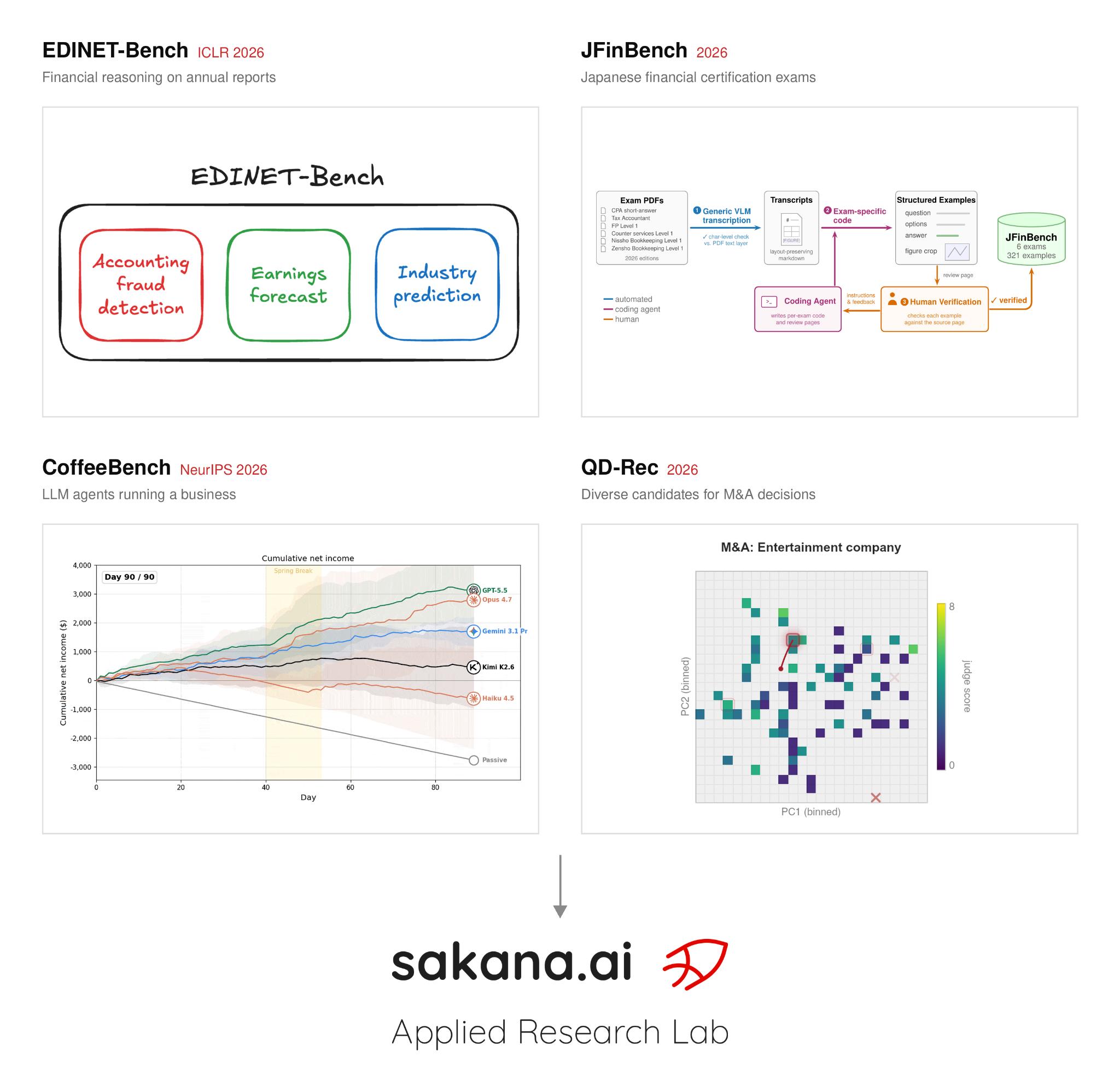 Some of the Applied Research Lab’s prior research.
One of the Lab’s initial focuses will be on agent-based modeling, building on our existing work in this area. Shachi (ALIFE 2026) provides a simulation framework with LLM-powered agents with modular minds (configuration, memory, and tools), used to study how collective behavior, such as a market’s reaction to a tariff shock, emerges. CEDAR (ALIFE 2026) complements this by using LLM-guided tree search to discover and refine the structure of complex systems toward desired behaviors. The Lab also draws on advances across the company: ShinkaEvolve (ICLR 2026) and AB-MCTS (NeurIPS 2025) for search, evolving and refining code such as a trading strategy. Related work includes The AI Scientist (Nature, March 2026), which automates research from hypothesis to experiment to paper.
Sakana AI has always held that progress comes through ideas rather than compute; at the Lab, we believe that advances come through understanding the structure of systems, scaling that understanding, and automating the building blocks of the process. Markets are the oldest form of collective intelligence, hence a natural subject for Sakana AI. And markets answer back: reflexivity is a feature of human systems.
Join the Sakana AI Applied Research Lab
The Lab is based at Sakana AI’s headquarters in Tokyo, one of the world’s great financial centers. We are building a small interdisciplinary team and would especially like to hear from two kinds of people:
- Researchers from any quantitative discipline, such as physics, statistics, mathematics, or economics, who are driven by curiosity, program well in Python, and have done real research on real data. A PhD helps; a specialist background is not required.
- Engineers who build harnesses, such as data pipelines, simulation infrastructure, and agent orchestration at scale, and who want their systems tested against the hardest data there is.
If this sounds like you, we would love to hear from you. For now, the way in is through our Member of Technical Staff (MTS) internship or Visiting Researcher programs. Apply on our careers page and mention your interest in the Lab.
We also welcome partners: institutions, investors, policy-makers, and firms with hard real-world problems. Get in touch.
Japanese
複雑な現実のシステムをAIで理解する:Sakana AI Applied Research Labを設立
Read in English
Sakana AIは、社内に新しい研究組織「Sakana AI Applied Research Lab」を設立しました。Applied Research Labは、当社の研究を大規模で複雑な現実のシステムに応用する研究グループです。システムへの理解を深めること、そしてその成果をお客様に提供することを目指します。
最初のプログラムは金融・経済分野で、今後ほかの分野にも広げていく予定です。
市場や経済のような複雑系は、LLMを使ったエージェントをひとつ用意すれば扱えるものではありません。システムを構成する単位や単位同士のつながり、ある部分の変化が他の部分にどう伝わるかを捉えたうえで、システムとしてモデル化する必要があります。
これまでは、どの問いを立てるか、何をモデル化するか、結果をどう評価するかを人間の専門家が決めてきたため、研究のスピードは人間の作業量に左右されてきました。現在のエージェント型AIは、モデルを大規模に実装・検証・改良できるようになりましたが、どの問いが重要かを判断するのはまだ得意ではありません。Applied Research Labでは、人間の知識を土台にしてAIの能力を組み合わせることを中心テーマとしています。
最初のプログラム
ファイナンスは資産価格を、経済学はその背後にある経済システムを、それぞれ研究対象としてきました。AIを使うと、企業や取引といった細かい粒度で、ほぼリアルタイムにこの2つを結びつけられるようになります。そうなると、資産価格は経済の状態を映す指標として読めるようになります。Applied Research LabのComputational Finance and Economics(COFE)プログラムでは、市場で観測される価格と、その背後にある実体経済の両方を研究対象とします。
これまでの研究
Applied Research Labは、2023年7月の創業以来Sakana AIが取り組んできた研究、たとえば科学的発見の自動化、進化的探索、エージェントベース・シミュレーション、評価手法などをベースにしています。
とくに関係が深いのが、金融・経済分野でのこれまでのプロジェクトです。EDINET-Bench(ICLR 2026)は、日本企業の有価証券報告書10年分を使い、シングルターン・非エージェント型の設定でLLMの金融推論能力を評価するベンチマークです。会計不正の検知や業績予測では、最先端のLLMでもロジスティック回帰をわずかに上回る程度という結果になりました。JFinBenchは、公認会計士試験や税理士試験など、日本の6つの金融資格試験の2026年版をもとにLLMを評価するベンチマークです。有限責任 あずさ監査法人と共同開発したCoffeeBench(NeurIPS 2026)は、コーヒーのサプライチェーンを模したマルチエージェント経済の中で、LLMエージェントが90日間黒字で事業を運営できるかを検証します。QD-Recは、M&Aのような意思決定に品質多様性(Quality-Diversity)探索を応用し、単一のランキングではなく、多様で妥当な候補群を提示する手法です。
Applied Research Labの前身となる研究の一部。
当面の重点テーマのひとつは、これらの研究をもとにしたエージェントベース・モデリング(ABM)です。Shachi(ALIFE 2026)は、設定・記憶・ツールからなるモジュール型のLLMエージェントによるシミュレーション・フレームワークで、関税ショックに対する市場の反応のような集団的な振る舞いがどう生じるかを調べるために使います。CEDAR(ALIFE 2026)は、LLMを使った木探索によって複雑系の構造を見つけ、目的の振る舞いに近づくよう改良していく手法です。このほか、トレーディング戦略などのコードを進化的に改良するShinkaEvolve(ICLR 2026)やAB-MCTS(NeurIPS 2025)、仮説立案から実験、論文執筆までを自動化するAIサイエンティスト(Nature、2026年3月)など、社内のさまざまな研究成果も活用します。
Sakana AIは創業時から、AIの進歩には計算資源の量だけでなく、新しいアイデアが重要だと考えてきました。Applied Research Labでは、システムの構造を理解し、その理解を大規模に活用し、研究プロセスの一部を自動化することに取り組みます。市場は多くの参加者の判断が集まって成り立つ仕組みで、私たちの研究テーマとも相性がよい対象です。また市場は、それを観察し、働きかける人々の行動によって変化していきます。この再帰性(reflexivity)は、人間がつくるシステムに特有の性質です。
Applied Research Labへの参加
Applied Research Labでは、東京で少人数の学際的なチームをつくっています。特に次のような方を募集しています。
- 物理学、統計学、数学、経済学などの定量的な分野で実データを使った研究経験があり、Pythonが得意な研究者(博士号があれば望ましいですが、分野は問いません)
- データパイプライン、シミュレーション基盤、大規模なエージェント・オーケストレーションなどの構築経験があり、それを実データで試してみたいエンジニア
現在はMember of Technical Staff(MTS)インターンシップまたはVisiting Researcherとして募集しています。採用ページから応募し、Applied Research Labに関心がある旨を書き添えてください。
研究機関、投資家、政策立案者、企業の皆様からのお問い合わせもお待ちしています。