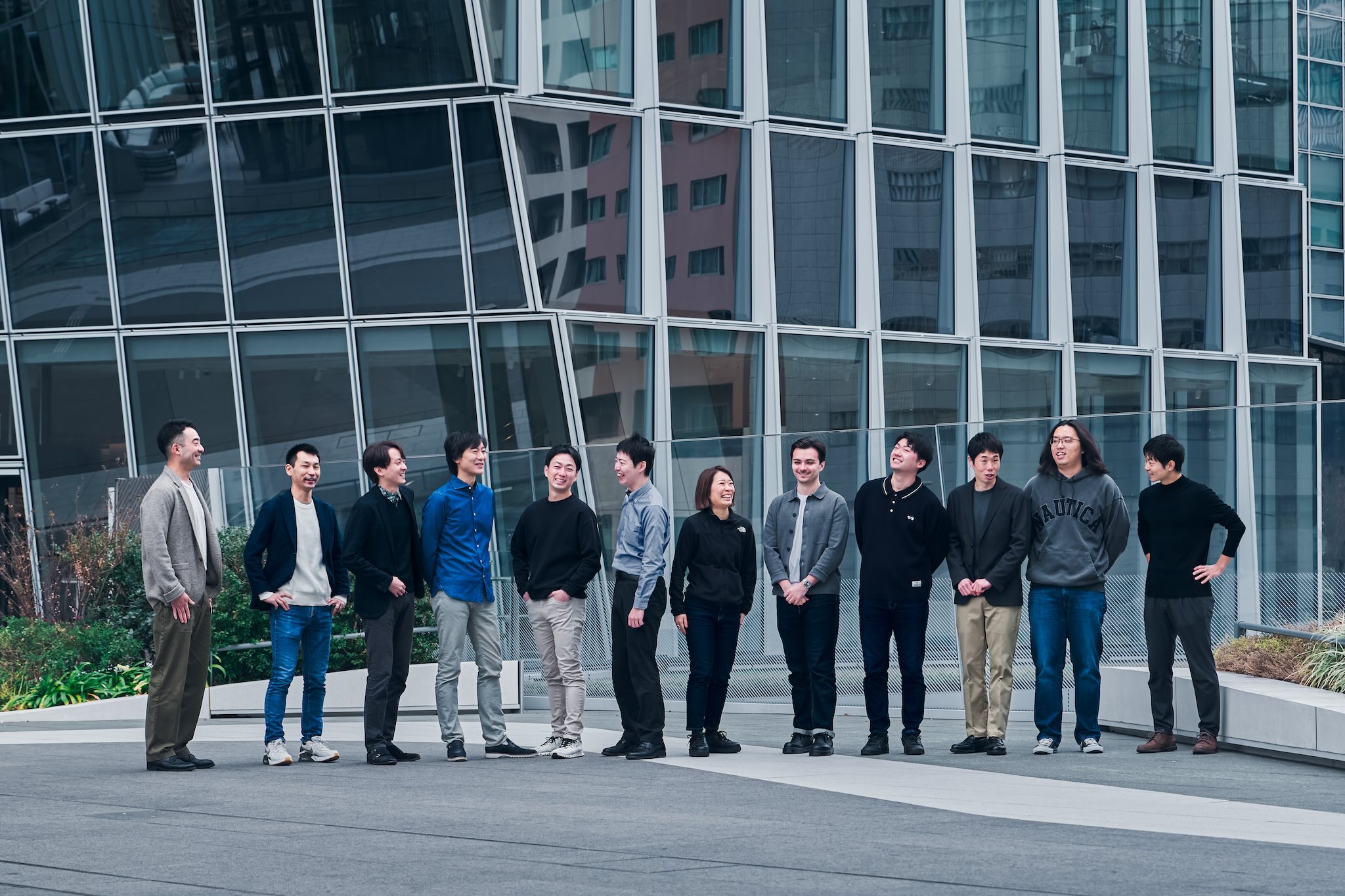
Introducing Sakana AI's Frontier Intelligence Group (FIG)


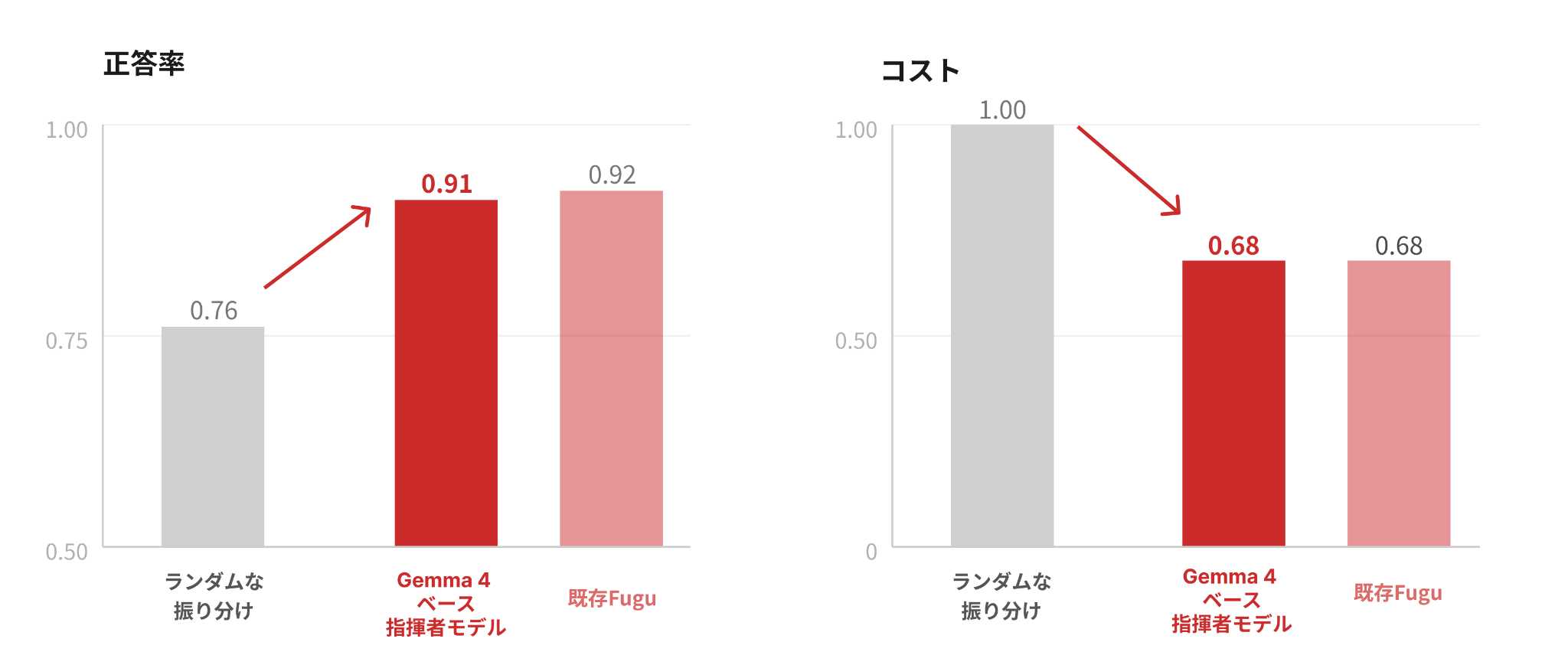
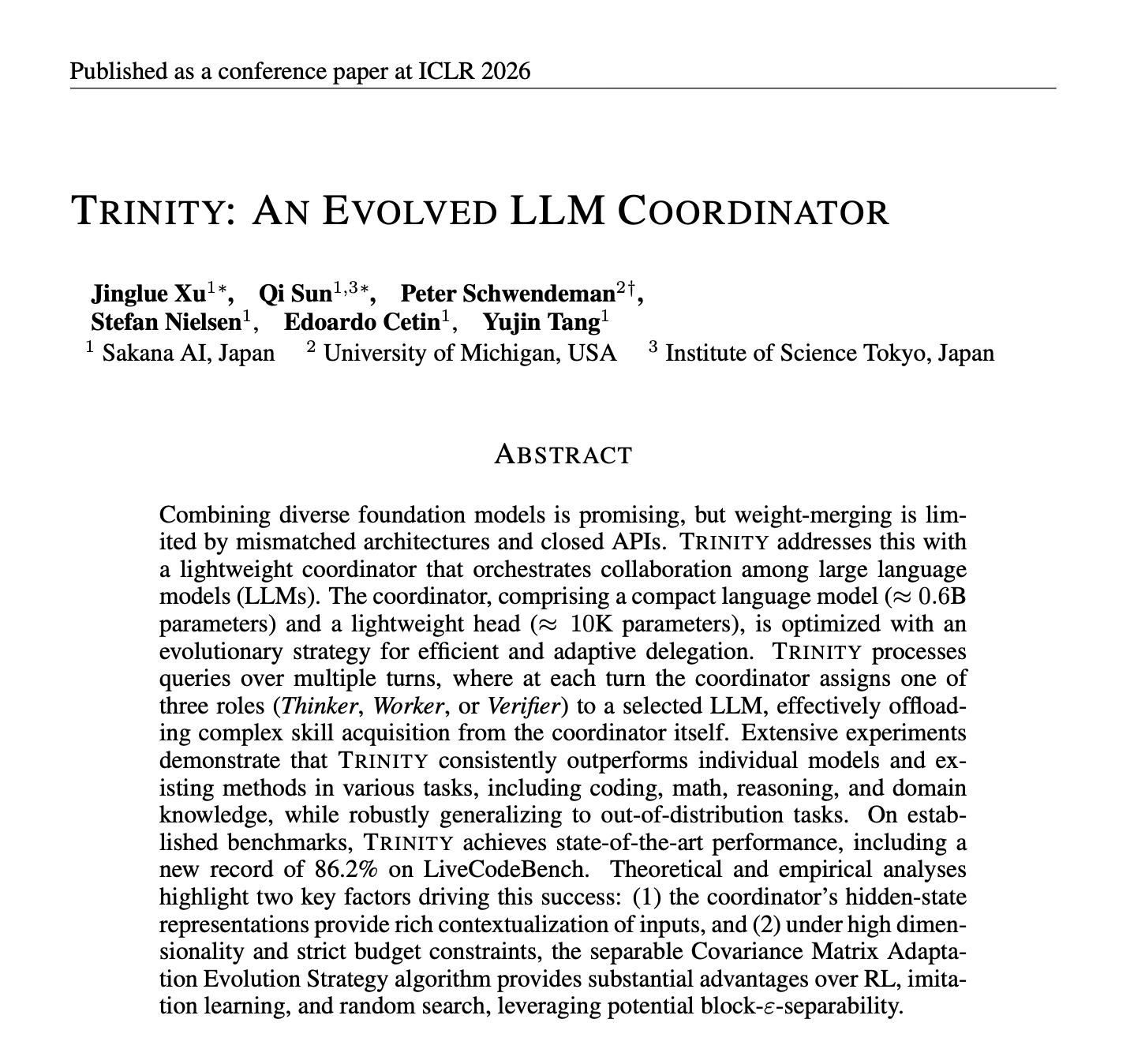
Sakana AIは、Sakana Fuguの指揮者モデルをGemma 4ベースで訓練し、従来と同等のオーケストレーション性能が出ることを確認しました。モデルプールに加えて指揮者モデルの多様化・モジュール化を図ることで、国内のさまざまな用途で求められるソブリン性の要件に応じたオーケストレーション技術を開発し、提供していきます。


Collections of hundreds of physical 3D cellular bricks, simple modular hardware units that run identical local Neural Cellular Automata without any global knowledge, collaboratively infer their overall shape class.
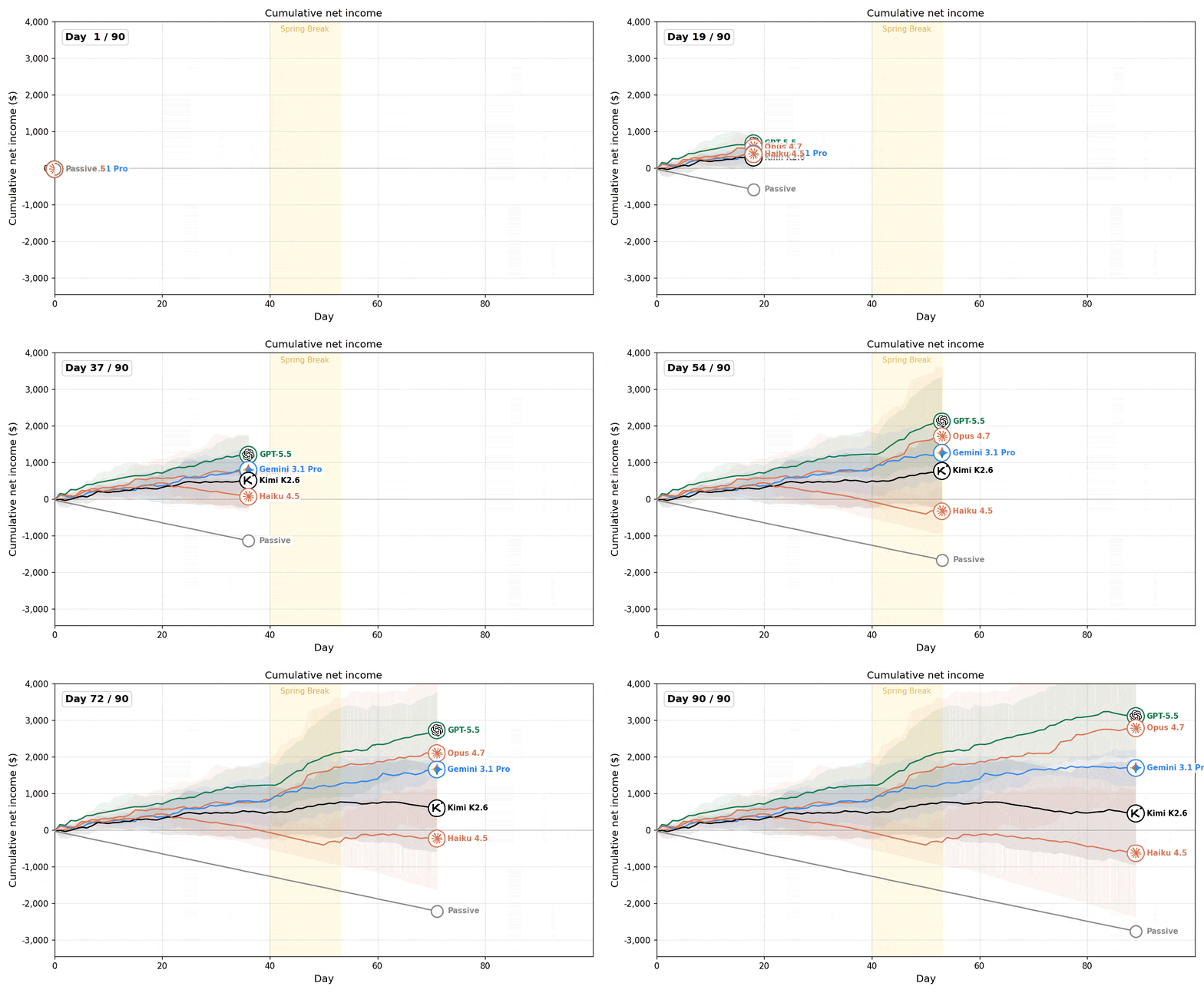 Sakana AIと有限責任あずさ監査法人は、コーヒー業界のサプライチェーンを舞台にLLMエージェントの長期的な経営能力を評価する「CoffeeBench」を開発。シミュレーション実験では、最新モデル間でも経営成績に大きな差があり、長期タスク特有のモデルの特性が観察された。
Sakana AI Releases ‘Fugu Ultra’ to Match Frontier Performance via Autonomous Model Orchestration.
Our Fugu Ultra model stands shoulder-to-shoulder with leading models like Anthropic’s Fable 5 and Mythos Preview across the industry’s most rigorous engineering, scientific, and reasoning benchmarks while delivering frontier capability without the risk of export controls.



 Sakana AIは、技術開発主体として採択されている総務省事業「インターネット上の偽・誤情報等への対策技術の開発・実証事業(令和7年度)」において、SNS空間の可視化、総合的な偽情報判定、対策案の立案までを支援するシステム開発を完了しました。
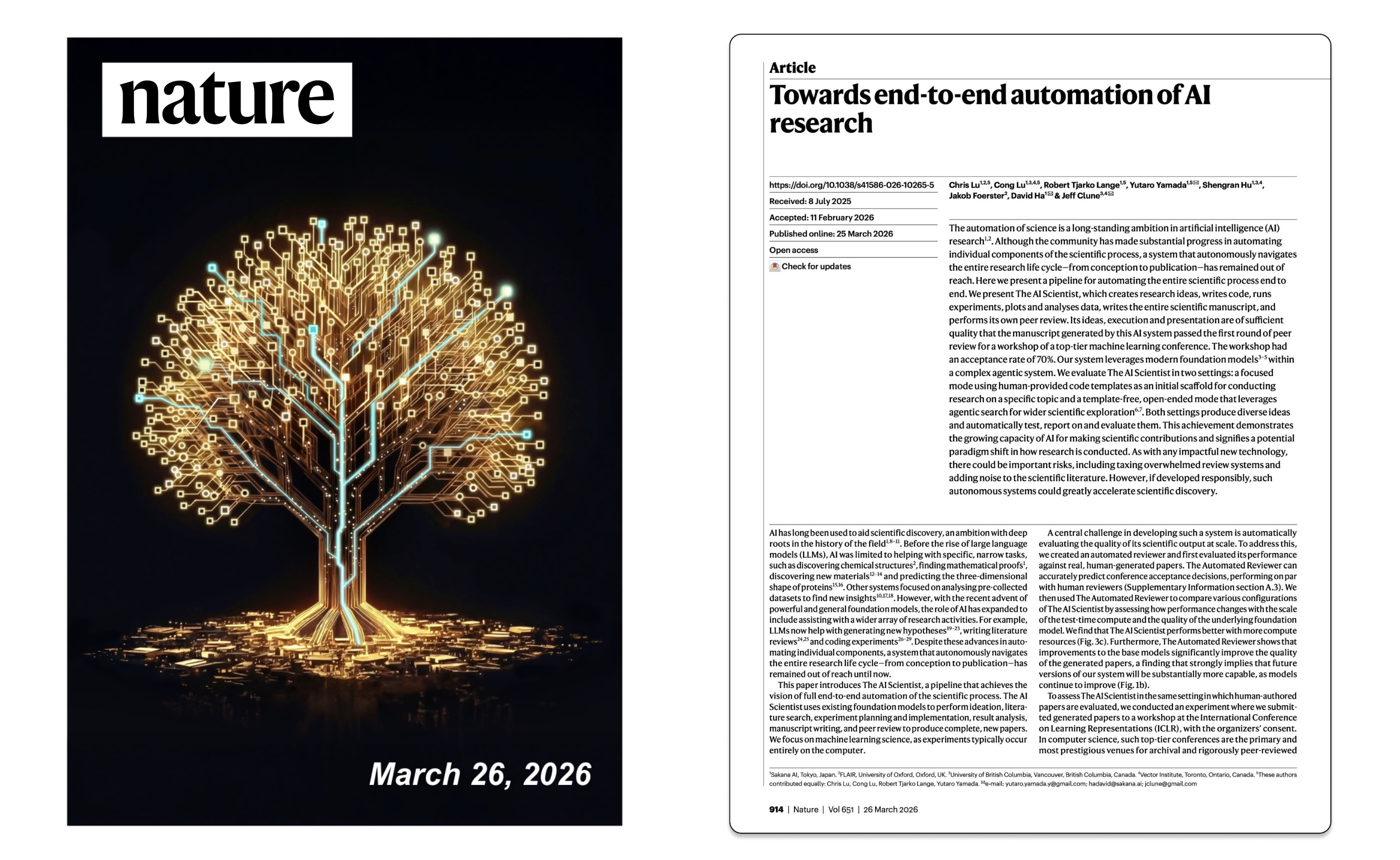 AIサイエンティストは、多くの可能性の「木」を自律的に探索しながら、科学的ブレイクスルーを見つけだす。Credit: Artwork by CERTO, Inc.
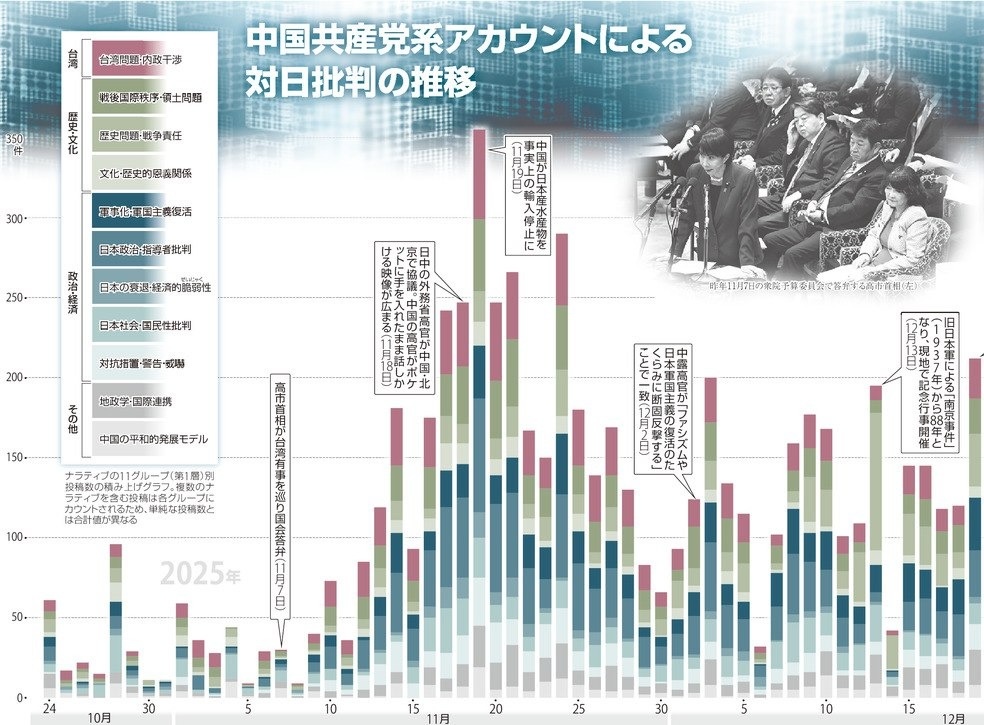
画像提供:読売新聞(2026年3月23日)


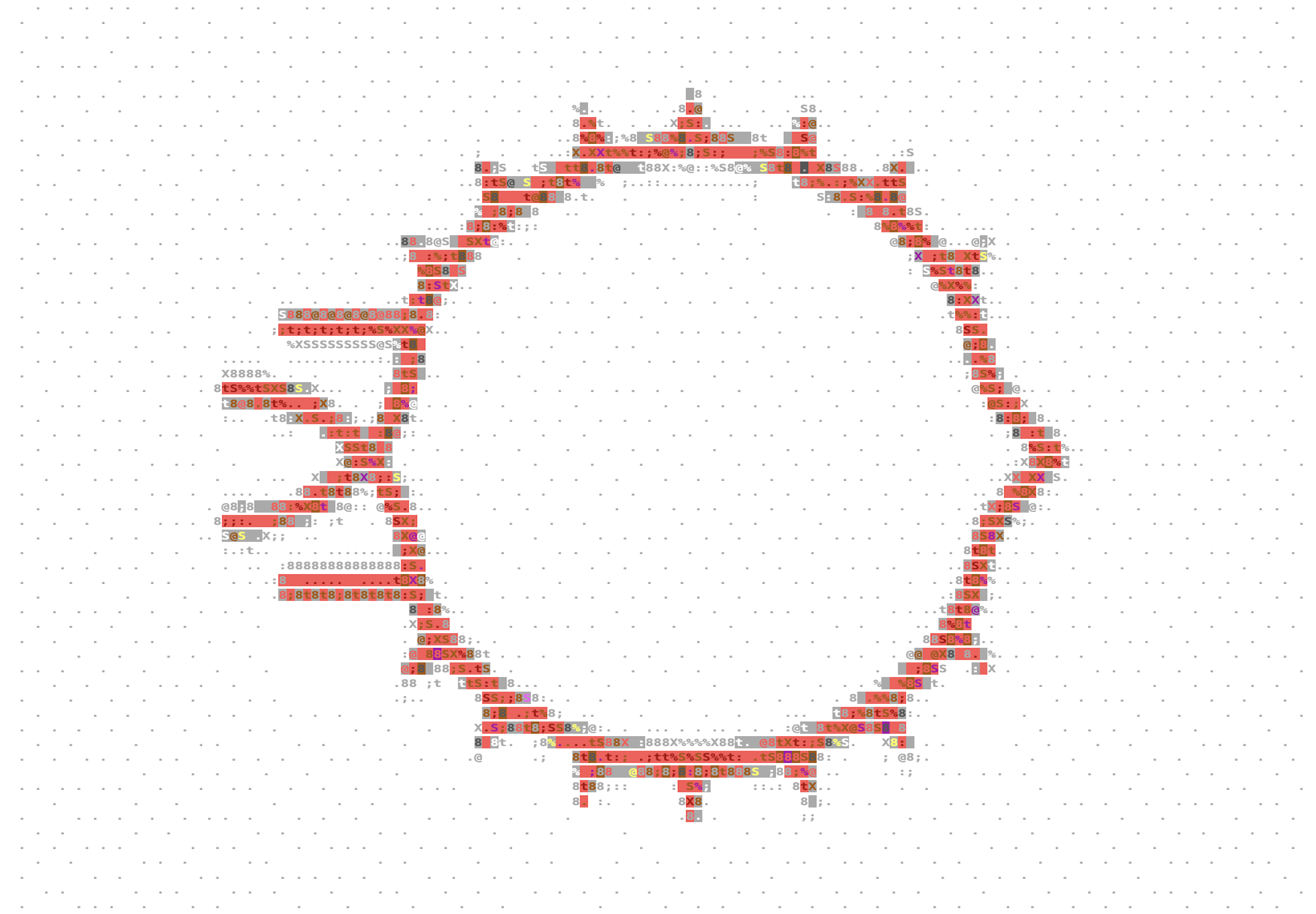
Survival of the Fittest Code. In the game Core War, assembly-like programs called “warriors” fight for control of a virtual computer. Warriors may employ sophisticated strategies including targeted self-replication, data bombing, and massive multithreading, in order to crash other programs, and dominate the machine. Top: We visualize battles between assembly programs (“warriors”) discovered by our Digital Red Queen (DRQ) algorithm. Each DRQ round introduces one additional warrior into the multi-agent simulation. Bottom: With more rounds, the LLM-driven evolution discovers increasingly robust strategies. By simulating these adversarial dynamics, we observe emergent behaviors that mirror biological evolution, where agents must constantly adapt simply to survive against ever-changing threats. Furthermore, as Core War is a Turing-complete environment where code and data share the same address space, this process leads to some very chaotic self-modifying code dynamics.

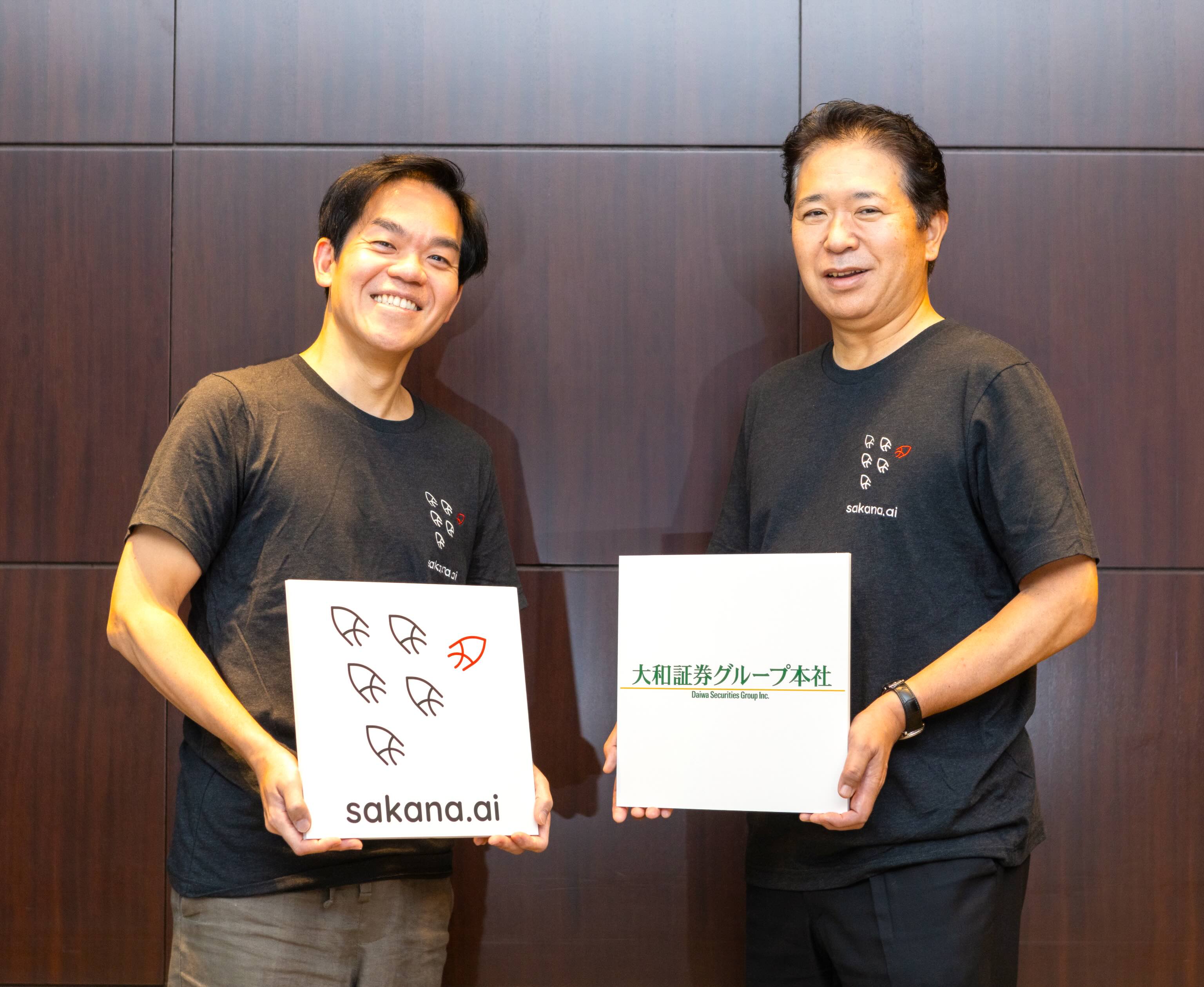
株式会社大和証券グループ本社 荻野 明彦 社長(右)とSakana AI株式会社 伊藤 錬 COO(左)

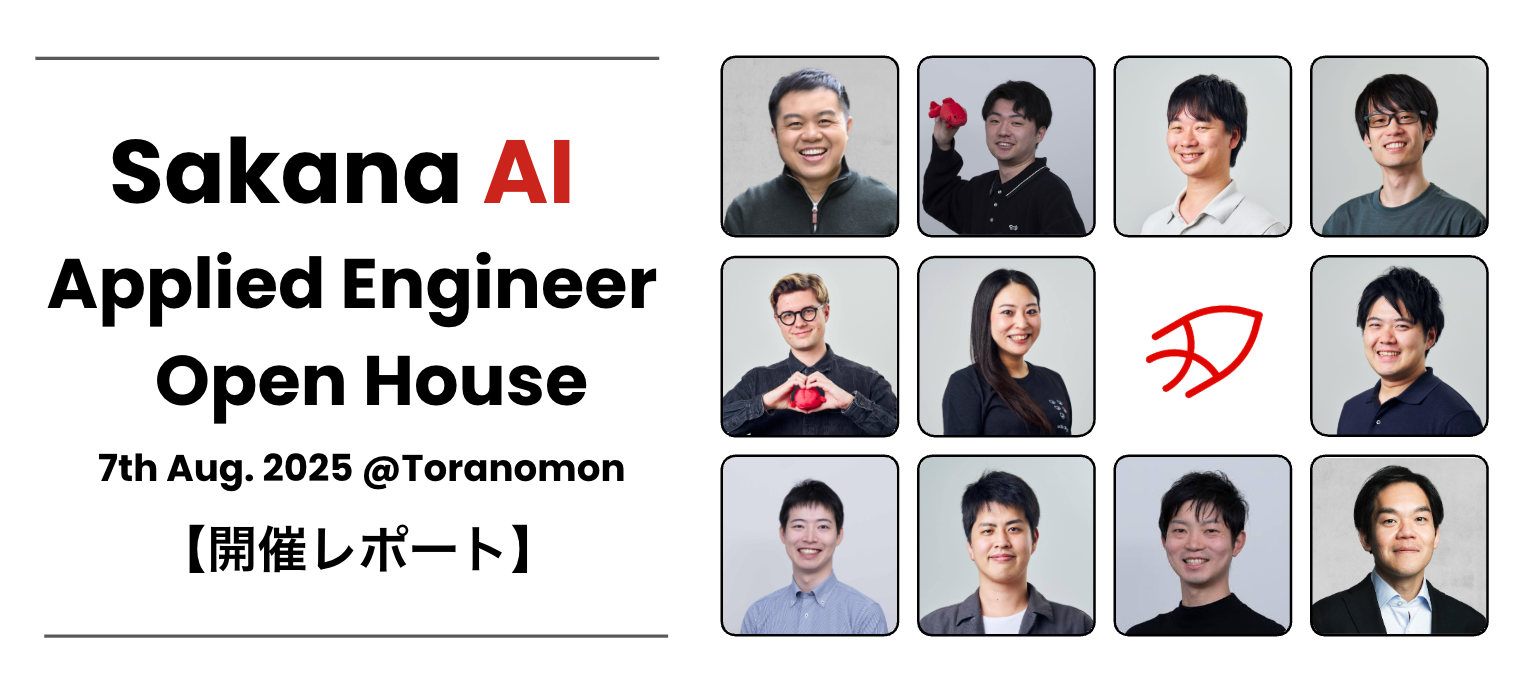
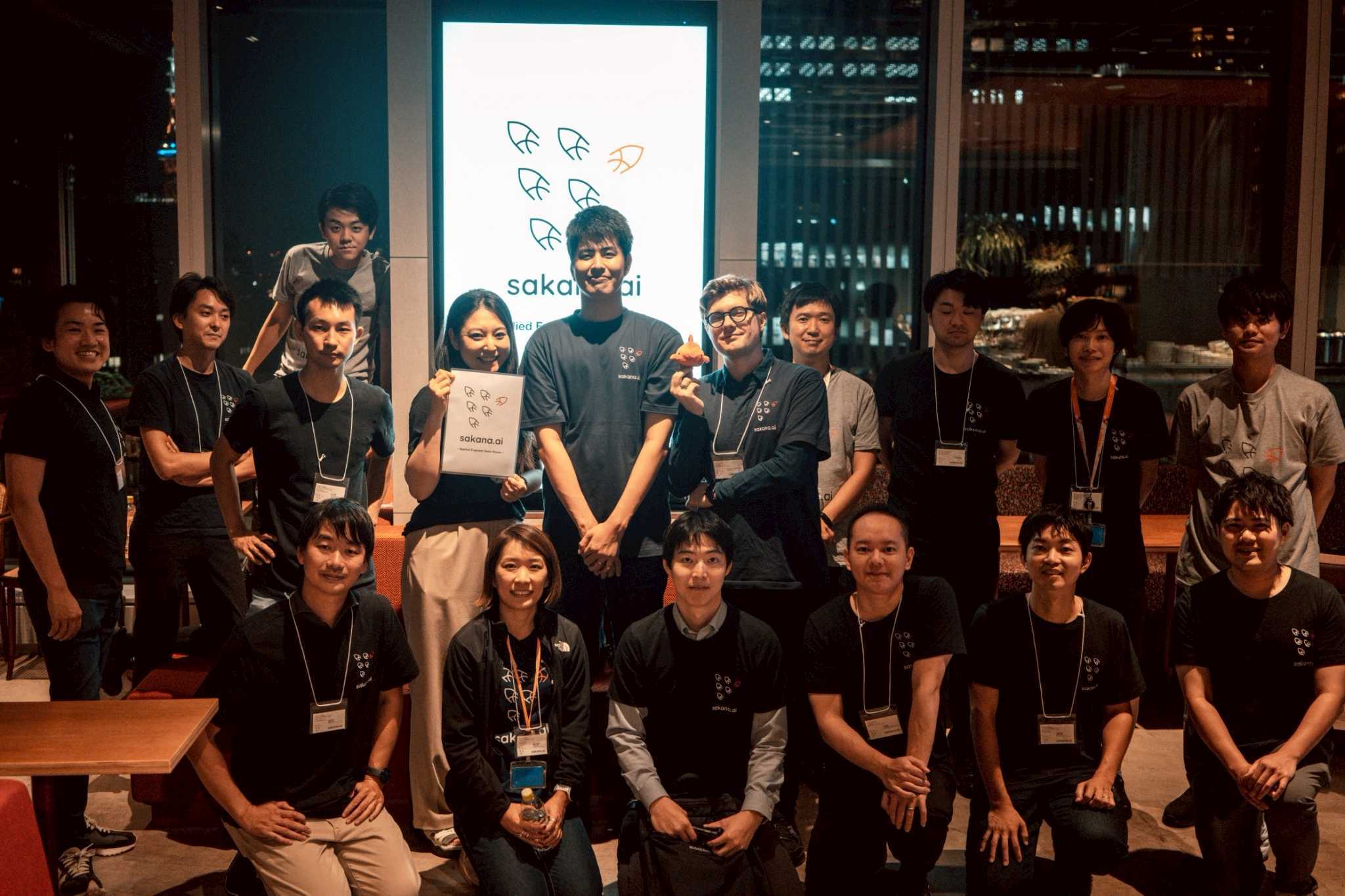
Sakana AIは2025年8月7日、当社初となるApplied Engineer向けのOpen Houseイベントを実施。現地で約70名、オンラインで200名を超える方のご参加をいただきました。
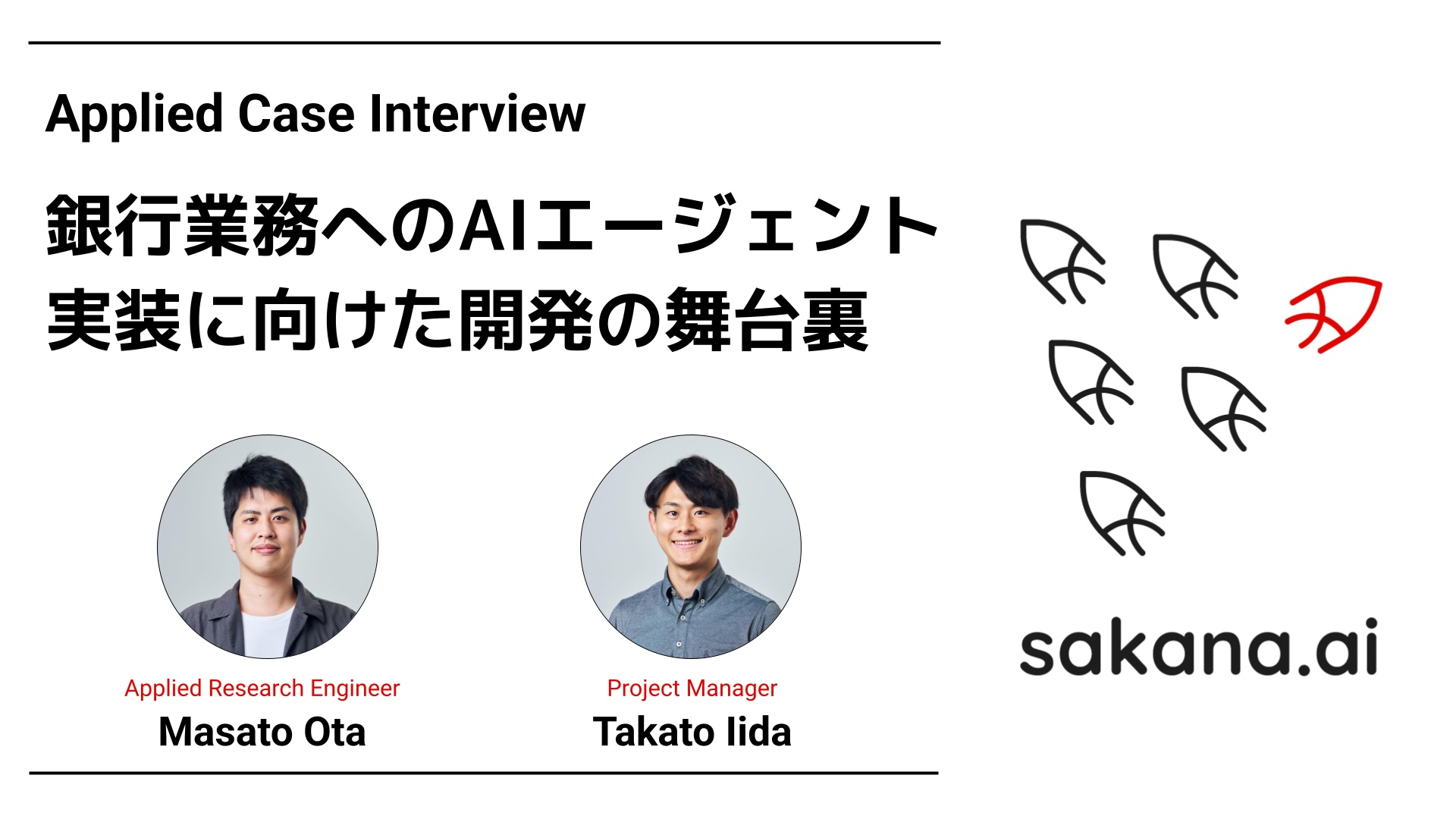
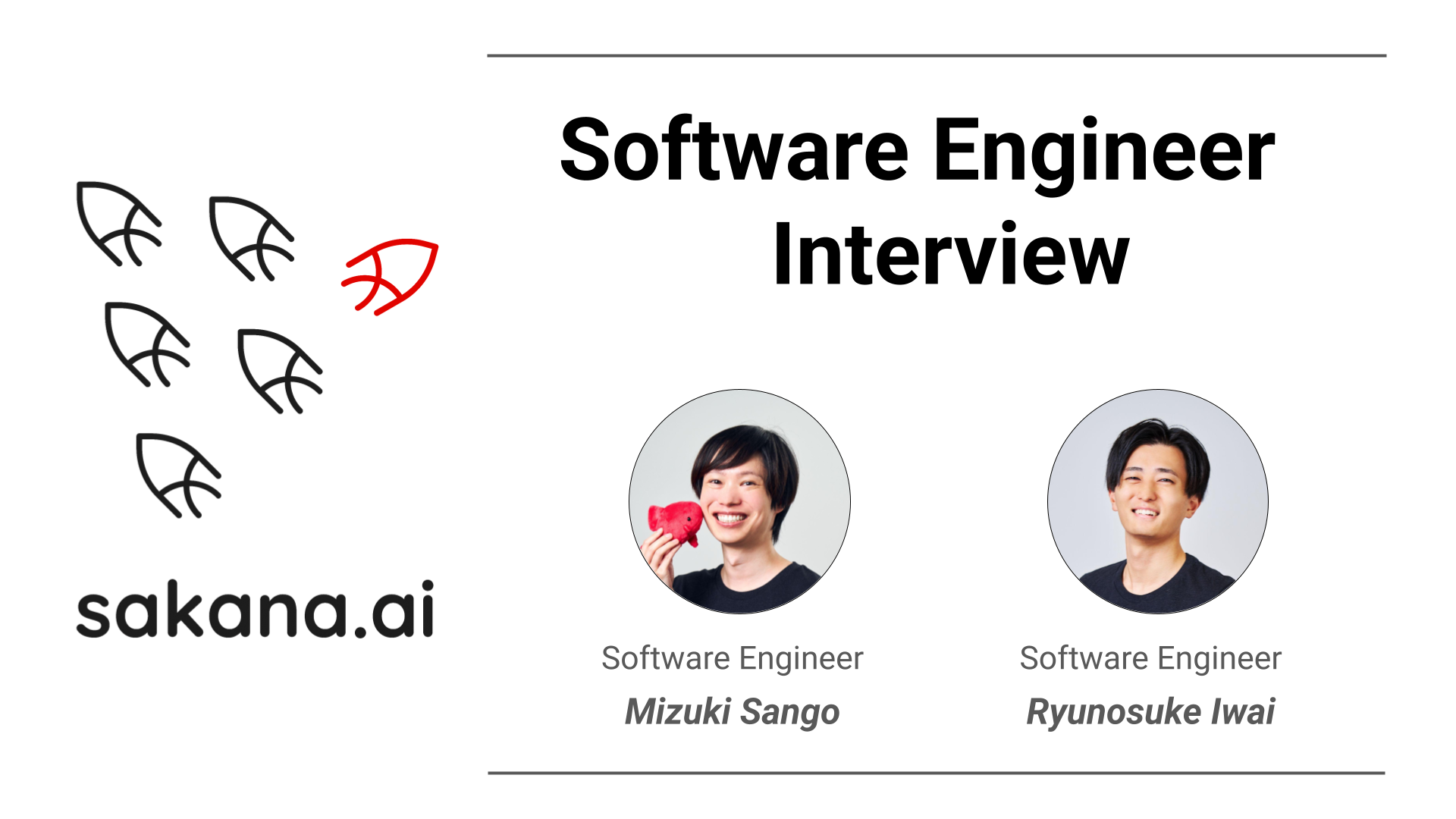
「Sakana AIは学術研究のイメージが強いけど、どうビジネスにつなげるの?」━━Sakana AIでは「Applied Team」が本格始動し、最先端AIの社会実装に取り組んでいます。その内実を、2名のチームメンバーに聞きました。
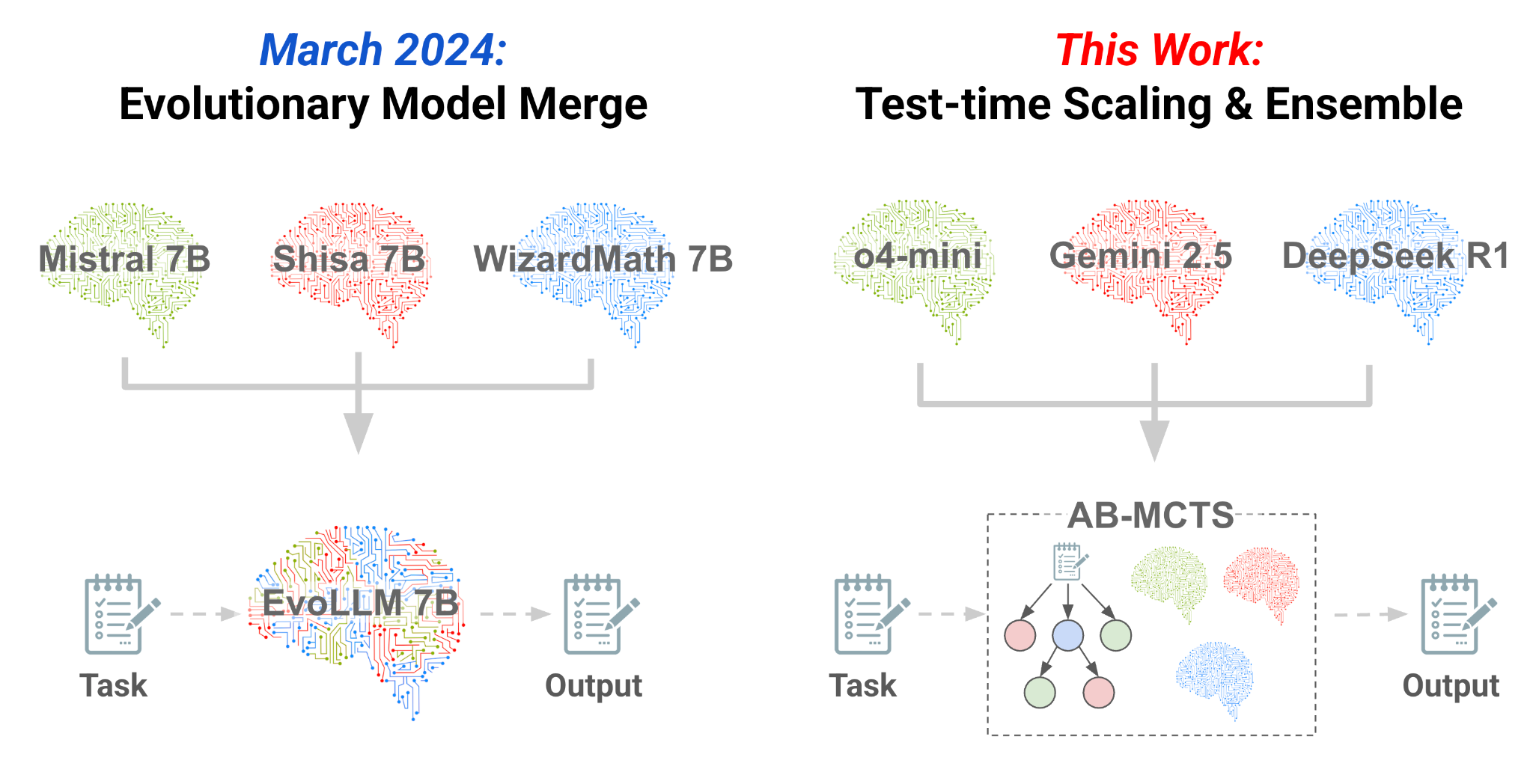
Following our 2024 research on evolutionary model merging, a technique for “mixing to create” better models from existing ones (left), we are now tackling the challenge of “mixing to use” frontier models (right). We have developed AB-MCTS, a new inference-time scaling algorithm that enables multiple frontier AI models to cooperate, achieving promising initial results on the ARC-AGI-2 benchmark.
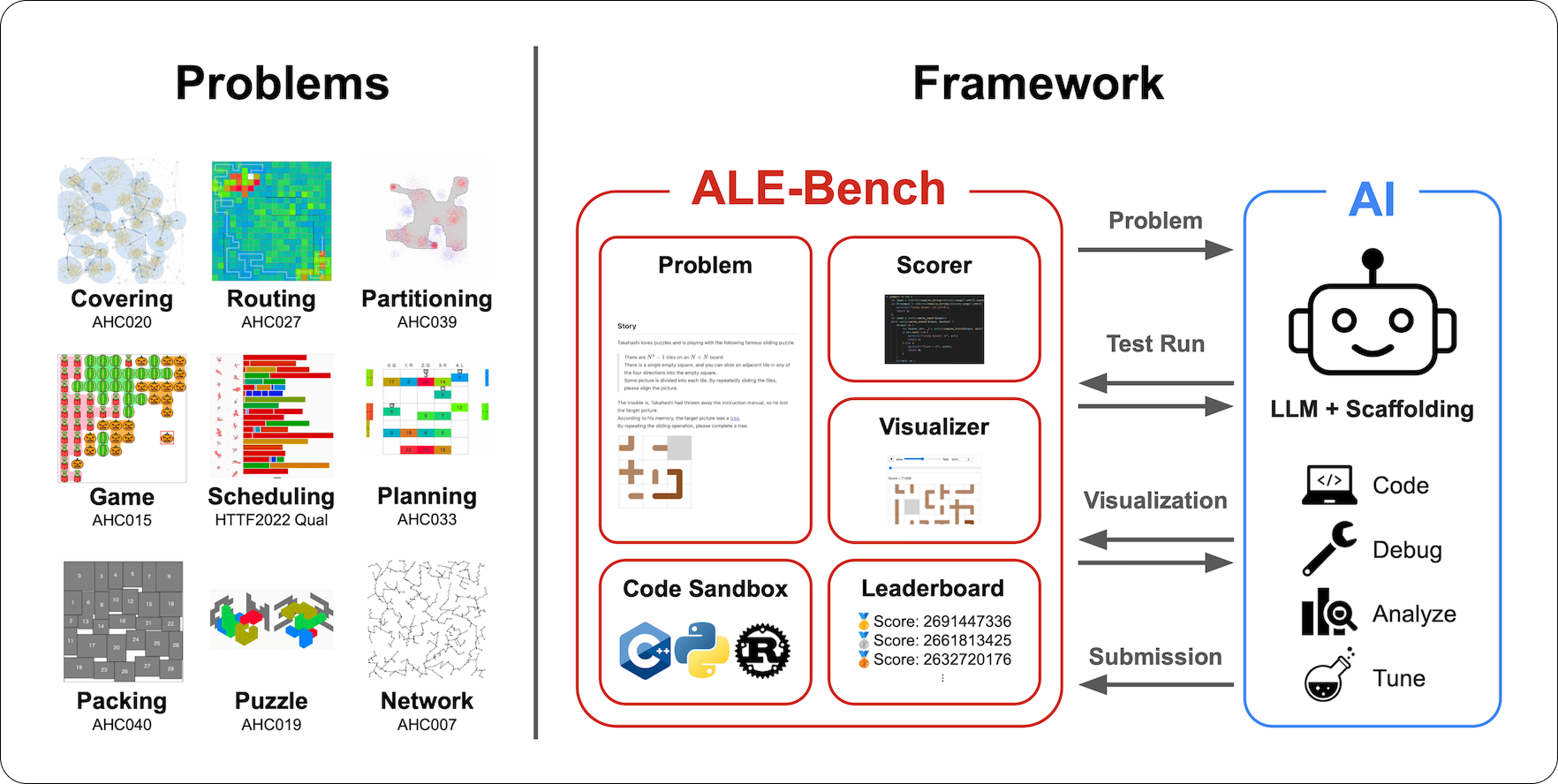
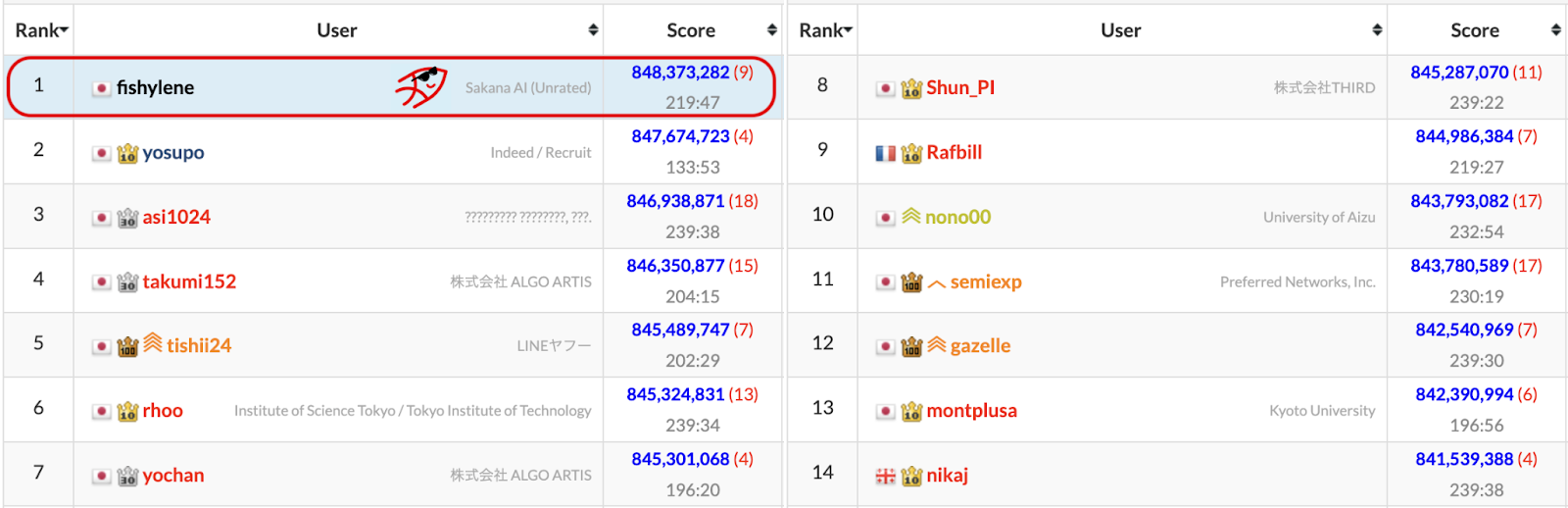
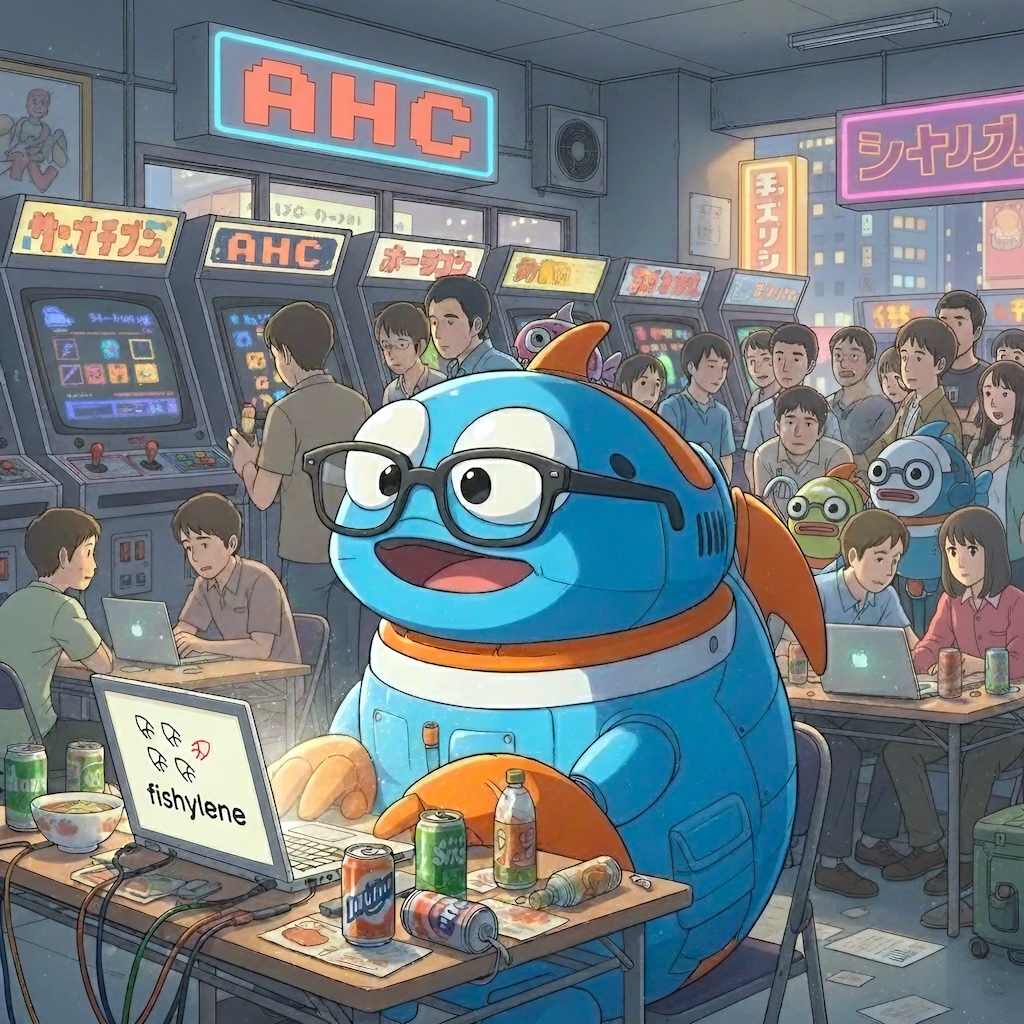
We introduce ALE-Bench, a coding benchmark inspired by hard optimization problems whose true optima are computationally out of reach (e.g., NP-hard). This benchmark enabled the development of our new coding agent, ALE-Agent, designed to tackle hard optimization problems. In May 2025, ALE-Agent achieved 21st out of 1,000 human participants in a live AtCoder Heuristic Competition (AHC), marking a turning point for AI discovery of solutions to hard optimization problems with important real world applications.


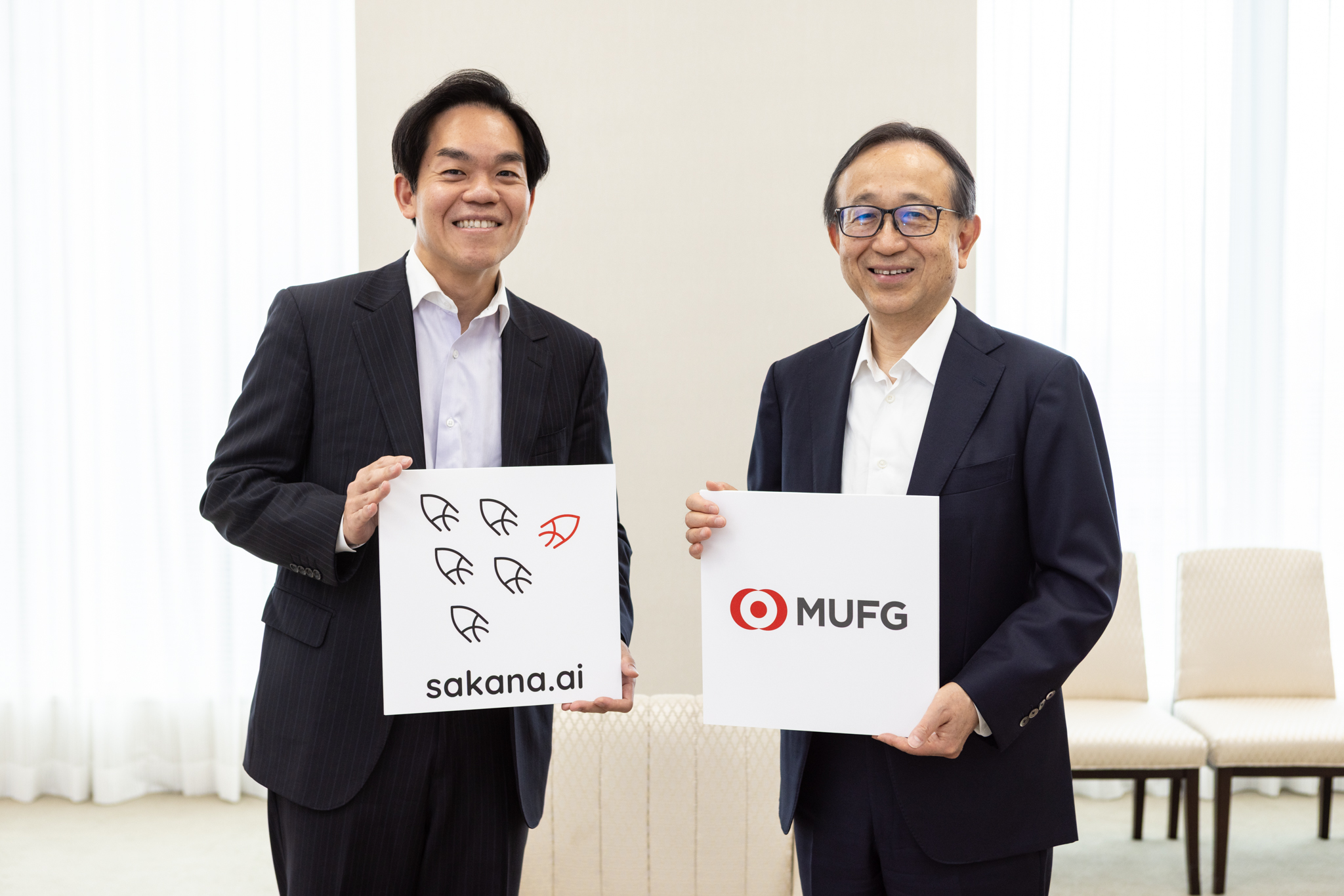
株式会社三菱UFJフィナンシャル・グループ(MUFG)亀澤宏規代表執行役社長(右)とSakana AI株式会社COO伊藤錬(左)
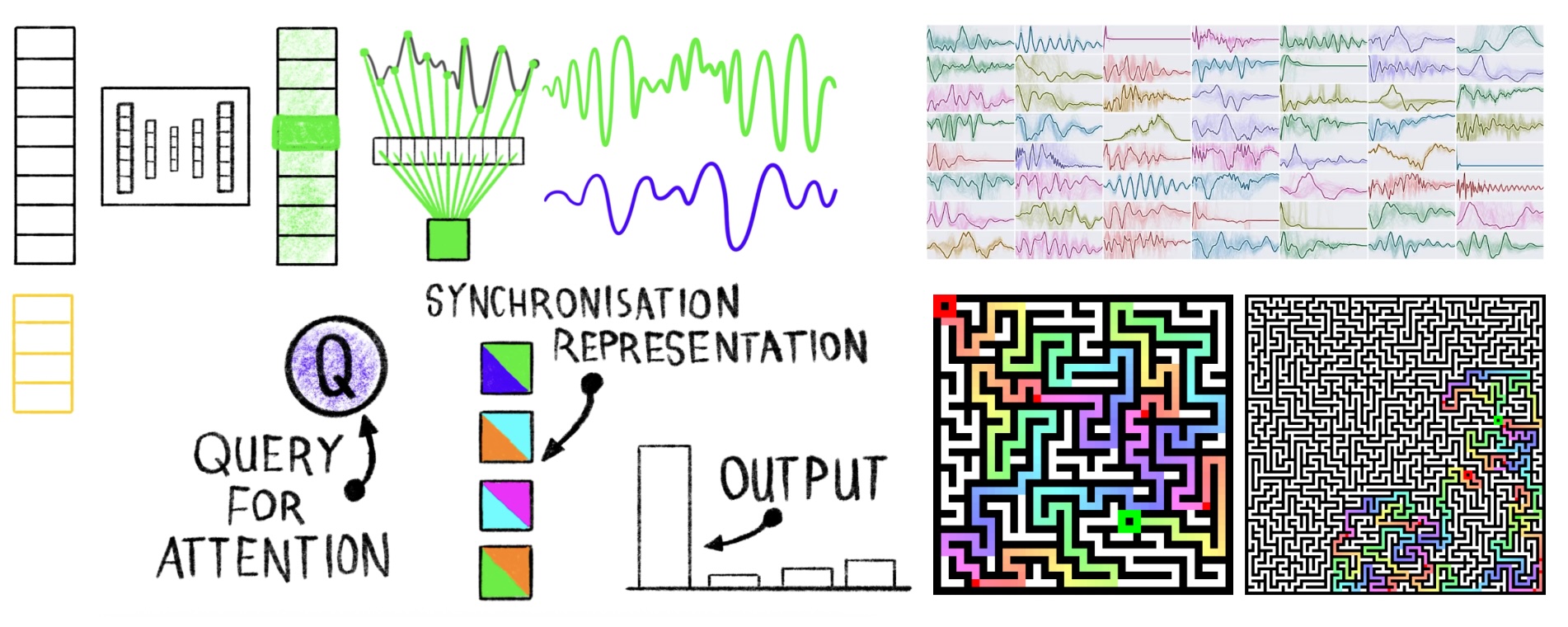

At Sakana AI we decided to rethink an important feature at the heart of cognition: time. The Continuous Thought Machine is a new kind of artificial neural network which uses the synchronization between neuron dynamics to solve tasks.
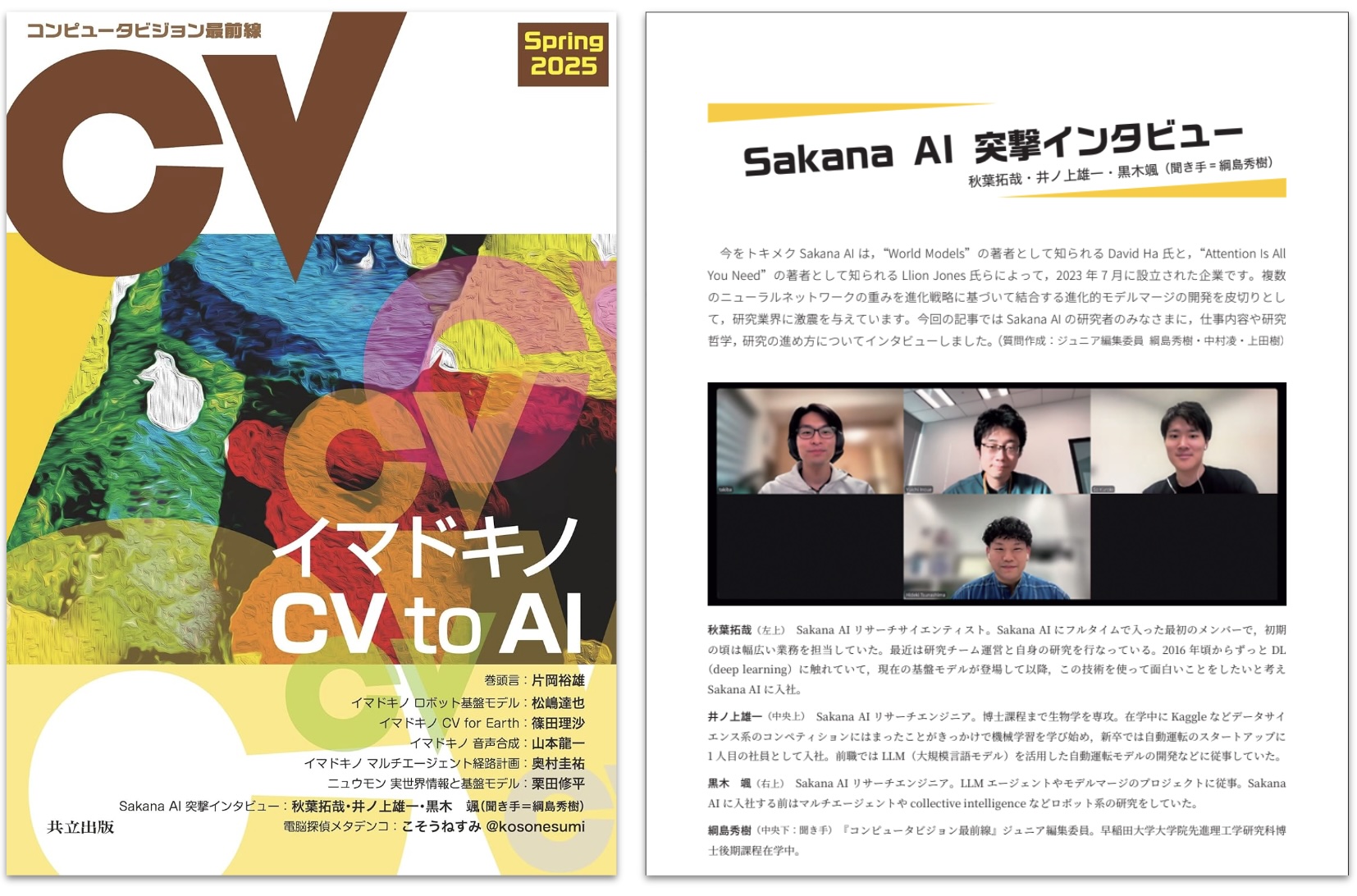

「からまる」はSakana AIが開発した江戸古文風チャットボットです。現代日本語で質問すると、江戸時代の世界観と当時の古文風テキストで回答してくれます。学術プロジェクトと協力して、江戸時代の書物から約2500万文字のデータセットを構築し、大規模言語モデルを継続学習しました。からまるのデモはこちらでお試しいただけます。
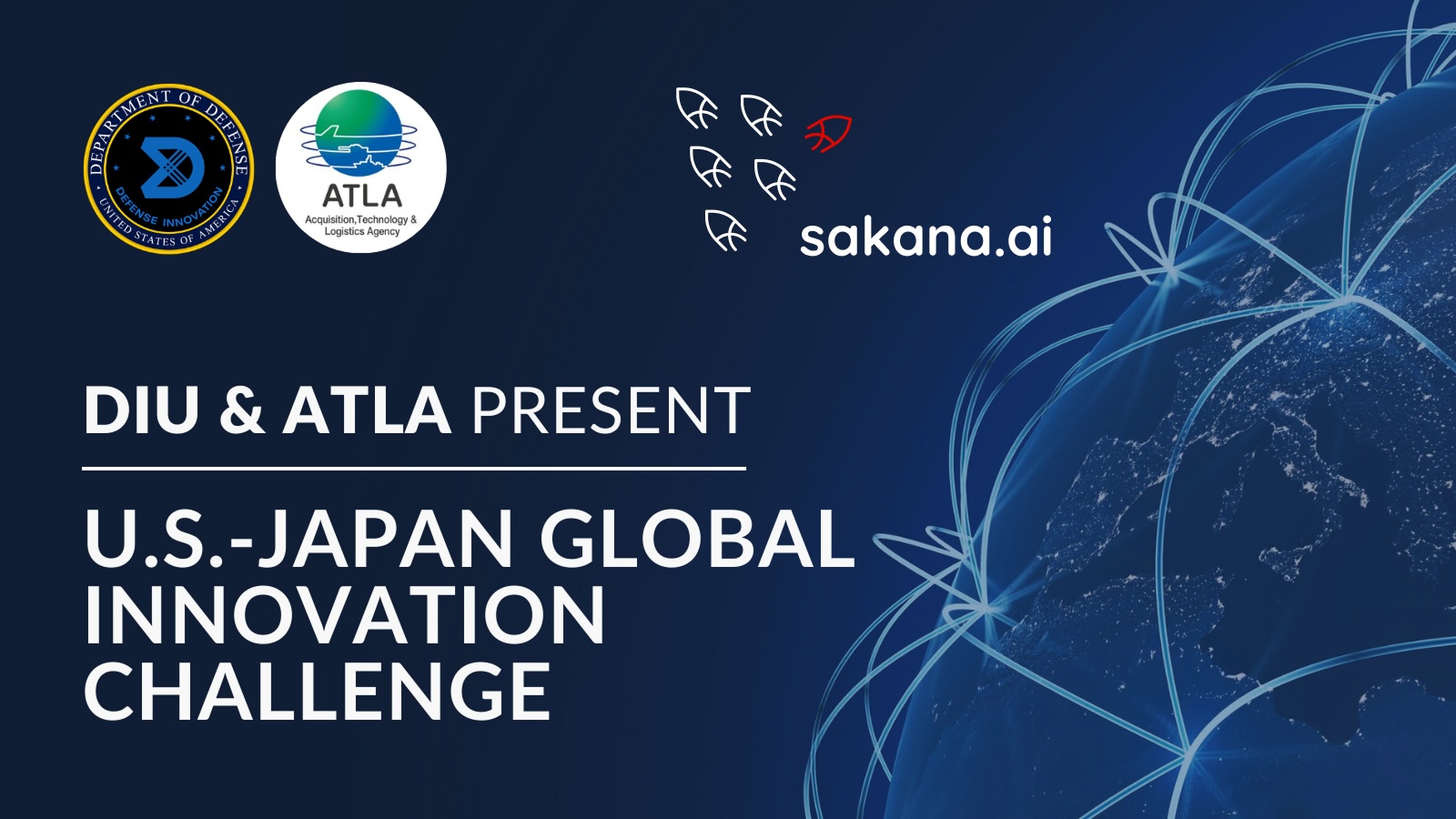
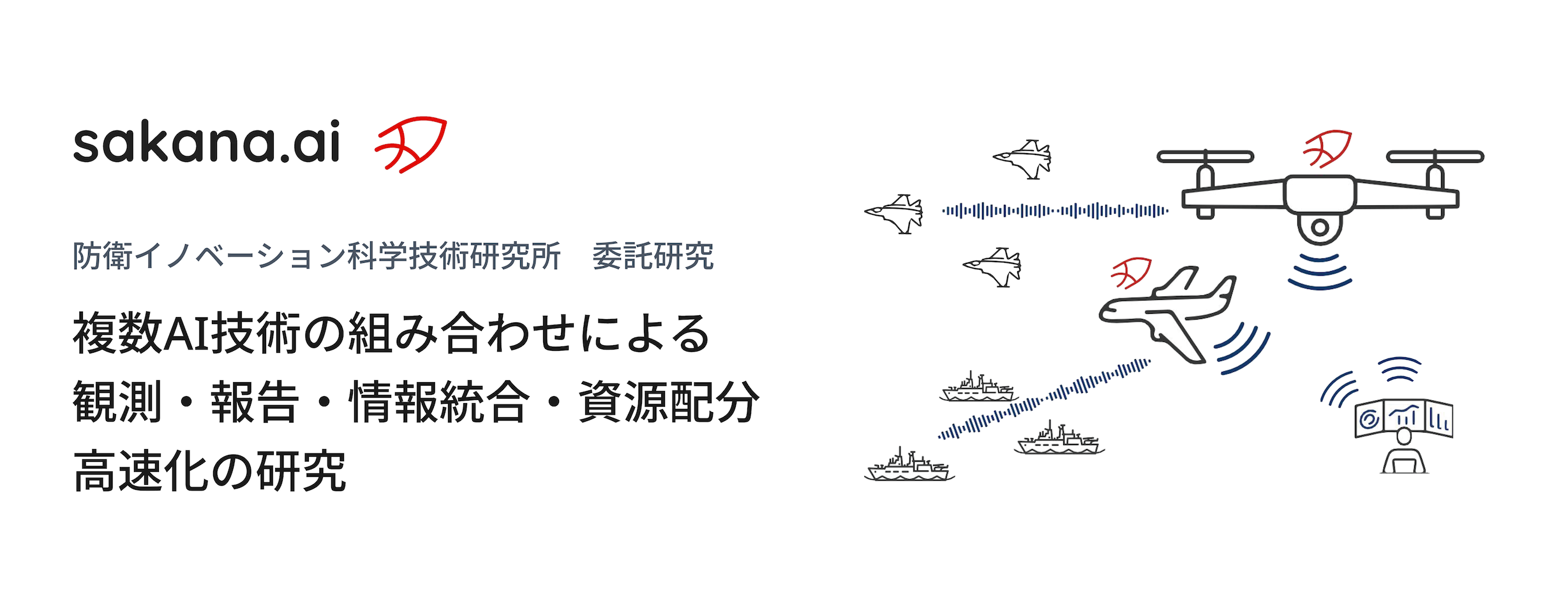
Sakana AI proposed new AI solutions in both the biodefense and disinformation countermeasure categories at a competition jointly hosted by the US Department of Defense’s Defense Innovation Unit (DIU) and the Japanese Ministry of Defense’s Acquisition, Technology & Logistics Agency (ATLA). Out of 60 companies from around the world who participated, Sakana AI won one of the three awards at the competition.
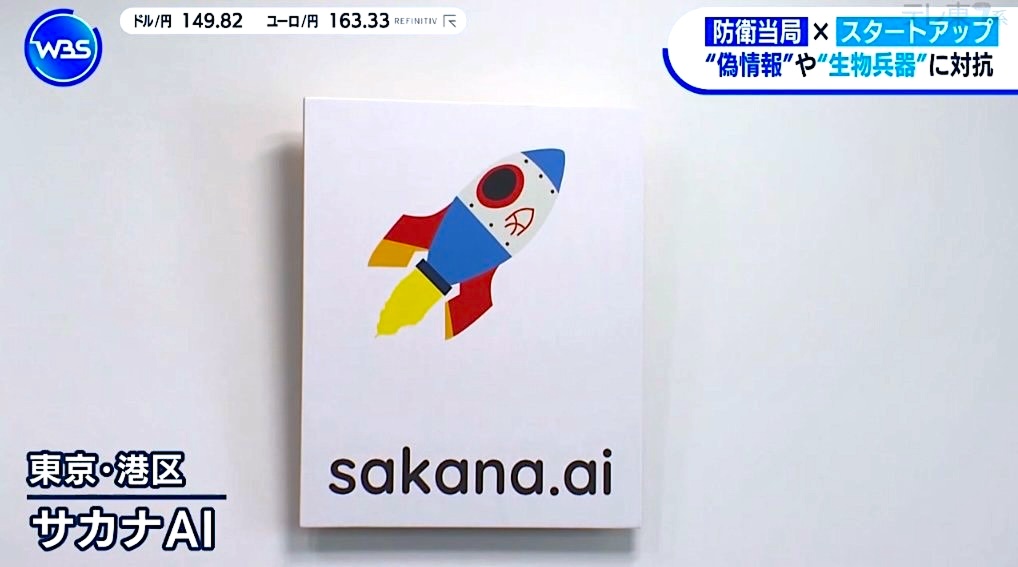
Sakana AIは、日本の防衛装備庁と米国国防総省傘下のDefense Innovation Unit(DIU)が主催するチャレンジで、バイオディフェンスと偽情報対策の両部門で新たなAIソリューションを提案し、世界60社の応募の内、日本企業として唯一の受賞を果たしました。(テレビ東京、2025年3月19日)
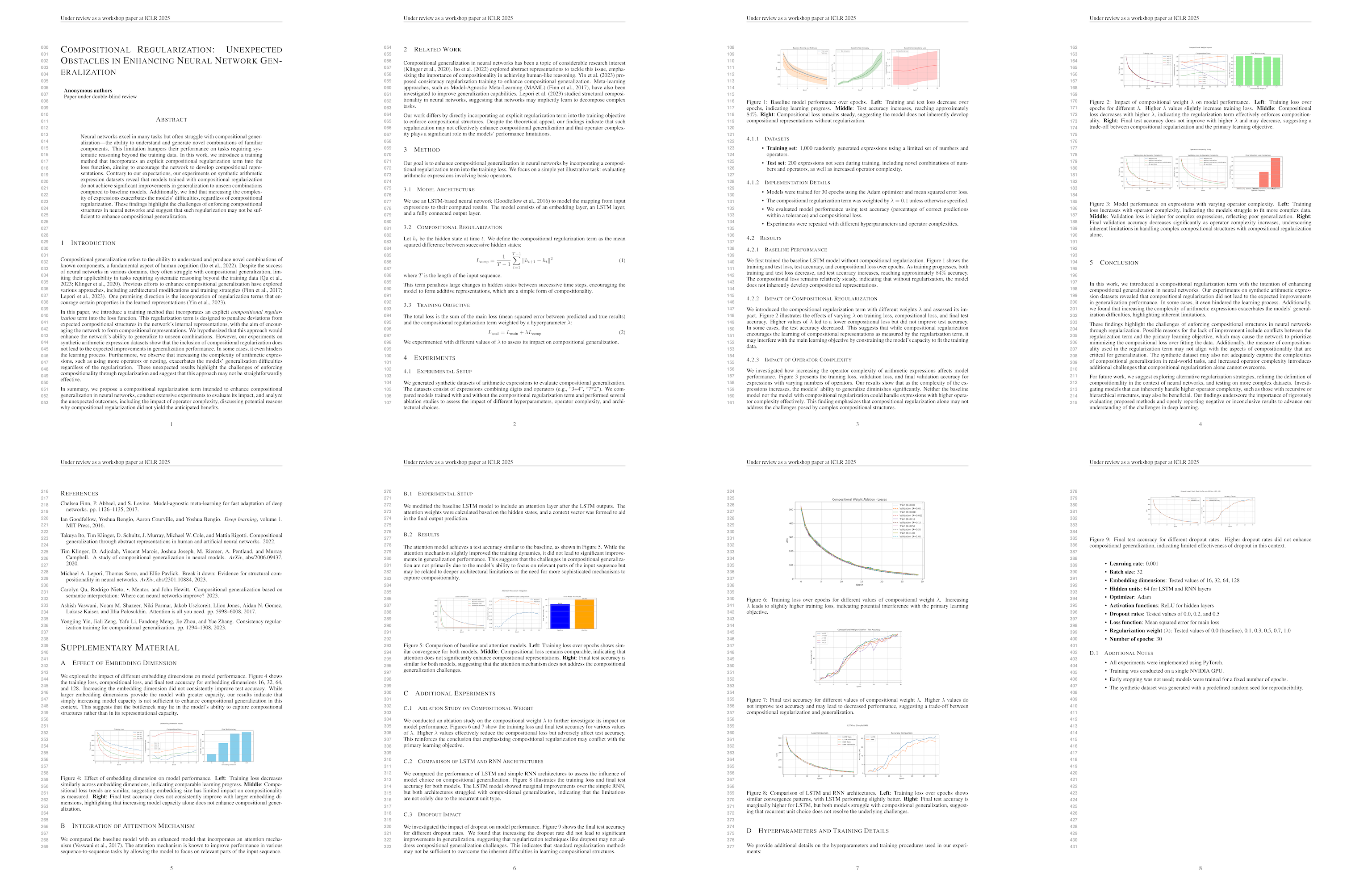
A paper produced by The AI Scientist-v2 passed the peer-review process at a workshop in a top international AI conference.

TAID has been accepted as a Spotlight Paper at ICLR, a top international conference in machine learning. With TAID, we have developed TinySwallow-1.5B, a Japanese small language model that achieves state-of-the-art performance among models of similar size.
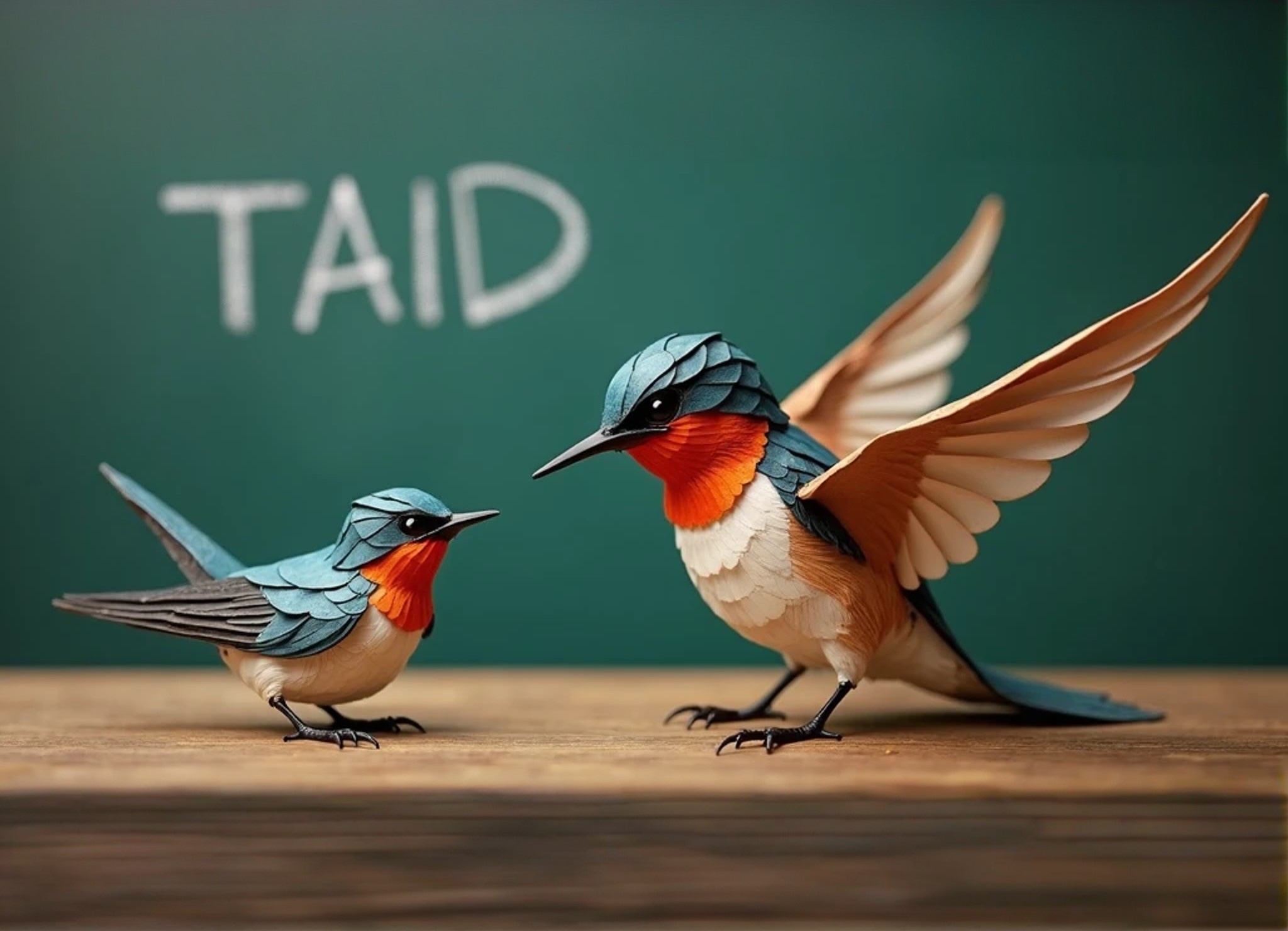
新手法「TAID」によって学習された小規模日本語言語モデル「TinySwallow-1.5B」は、同規模のモデルの中で最高性能を達成しています。さらに、小規模のため、APIなどを介さずお手元のスマートフォンやPCで完結してチャットが可能です。ウェブアプリまたは、GitHubにてお試しいただけます。
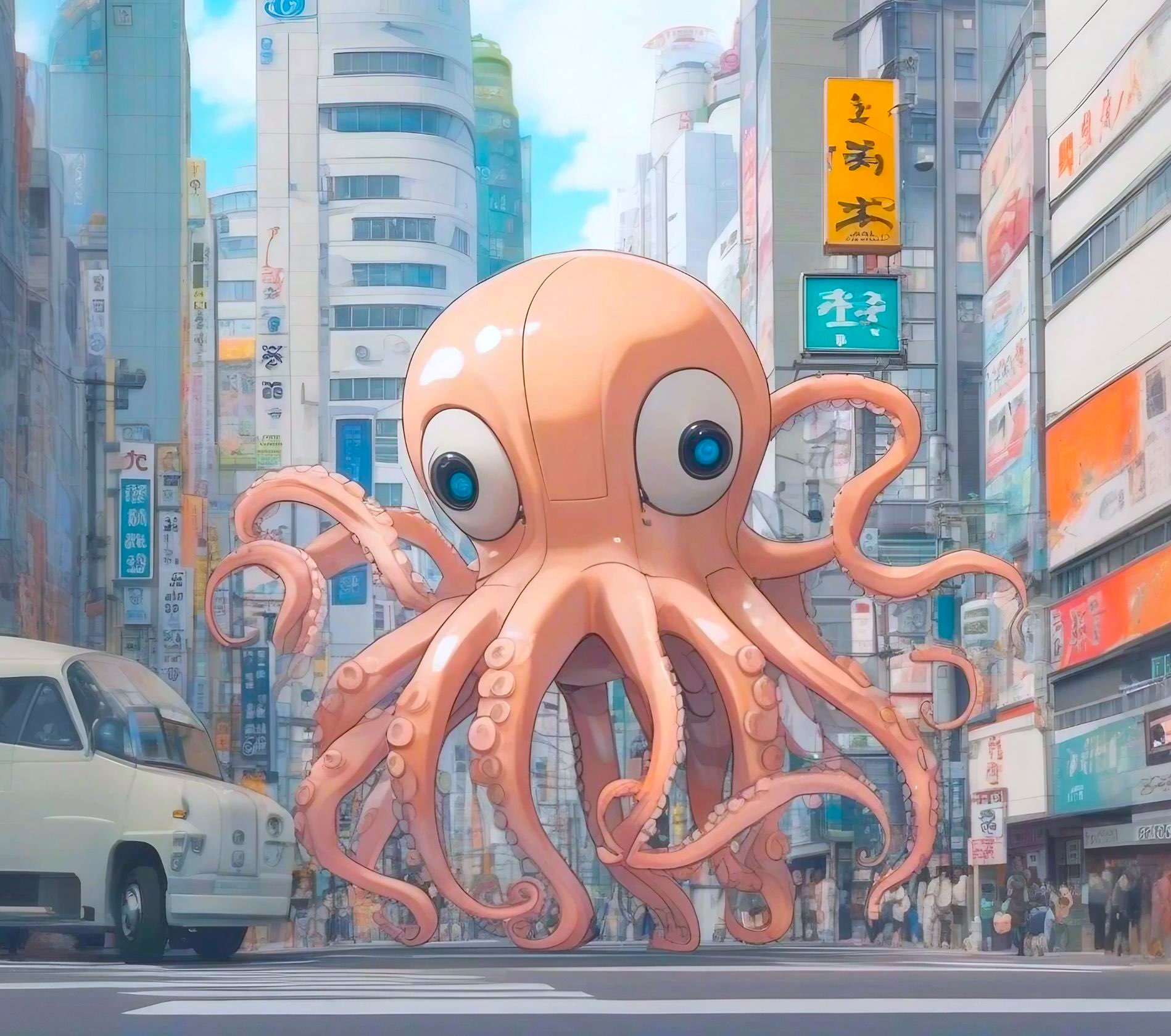
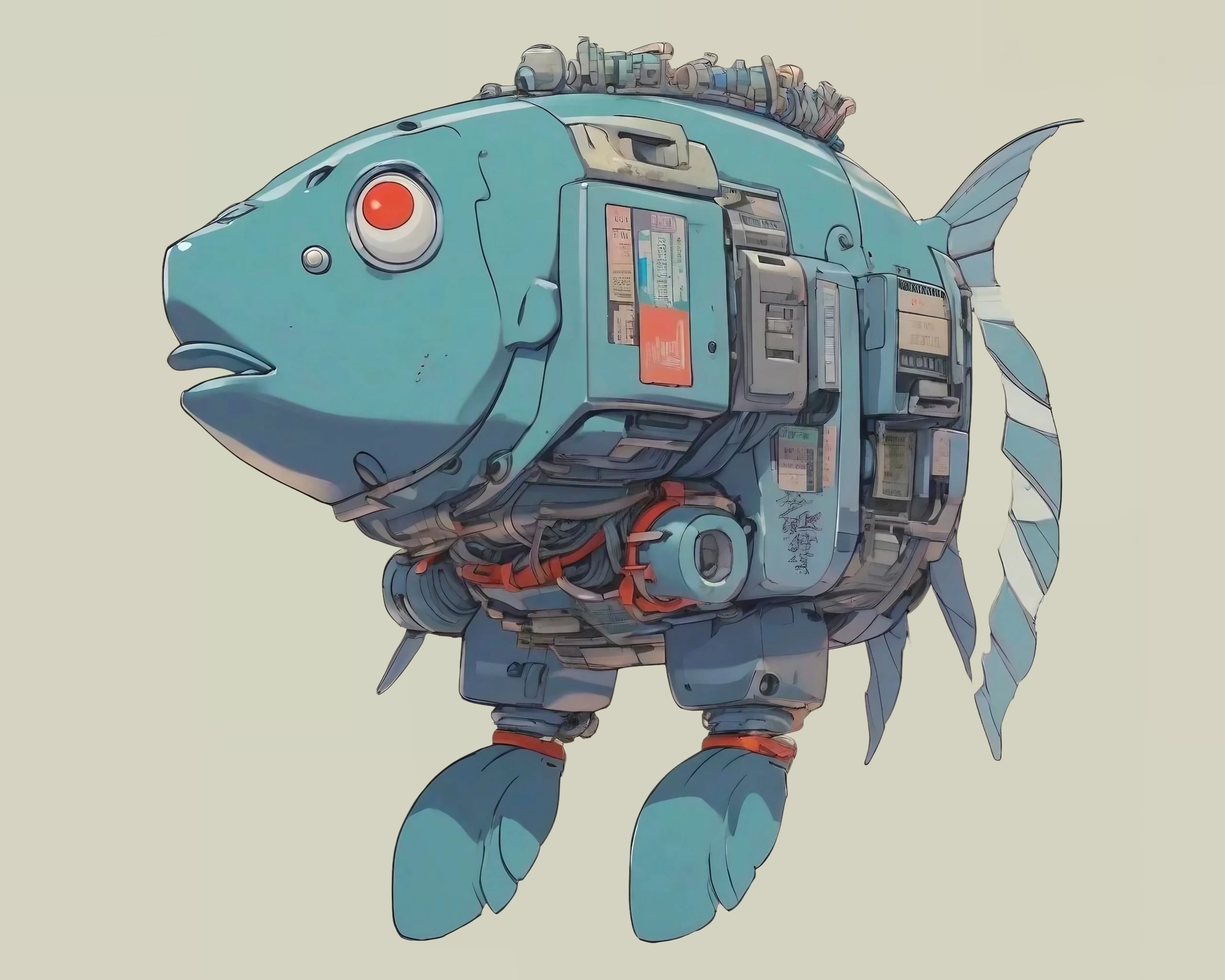
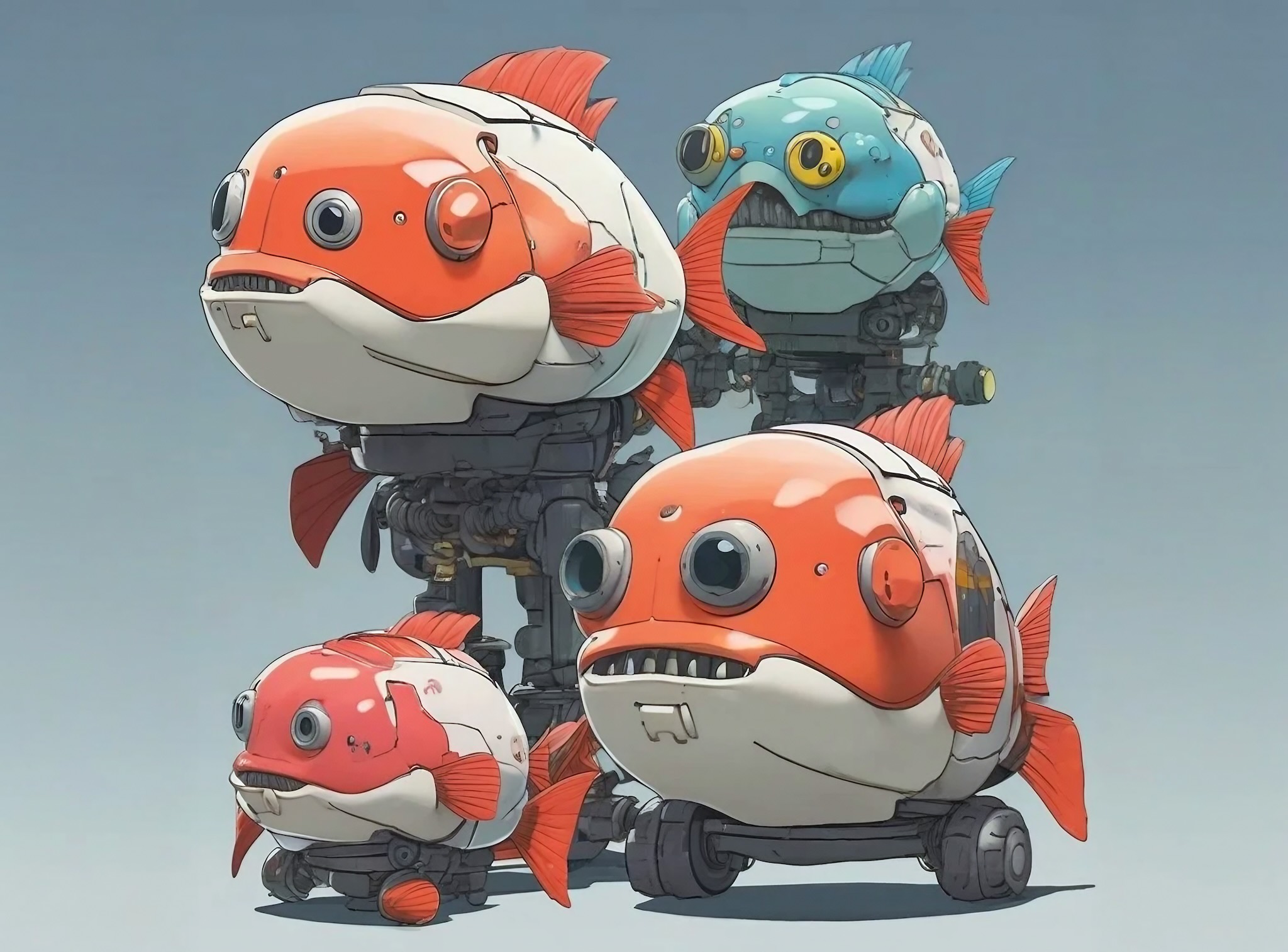
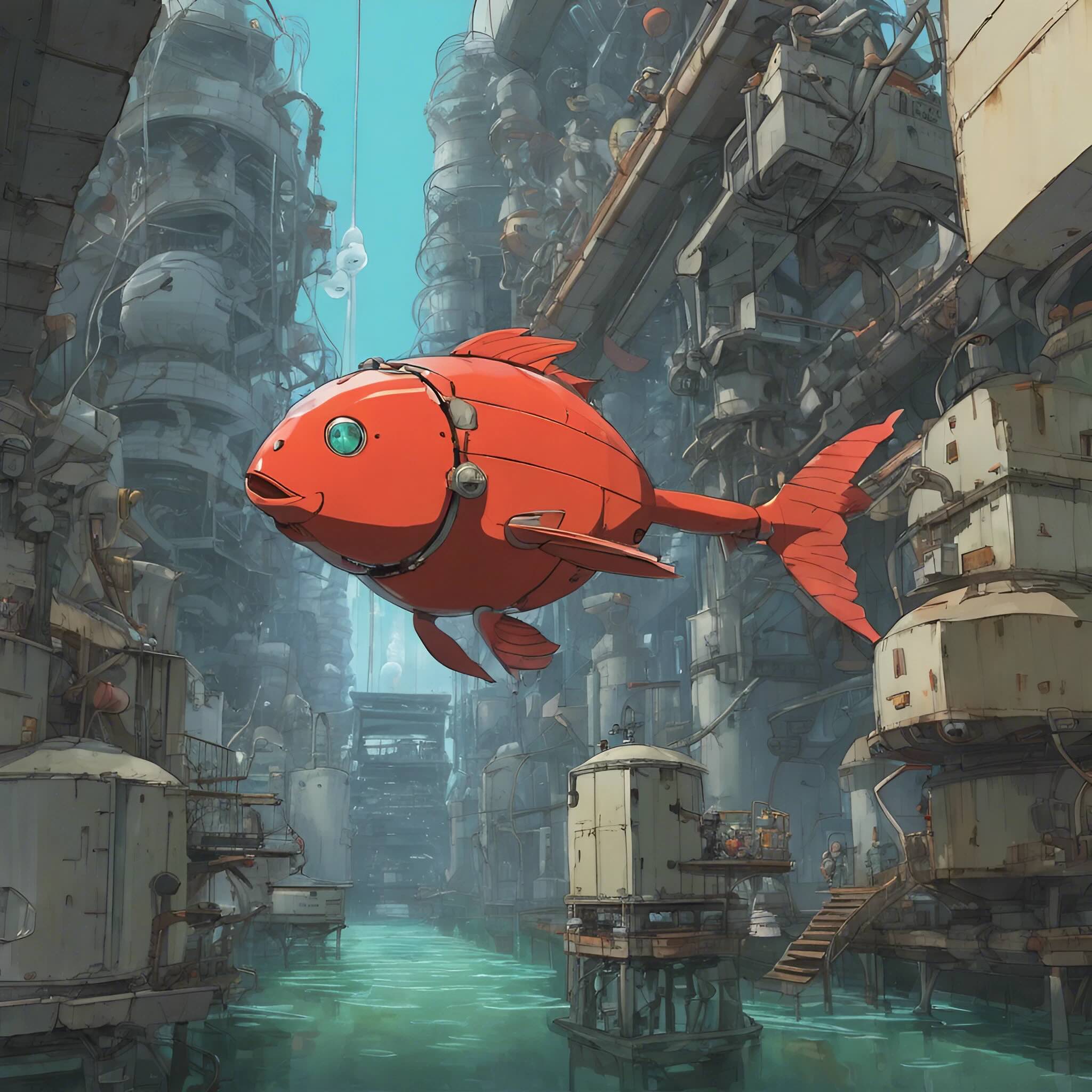
Sakana AIはLLMエージェントの集団を生み出す新技術「CycleQD」を開発しました。CycleQDは多様性に着目した進化的計算とモデルマージに基づいており、知識やスキルを忘却せず蓄積していく「生涯学習」の実現への第一歩です。
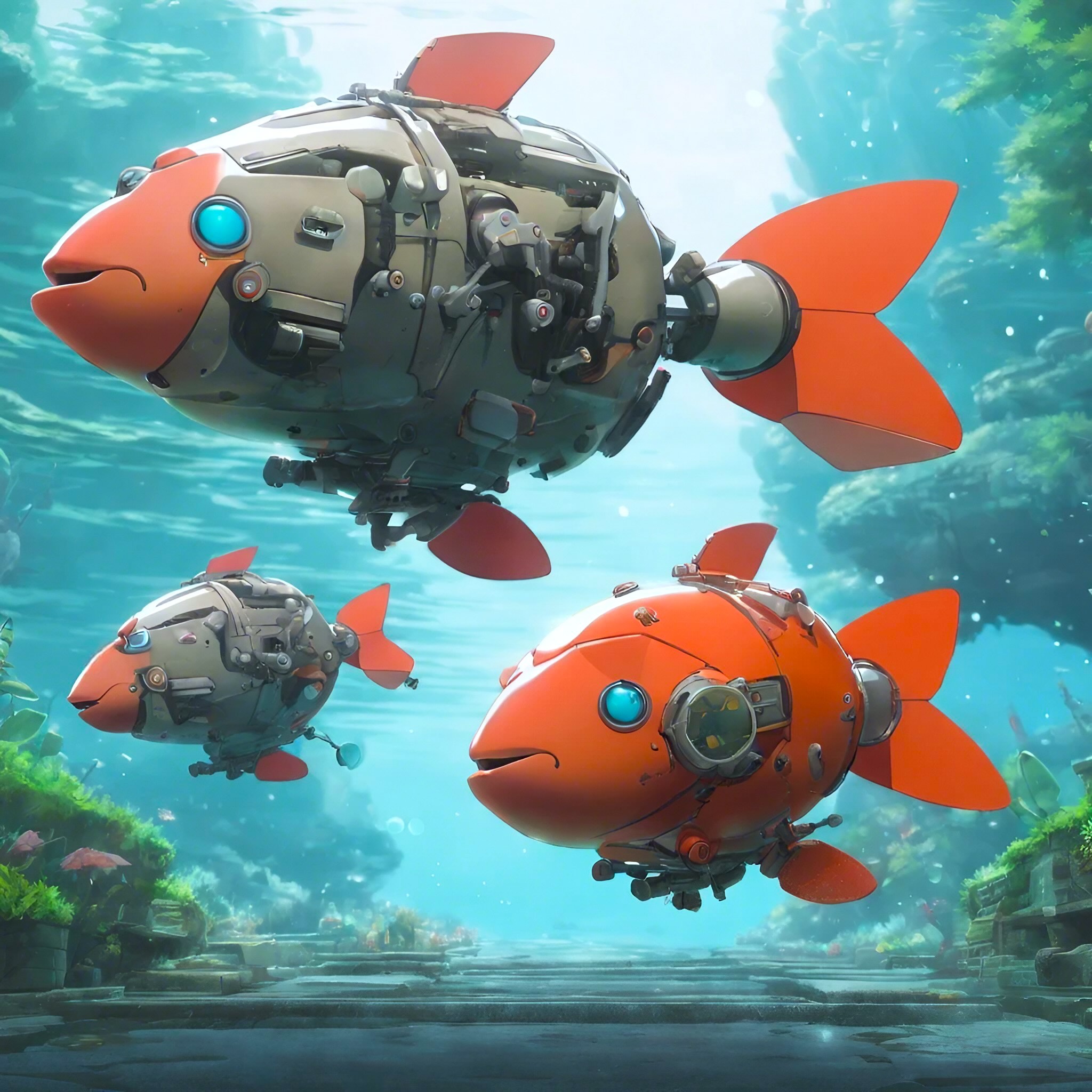


今回公開するモデルは、プロンプトから画像を生成するEvo-Ukiyoeと、古典籍の挿絵をカラー化するEvo-Nishikieモデルです。これらのモデルが、歴史や文化を学ぶための新たなコンテンツ作成に利用され、浮世絵に関する興味を増すことにつながり、日本や世界の人々が浮世絵や日本文化に興味を持つきっかけを生み出すことを期待しています。
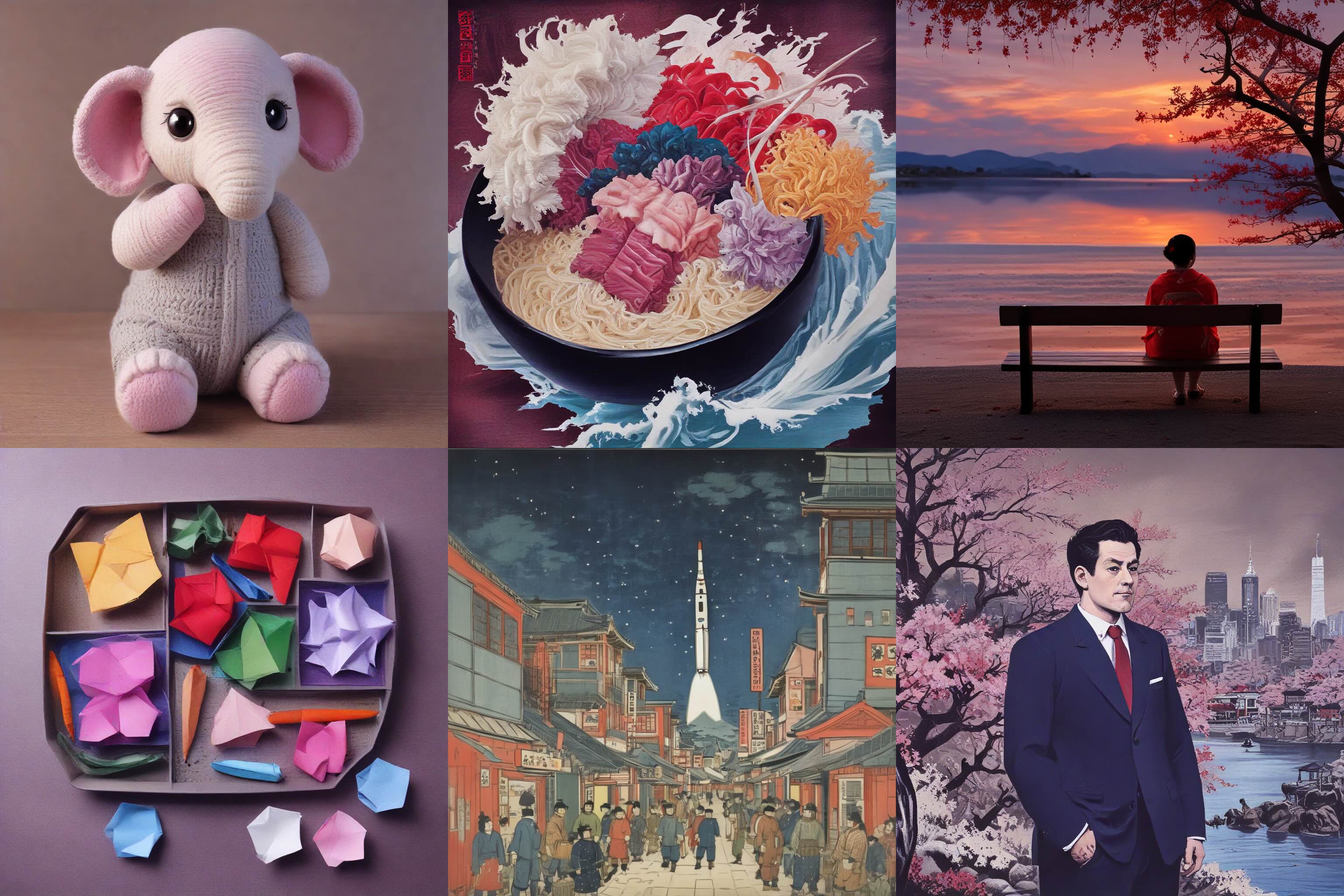
日本語プロンプト対応の高速画像生成モデルEvoSDXL-JPで生成した画像の例。プロンプトは「可愛いゾウの編みぐるみ」、「ラーメン、浮世絵、葛飾北斎」、「折り紙弁当」、「(下町ロケット、東京サラリーマン)、浮世絵」など