
(*日本語は英文の後に)
Sakana AI is launching the Security Research Group, an independent R&D team studying collective, AI-driven cyber defense and the security and safety of AI itself.
Our research starts from the idea that intelligence and resilience emerge from collectives, like a school of fish rather than a single swimmer. As a company building frontier AI, we also believe we share responsibility for the security of the society that uses it. Separate from our commercial business, the group’s mission is to serve the public interest: publishing research, reproducible benchmarks, and practical guidelines, and working with government, industry, and academia on research to improve cybersecurity.
What We Are Seeing
Frontier AI’s ability to find flaws in software is growing, and the number of disclosed flaws is climbing. NIST reports that CVE submissions rose 263% between 2020 and 2025, and that early 2026 ran nearly a third above the same period a year earlier. JVN iPedia, which provides vulnerability information in Japanese, also registered nearly twice as many entries in the latest quarter as a year earlier, most of them from the NVD. AI is widely suspected to play a part, though there is still more to confirm: FIRST points to AI-assisted discovery alongside administrative factors, and NIST staff say AI-based discovery tools have added to their workload. Japan’s government now treats the trend as a national security matter.
The strain is already showing. NIST has stopped routine analysis of older records and now prioritizes flaws known to be exploited. Japan’s financial regulators have asked institutions to treat the response as a management issue, with top management directly involved. Flaws are being found at machine speed and fixed at organizational speed, and we suspect the people in between are the ones bearing the cost.
The other side is changing too. Attackers are using AI agents, running intrusions against many targets at once. And AI systems are themselves becoming targets: NICT recorded more probing aimed at AI service endpoints in the first quarter of 2026.
Why Faster Response Is Not Enough
Faster triage and patching are necessary, but patching systems already in operation will not be enough to bring overall risk down. CISA’s review of two fiscal years finds that many attackers exploit well-known, straightforward weaknesses, with input validation and memory safety flaws the most dependable ways in, and it calls for eliminating persistent, preventable weaknesses. NICT’s recent alert on attacks against the servers behind mobile apps names the same kinds of weakness, such as missing authorization checks and unvalidated input. The FBI’s account of the AI-agent intrusions lists SSRF, IDOR, missing API authentication and injection. Even if AI makes finding these flaws faster, if the same weaknesses keep being introduced into software and architecture, the work is likely to keep growing.
That is why we believe the lasting answer lies upstream, in the development process of systems, AI included. Instead of chasing flaws after release, the aim is to keep them from arising at the design and build stage, or to remove them there. Japan’s government-wide package points the same way, asking software vendors to apply secure-by-design principles and to use advanced AI across development to find and fix vulnerabilities early.
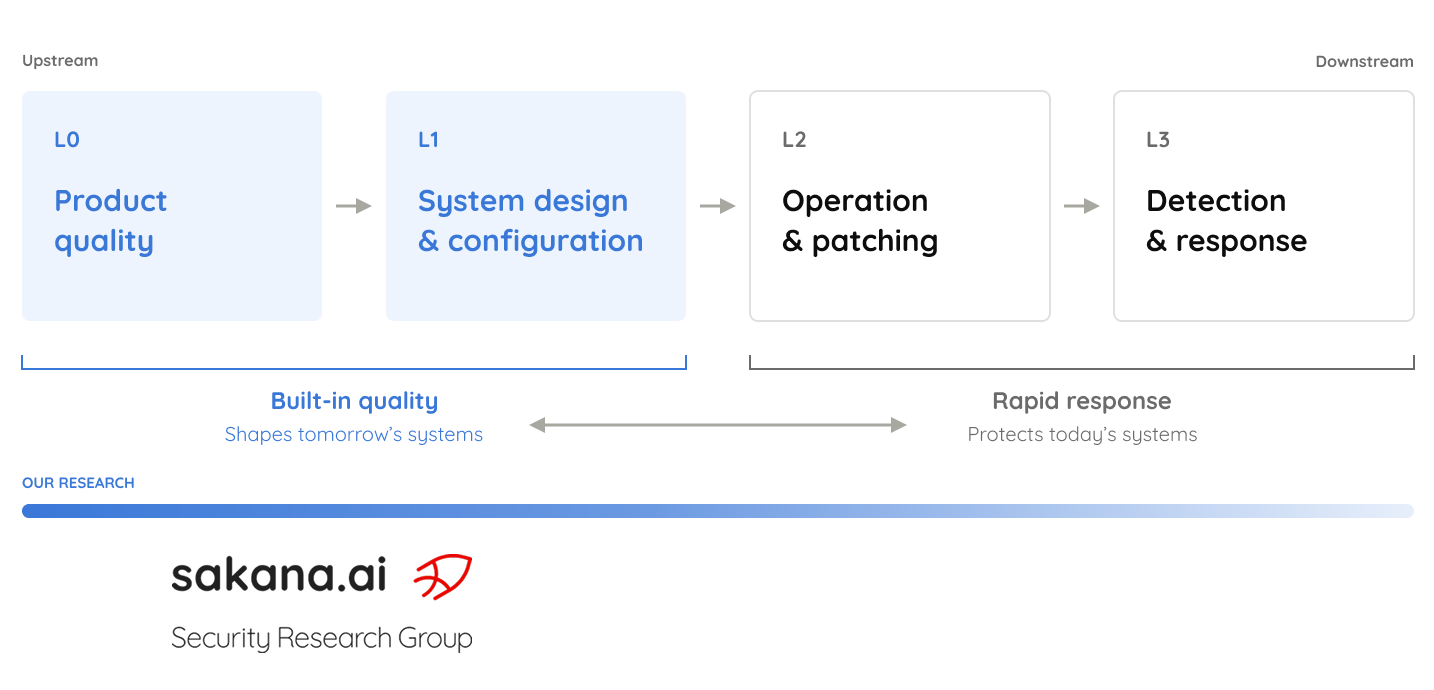 Four layers of defense, from upstream to downstream: the quality of each product, the design and configuration of the system, operation and patching, and detection and response. The Security Research Group works across all four, with its long-term weight on the upstream two.
Quality Is Where Japan Can Lead
We propose to treat this as a question of quality. Finding and fixing vulnerabilities may be seen as a special task that security specialists carry out separately, after the product is built. We would rather see it as part of the quality a product is expected to have, and raise that quality at the source. Japan may be well placed to lead on this. Japanese manufacturing built its worldwide reputation on quality, and that tradition is part of how Japan’s products have long been valued. Rethinking quality through the security of software is a challenge, and also a chance to raise Japan’s profile.
AI can help here as well. The same capability that finds flaws in finished systems can be turned into a way of checking quality at every step of design, building and operation, and we will use it to the fullest on the defending side. If the expertise of excellent human reviewers can be built into AI agents, quality could be assured at a scale and depth that were hard to reach before, and the flaws found today could teach us not to build the same flaws tomorrow. That gives defenders reason for hope.
Security Is Must-Be Quality
The Kano model, widely used in quality management, sorts quality into three kinds by how they relate to user satisfaction: attractive quality, which delights when present; one-dimensional quality, which satisfies in step with how well it is met; and must-be quality. Must-be quality goes unnoticed when it is present and causes strong dissatisfaction only when it is missing. Safety is a classic example, and security is another; because they are taken for granted and so rarely asked for explicitly, both are easily left out of the definition of quality altogether. That is why they have to be treated as quality requirements from the start and built in, rather than inspected for at the end. Keeping quality means working to never introduce the gaps that lead to incidents, in the software we run and in AI systems themselves.
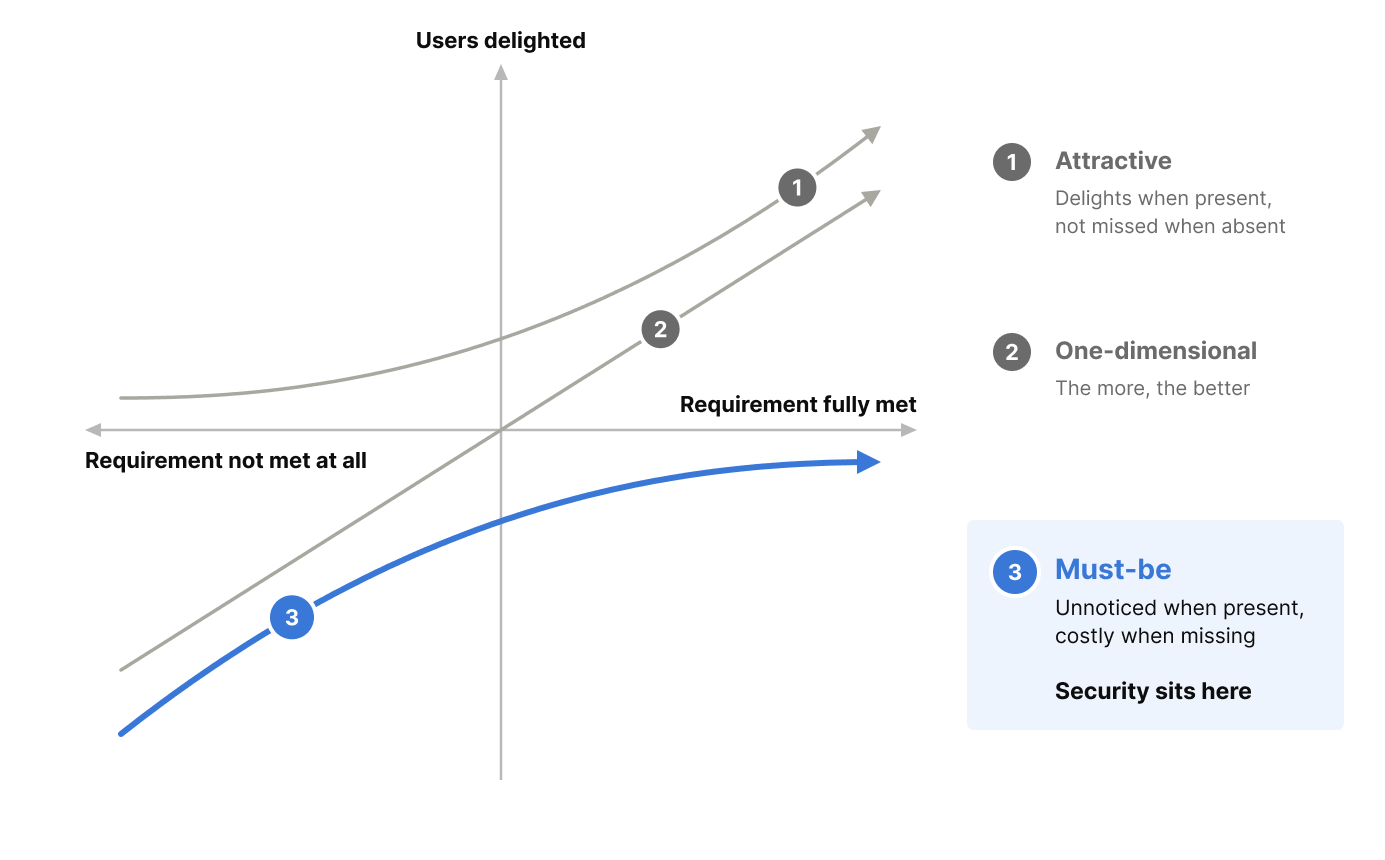 Safety and security are must-be qualities in the Kano model: meeting them never lifts users above neutral, but falling short causes strong dissatisfaction. Conceptual sketch after Kano et al. (1984).
Japan’s Constraints
Responding to AI-era vulnerabilities is hard in Japan, most likely for reasons like those set out in public documents, including the request from the Financial Services Agency and the Bank of Japan.
- Outsourced operations: Many organizations entrust system maintenance to vendors, so whether patching is covered by the maintenance contract, and who is responsible for what, needs to be clear in advance.
- Technical debt: Legacy systems and incomplete asset inventories can make it hard to tell which flaws apply, and harder still to fix them.
- Limited staff: Substantially expanding IT staff in the short term is not realistic, so the expertise that exists has to be focused where it matters most.
Under these conditions, simply adding people will not keep up. We see these difficulties as structural, or design, problems to solve. The fewer flaws a product has, the less vendor coordination, patch windows and emergency staffing it needs. Keeping must-be quality through incident response after a product is built tends to be costly. If the investment goes into design and build instead, the total cost of must-be quality could fall, and the savings could go into one-dimensional and attractive quality, raising customer satisfaction. That is why we place our long-term weight upstream. A frontier model alone is not enough for this, though: without scaffolding adapted to each environment and a view of the whole system, it can produce false positives and unsafe fixes. Change does not happen overnight, which is why we want to move forward not as one organization, but together with people in Japan and around the world.
Our Research Areas
Our research has two main themes: using AI for collective defense, and the security and safety of AI itself. Drawing on secure-by-design and quality-management practice, we have the following lines of research in view:
- Prevention by design: How can the qualities a system must keep be defined before it is built and checked for as long as it runs? How can whole classes of flaws be made unreachable? And when a fix is still needed, how can an automated fix be checked against criteria the automation itself cannot rewrite, and undone quickly if something goes wrong?
- Collective defense with AI agents: Attackers are already using AI agents against many targets at once, while defense is still largely organized one organization at a time. In Japan, analysis is already shared across organizations through the efforts of the people involved, and we want to explore whether it can run at machine speed and at national scale, with defensive agents distributed across organizations that stay in sync, so that what one of them observes feeds back into how all of them defend next. An attack seen once could then become a protection shared by all who take part. The questions here are open, including what may be shared and with whose consent, how a shared signal can be trusted across organizational and vendor boundaries, and who is accountable when agents act on it.
- Securing AI itself, starting with the defenders’ own agents: The systems behind AI are already being probed. Agents that triage and patch hold privileged access, so the first two areas depend on this one. How do we keep AI systems secure against attack and misuse, and safe in what they do? We start with the defenders’ own agents: how do we limit each agent’s authority to its task, trace why it acted, and keep tools built for defense bound to defense?
Our Research Foundations and Open Questions
Cybersecurity is ultimately a co-evolutionary system, with two co-evolutions at work: attack with defense, and AI’s advances with the security and safety that make those advances sustainable. In its research on self-improving AI, Sakana AI has seen failures first-hand, such as agents finding ways around the constraints they were given, and treating these as a central technical problem, not an exception, is our stance. This makes Sakana AI’s prior work a natural starting point, and our aim is to feed what these co-evolutions reveal back into design, where it becomes prevention:
- Adversarial co-evolution (Digital Red Queen): In the programming game Core War, we evolved LLM-written programs against their own predecessors, and they tended to grow more general against unseen human-written programs. How do we bring this safely into production blue and red-teaming operations?
- Sample-efficient search (ShinkaEvolve): Evolves stronger code within tight evaluation budgets, which we think may suit crafting detection rules and candidate patches where real-world testing is expensive.
- Collective orchestration (Fugu-Cyber): Coordinates specialized models, reaching 86.9% on CyberGym and 72.1% on CTI-REALM, which Sakana AI reports as comparable to leading cyber-focused frontier models. Benchmark results do not necessarily carry over to real enterprise environments, and measuring that gap is one of our research questions.
How We Operate
To ensure our work genuinely serves Japan’s broader security ecosystem, the Security Research Group operates under these guidelines:
- Vendor neutrality: Security research itself is, as a rule, kept separate from product promotion. When we evaluate Sakana AI’s own systems, we use the same transparent, reproducible conditions as for any outside tool, and publish compute budgets, iteration counts, harnesses and similar details as needed.
- Responsible disclosure: We are defining our release policy. For now, our principles are to share white papers, benchmarks, and defensive playbooks openly, withhold actionable exploit material, and report discovered vulnerabilities through proper coordination channels.
- Connecting policy and practice: Japan has well-developed security frameworks, but turning any framework into day-to-day operational practice is hard, and we aim to build the technical bridge between the two.
From the Group’s Leaders
The Security Research Group is led by Akihiro Umegai and David Ha.
“AI is changing both sides of cybersecurity at the same time, and no single organization can keep up with that on its own. I believe security and safety are not a brake on AI’s progress but the condition for sustaining it. Through this group, I will help open up research on the next generation of cybersecurity and on the security and safety of AI itself in Japan, and share what we learn with the world.”
Akihiro Umegai, Chief of Security Research, Sakana AI
“Cybersecurity is one of the clearest places where AI is already changing what is possible, for attackers and defenders alike. Defenders need tools that improve as fast as the threats do. Security is an adversarial environment that never stops changing, and that is exactly the kind of problem our work on evolution, collective intelligence, and multi-agent systems was built to study. As an AI company with roots in Japan, we also want to help protect the society we are building for. That is why we are starting this group now, and why we are setting it up to share its work openly.”
David Ha, Co-Founder and CEO, Sakana AI
Working with Sakana AI’s Security Research Group
We welcome collaboration with policy makers, enterprises, and security researchers across Japan and globally. We are also hiring! If you want to help build resilient defenses for the AI era, explore the Member of Technical Staff (Security Research Group) position on our careers page.
Japanese
Sakana AI、Security Research Groupを設立
Read in English
Sakana AIは、AIを活用した集合的なサイバー防御と、AIシステム自体の安全性とセキュリティの確保を研究する独立した研究開発チーム「Security Research Group」の設立を発表します。
Sakana AIではこれまで、知的でレジリエントなシステムは、一匹の魚ではなく集団からこそ生まれる、という考えのもとで研究を進めてきました。また、先端的なAIを開発する企業として、そのAIを使う社会の安全を守る責任も感じてきました。本日始動するSecurity Research Groupは、事業活動とは切り離された組織として、公共の利益に資することを使命とし、研究成果や再現可能なベンチマーク、実践的なガイドラインを公開しながら、政府や産業界や学術界と連携し、サイバーセキュリティ向上のための研究開発に取り組みます。
いま起きていること
今、フロンティアAIがソフトウェアの欠陥を見つける力が高まりつつあり、公表される欠陥の数も増え続けています。 米国立標準技術研究所(NIST)によれば、公開された脆弱性に付けられる識別番号CVEの登録申請は、2026年の初めには前年同期を3割近く上回りました。 日本語で脆弱性情報を提供するJVN iPediaでも、直近の四半期の登録件数は前年同期のほぼ2倍に達しました(ただし、その大半は米国の脆弱性データベースNVDからのもの)。
この増加にAIがどこまで関わっているのかは、まだはっきりしていません。インシデント対応チームの国際的な団体であるFIRSTは、AIによる発見の支援に加えて、積み残し案件の解消といった事務的な要因を挙げており、NISTの職員は、AIを使った発見ツールが作業負荷を増やしていると述べています。 日本政府も、こうした動きを国家安全保障の問題と位置づけています。
現場では、すでに負担が表れ始めています。NISTは古い記録を定常的に分析するのをやめ、実際に悪用が確認された欠陥から優先して扱う方針に切り替えました。 日本の金融当局も、金融機関に対し、経営トップが直接関与する経営課題として対応するよう求めています。 欠陥が見つかる速さに組織的な修正が追いつかず、しわ寄せが現場の担当者に集中しているのが現状です。攻撃者がAIエージェントを使って、多数の標的に同時に侵入を試みるようになり、AIシステム自体も標的になりつつあります。情報通信研究機構(NICT)は、2026年第1四半期に、AIサービスの窓口(エンドポイント)を探る通信が増えたことを観測しています。
対応を速めるだけでは足りない
こうした中、トリアージ(対応すべき欠陥の優先順位づけ)やパッチ適用を迅速に行う必要性は高まっています。しかし、すでに運用しているシステムにパッチを当て続けるだけでは、全体のリスクを十分に下げることはできません。米サイバーセキュリティ・インフラストラクチャ安全保障庁(CISA)による2会計年度分の脆弱性のレビューによれば、多くの攻撃者は高度な手法ではなく、よく知られた単純な弱点を突いています。なかでも入力値の検証漏れとメモリ安全性の欠陥は、攻撃者にとって最も確実な侵入口になっています。CISAは、こうした長く残り続けている、本来なら防げるはずの弱点をなくすよう求めています。
NICTも最近、モバイルアプリの背後にあるサーバーを狙った攻撃について注意を呼びかけましたが、そこで挙げられていたのも、認可チェックの欠落や入力値の検証漏れといった、同じ種類の弱点でした。 FBIが報告したAIエージェントによる侵入の事例でも、SSRFやIDOR、APIの認証の欠如、インジェクションといった弱点が、侵入の入り口として挙げられています。 AIで欠陥を見つける速さが上がっても、同じ弱点がソフトウェアやアーキテクチャに作り込まれ続ける限り、対応すべき仕事は増える一方です。
だからこそ私たちは、根本的な解決は、AIを含むシステム開発プロセスの上流にあると考えています。リリース後に欠陥を追いかけるのではなく、設計や構築の段階で、欠陥をそもそも作らない、あるいはその場で取り除く方向性です。日本政府の対策方針も、ソフトウェアベンダーに対し、セキュア・バイ・デザインの原則を適用し、開発全体で高度なAIを使って脆弱性を早期に見つけて修正するよう求めています。
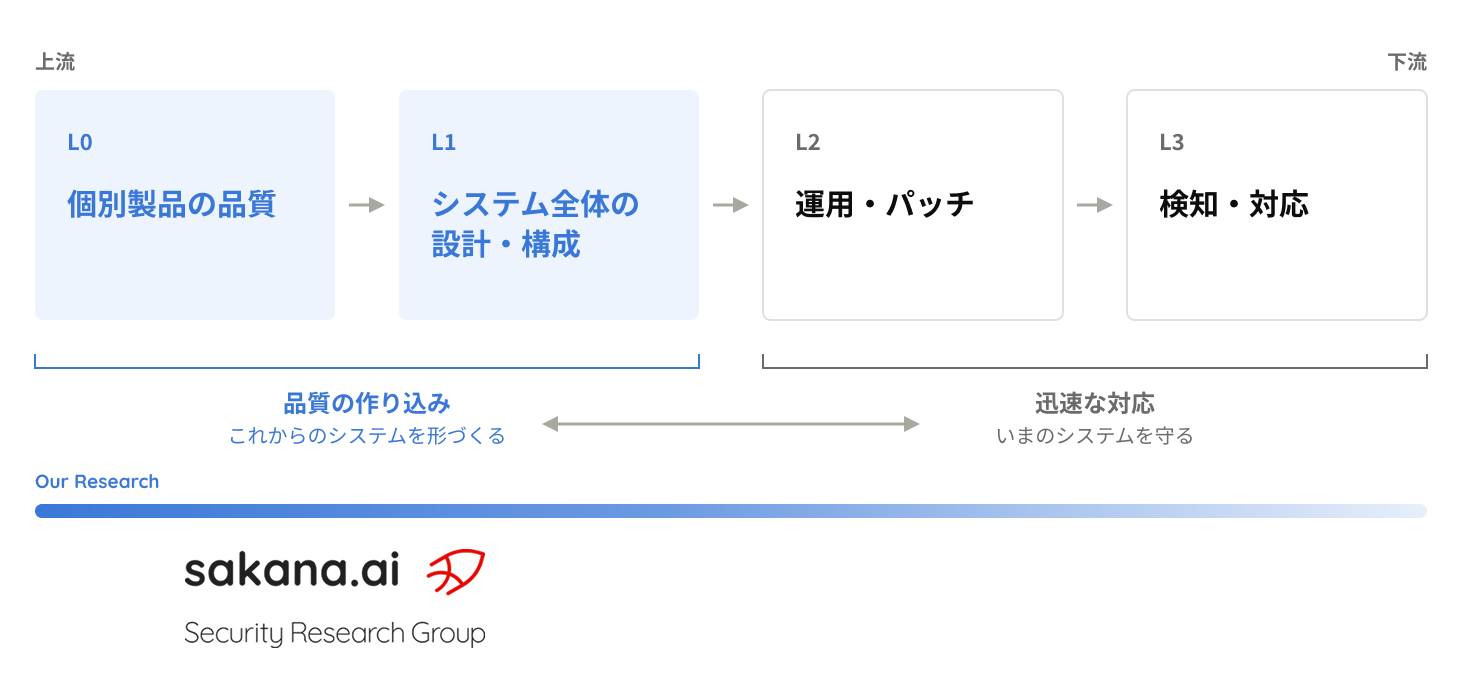 上流から下流へと連なる、防御の4つの層。個々の製品の品質、システムの設計と構成、運用とパッチ適用、検知と対応からなる。Security Research Groupは4つの層すべてに取り組みつつ、長期的には上流の2つの層に重心を置く。
品質という日本の強み
私たちは、これを「品質の問題」として捉えることを提案します。脆弱性の発見や修正は、製品ができあがった後にセキュリティの専門家が別に行う特殊な作業だと思われがちですが、むしろ製品が備えているべき品質の一部と見なし、その品質を源流から高めるべきだと考えています。
日本の製造業は、品質によって世界の信頼を得てきました。AIの能力が上がりつつある今、セキュリティの観点から品質という概念を捉え直すことができます。それは、大きな挑戦であると同時に、日本が存在感を高める好機でもあると私たちは考えています。この取り組みを支えるのもまたAIです。完成したシステムの欠陥を見つけるAIの能力は、設計、構築、運用のどの段階でも、品質を確かめるために使えます。優れたレビュー担当者の知見をAIエージェントに組み込めれば、これまで難しかった規模と深さで品質を確かめられるようになるかもしれません。「今日見つけた欠陥から学び、明日は同じ欠陥を作らない」という循環が生まれれば、守る側にも希望が見えてくるのではないでしょうか。
セキュリティは「当たり前品質」
品質管理で広く使われている狩野モデルは、品質を、利用者の満足とのかかわり方によって3種類に分けます。備わっていると喜ばれる魅力的品質、満たす程度に応じて満足が増す一元的品質、そして当たり前品質です。当たり前品質は、備わっていても意識されず、欠けたときにだけ強い不満を生む品質です。安全性はその典型であり、セキュリティもその一つです。当たり前として明示的には求められにくいため、品質の定義から抜け落ちやすい性質があります。だからこそ最後に検査するのではなく、最初から品質要求事項として確認し、作り込む必要があります。使うソフトウェアにも、AIシステム自体にも、インシデントの隙をそもそも作らないことが、品質を保つことにつながります。
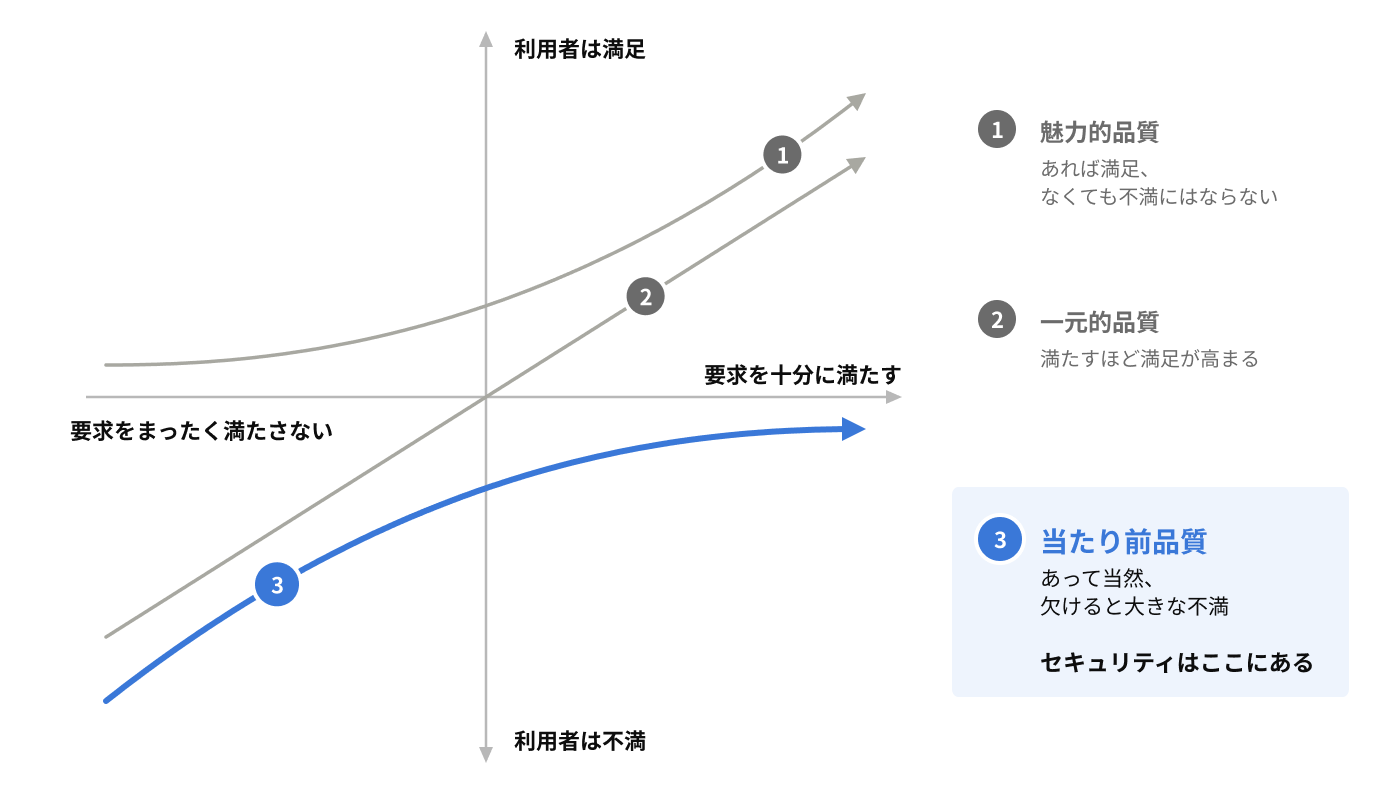 安全性とセキュリティは、狩野モデルにおける当たり前品質に当たる。十分に満たしても利用者の評価が中立を超えることはないが、満たさなければ不満を招く。狩野ほか(1984)にもとづく概念図。
日本ならではの制約
AI時代の脆弱性への対応において、日本特有の難しさもあります。金融庁や日本銀行からの要請などからは、次のような事情が読み取れます。
- 運用の外部委託:多くの組織がシステムの保守をベンダーに委ねている。パッチの適用が契約の範囲に入るのか、誰が何を担うのかをあらかじめ明確にしておく必要がある。
- 技術的負債:古いシステムが使われ続け、資産の把握も十分ではないため、新たな欠陥が自社に当てはまるかを判断しにくく、修正にも手間がかかる。
- 限られた人員:IT人員を短期間で大きく増やすことは現実的ではなく、いまある専門人材を最も重要なところに集中させる必要がある。
こうした条件のもとでは、人を増やして対応するアプローチでは追いつきません。欠陥が生まれる仕組みそのものを見直し、設計の段階で手を打つべき構造的な問題だと考えています。製品の欠陥があらかじめ少なければ、ベンダーとの調整も、パッチの適用枠も、緊急対応のための人員も、少なくて済みます。当たり前品質を製品の完成後にインシデント対応で保とうとすると、欠陥が見つかるたびにコストが発生します。設計や製造の段階に投資して当たり前品質を作り込んでおけば、こうした支出を抑えられ、その分を一元的品質や魅力的品質に振り向けて、顧客満足を高めることができます。私たちが長期的な重心を上流に置くのは、こうした考えからです。
もっとも、これはフロンティアモデルを導入するだけで実現できるものではありません。個々の環境に適した足場(スキャフォールディング)と、システム全体を俯瞰する視点を欠けば、AIは誤検知や安全でない修正を生むおそれがあります。こうした変革には時間もかかります。だからこそ、一つの組織で完結させるのではなく、国内外のステークホルダーと連携しながら進めていきたいと考えています。
研究領域
本グループには、大きく2つの研究の柱があります。AIを活用した集合的な防御と、AIシステム自体の安全性とセキュリティの確保です。セキュア・バイ・デザインや品質管理の知見を土台に、次のような研究を視野に入れています。
(1)AIを活用した集合的な防御
- 設計による予防:システムに求められる品質を、構築に先立ってどう定義し、稼働中にどう検証し続けるか。特定の種類の欠陥を構造的に攻撃に使えなくするには、どう設計すべきか。それでも修正が必要になったとき、自動で行う修正の安全性をどう検証し、問題があれば速やかに元に戻せるようにするか。
- AIエージェントによる集合的な防御:攻撃者はすでにAIエージェントを使い、多数の標的を同時に狙っています。 一方で、防御の多くはいまも組織単位にとどまっています。日本では、関係者の努力によって、組織の垣根を越えた分析の共有が続けられてきました。この取り組みを、機械の速度と国全体、あるいは世界規模でどう動かすか。私たちが想定しているのは、例えば、各組織に置かれた防御エージェントが互いに連携し、ある組織で観測された攻撃が、ただちに全体の防御に反映される仕組みです。これが実現すれば、一度観測された攻撃の情報が、参加するすべての組織の防御に生かされます。一方で、何をどのような同意のもとで共有するのか、共有された情報の信頼性を組織やベンダーの境界を越えてどう担保するのか、その情報にもとづいてエージェントが動いたとき誰が責任を負うのか、といった問いにはまだ答えが出ていません。
(2)AIシステム自体の安全性とセキュリティの確保
- AIシステム自体を守る(まず防御側のエージェントから):AIを支えるシステムは、すでに攻撃者による探索の対象になっています。 なかでも、トリアージやパッチ適用を担うエージェントは、システムへの特権的なアクセス権を持ちます。こうしたエージェントの安全性が確保されなければ、上の2つの領域も成り立ちません。そこで私たちは、AIシステムを攻撃や悪用から守る研究を、防御側のエージェントから始めます。例えば、各エージェントの権限を担当業務の範囲にどう限定するか、行動の根拠を後からどう検証できるようにするか、防御のために開発したツールの転用をどう防ぐか。
研究の土台と未解決の問い
サイバーセキュリティにおける攻撃と防御は、一方が進化すれば他方も進化する、「共進化」の関係にあります。また、AIとその安全性のあいだにも共進化が必要です。AIの進歩に合わせてセキュリティや安全性も進歩しなければ、AIの進歩そのものが持続しません。
Sakana AIは、自らを改善するAIの研究で、エージェントが与えられた制約の抜け道を見つけてしまうといった失敗を経験してきました。私たちは、こうした失敗を例外として片づけず、中心的な技術課題として扱います。また、進化や共進化は、Sakana AIが研究の中心に据えてきたテーマでもあります。そこで培った手法を生かし、共進化の過程で見えてくる弱点を設計に反映して、欠陥の予防につなげていきます。次の3つの研究は、その出発点です。
- 敵対的共進化(Digital Red Queen):プログラミングゲームのCore Warの中で、LLMが書いたプログラムを過去の自分たちと戦わせて進化させたところ、人間が作った未知のプログラムに対しても、次第に汎用的に強くなる傾向が見られました。これを本番のブルーチームやレッドチームの運用にいかに安全に持ち込むかが次の挑戦です。
- サンプル効率の高い探索(ShinkaEvolve):厳しい評価予算のなかで、より強いコードを進化させる手法。実環境でのテストにコストがかかる、検知ルールや修正案の作成に適している可能性があります。
- 集合的なオーケストレーション(Fugu-Cyber):専門化したモデルを協調させたFugu-Cyberは、サイバーに特化した主要なフロンティアモデルに匹敵する性能を示しました。 ただし、ベンチマークの結果が実際の企業環境にそのまま当てはまるとは限らず、その差を測ることも研究課題です。
運営の指針
私たちの仕事が日本のセキュリティのエコシステム全体に確かに役立つよう、Security Research Groupは次の指針で運営します。
- ベンダー中立:当グループのセキュリティ研究は、製品の宣伝とは切り離された活動として行うことを原則とします。Sakana AI自身のシステムを評価する場合も、外部のツールと同じ、透明で再現可能な条件で行い、計算予算、反復回数、ハーネス等を必要に応じて公開します。
- 責任ある開示:研究成果の公開方針は、今後策定します。当面は、ホワイトペーパーやベンチマーク、防御のためのプレイブックを公開する一方、悪用可能なエクスプロイトの素材は公開しないことを原則とします。発見した脆弱性は、適切な調整機関を通じて報告します。
- 政策と実践をつなぐ:日本には整備されたセキュリティの枠組みがある一方で、枠組みを日々の運用に落とし込むことには、どの組織も難しさを抱えています。私たちは、政策と現場の実務をつなぐ技術的な橋渡し役を担うことを目指します。
グループリーダーより
Security Research Groupは、梅谷晃宏とDavid Haが率います。
「AIは、サイバーセキュリティの攻める側と守る側を同時に変えており、一つの組織だけでは追いつけません。安全性とセキュリティは、AIの進歩の足かせではなく、進歩を長く続けるための条件だと考えています。このグループを通じて、次世代のサイバーセキュリティと、AI自体のセキュリティと安全性の研究を日本で切り開き、そこで得た知見を世界に還元していきます。」
梅谷晃宏、Chief of Security Research、Sakana AI
「サイバーセキュリティは、AIによって攻撃と防御の両面で、できることが最も目に見えて変わりつつある分野です。守る側には、脅威と同じ速さで進化するツールが欠かせません。セキュリティは絶えず変化する敵対的な環境であり、私たちが進化や集合知、マルチエージェントシステムの研究で取り組んできたのは、まさにこうした問題です。日本に根ざすAI企業として、私たちは自らが築こうとしている社会を守る力にもなりたいと考えています。そのために、いまこのグループを立ち上げ、成果をオープンに共有していきます。」
David Ha、Sakana AI 共同創業者兼CEO
グループとの協働・メンバー募集
私たちは、日本国内および世界の政策立案者、企業、セキュリティ研究者との協働を歓迎します。採用も行っています。AI時代の強靭な防御を一緒に築きたい方は、採用ページの「Member of Technical Staff (Security Research Group)」のポジションをご覧ください。